DOAC May Be Safer Than DAPT After Left Atrial Appendage Closure: ANDES
The trial showed no difference in device-related thrombosis, but there were fewer adverse events with DOACs.
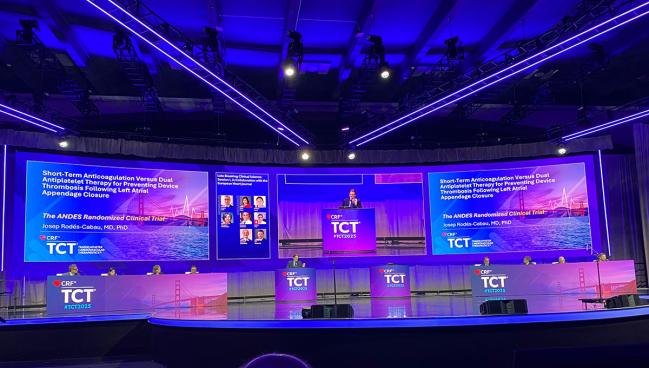
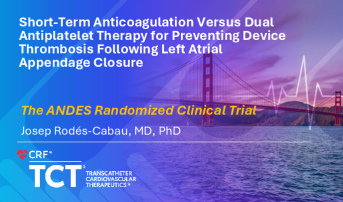
SAN FRANCISCO, CA—Direct oral anticoagulants (DOACs) don’t reduce device-related thrombosis (DRT) compared with dual antiplatelet therapy (DAPT) following left atrial appendage occlusion (LAAO), but they do appear to be linked to fewer adverse events, according to new data from the ANDES trial.
The pragmatic trial, presented last week at TCT 2025 and simultaneously published in Circulation, demonstrated no difference in the primary outcome of DRT on transesophageal echocardiography at 60 days among more than 500 patients randomized to DOACs or DAPT. However, the composite safety outcome of all-cause mortality, stroke, bleeding, or site-reported DRT leading to a treatment change at 60 days was significantly lower in the DOAC arm.
“In my opinion, the trial is saying DAPT is not the right treatment for these patients because you don’t have [anything] to win,” lead author Josep Rodés-Cabau, MD, PhD (Quebec Heart and Lung Institute, Quebec City, Canada), told TCTMD. “You have a clear tendency towards a higher rate of thrombosis, even if it’s not significant. Honestly, the tendency was clear and indeed this was associated with more events, meaning that, in the end, the conclusion we have is that DOAC seems to be a reasonable, and likely safer, antithrombotic strategy in in this context.”
Registry studies have hinted that post-LAAO antithrombotic regimens might need a rethink, with a real-world analysis showing better outcomes when aspirin was avoided.
During the press conference, Azeem Latib, MD (Montefiore Medical Center, Bronx, NY), said that antithrombotic regimens after LAAO differ in the United States and Europe. LAA closure is mainly performed in patients with bleeding issues in Europe, he said, adding that DAPT is the more commonly used choice there. In the US, LAAO has expanded to patients as an alternative to anticoagulation even if they aren’t at risk for bleeding, and practitioners are advised to continue offering DOACs after the procedure.
“I actually used DAPT thinking I’m decreasing the bleeding risk in my patients, and now you’ve challenged me to say, actually I’m not,” Latib said. “Now when I look at this data, actually I should probably use DOACs short-term. So, it is going to change, then, how I think about it.”
With a high rate of treatment cessation before the end of the 60-day follow-up window, Andrew Goldsweig, MD (University of Massachusetts-Baystate, Springfield), told TCTMD it is “intellectually, ethically hard for me to say, yeah, we’re going to change our treatment paradigm” based on the ANDES findings. His practice is to use DAPT post-LAAO, stopping the P2Y12 agent immediately if any problems arise.
“Will it be practice changing for me? Probably not,” he said. “Does it play a role in terms of a conversation? Absolutely.”
Another issue to contend with is that “patients come to you because they want to get off of DOACs,” Goldsweig added. “If you tell them: ‘I’m going to do this procedure, but I’m not going get you off of that agent—the one that made you have your GI bleed, the one that made you have your hemorrhagic stroke.’ That’s a harder sell.”
Sixty-Day Findings
ANDES randomized 510 patients (mean age 77 years; 35% women) undergoing LAAO between 2018 and 2025 to receive a DOAC or DAPT following the procedure. Both the WATCHMAN/FLX (47.5%; Boston Scientific) and Amplatzer Amulet (46.7%; Abbott) devices were used. Within the DOAC arm, most patients (76.3%) were discharged on apixaban, followed by rivaroxaban (12.3%), edoxaban (7.9%), and dabigatran (3.6%).
A total of 399 patients underwent TEE and were taking their assigned treatment at 60 days follow-up.
The primary outcome of DRT at 60 days occurred similarly in the DOAC and DAPT arms (1.5% vs 4.1%; P = 0.11). The composite safety outcome of all-cause mortality, stroke, bleeding, or DRT (site-reported and leading to a treatment change) happened less often among patients taking DOACs compared with DAPT (22.5% vs 34.9%; P = 0.003). This endpoint was primarily driven by less bleeding in the DOAC cohort (17.4% vs 24.9%; P = 0.038).
If patients can tolerate a full DOAC dose, “this seems to be a good therapy,” Rodés-Cabau said. However, many patients have bleeding issues and more work should be done to understand the best treatment for them, he suggested, adding that single antiplatelet therapy could potentially be an option.
Single antiplatelet therapy “is very appealing and sometimes, honestly, we have no choice,” Rodés-Cabau said. “In some patients you cannot do anything else. Just a pill of either aspirin or clopidogrel and that’s it—just cross your fingers. The thing is that with the data we have, I don’t expect that the device thrombosis rates will go down with a less intensive therapy.” But new devices are coming that will hopefully be less thrombogenic, he noted.
ANDES will follow up with patients at 1 and 5 years to see if there is any effect on longer-term outcomes, Rodés-Cabau said. The researchers also plan to look and see if there are any differences in events by device type, although there is no indication of that so far.
The ongoing CHAMPION-AF and CATALYST trials of LAAO will also give more insight, he said.
‘Remains to Be Determined’
Lead discussant Philippe Garot, MD (Institut Cardiovasculaire Paris Sud, France), said ANDES is the “the first large randomized controlled trial comparing two antithrombotic strategies after left atrial appendage occlusion confirming prior observations from smaller RCT and observational data suggesting that DAPT may not be the most appropriate option in this setting.”
The trial had a high rate of early discontinuation of assigned antithrombotic therapy overall, so the data cannot inform of the tolerability of these regimens in patients at high bleeding risk, he said. Also, ANDES may have been underpowered to compare DRT and longer-term safety data are still needed, Garot added.
“I would say that the optimal post-left atrial appendage closure antithrombotic regimen remains to be determined,” he concluded. “DAPT . . . should probably be discouraged due to the high risk of bleeding events to date. A personalized approach considering each patient’s bleeding risk profile appeals to be the most reasonable strategy moving forward.”
“My gestalt is, I think half dose Eliquis is probably the nice balance between DRT reduction and bleeding,” Jonathan G. Schwartz, MD (Sanger Heart and Vascular Institute – Atrium Health, Charlotte, NC), told TCTMD. “The complicating part of this is all these Watchman trials have had different regimens afterwards. So, it would’ve been nice if we had one [paradigm], but science and the real world moves too fast for that.”
The ongoing SIMPLAAFY trial will hopefully provide some answers in this space,” Schwartz added.
Note: A previous version of this story's headline incorrectly stated that DAPT was found to be safer than DOACs in this trial. This error has been corrected.

Yael L. Maxwell is Senior Medical Journalist for TCTMD and Section Editor of TCTMD's Fellows Forum. She served as the inaugural…
Read Full BioSources
Rodés-Cabau J. Short-term anticoagulation versus dual antiplatelet therapy for preventing device thrombosis following left atrial appendage closure: the ANDES randomized clinical trial. Circulation. 2025;Epub ahead of print.
Disclosures
- Rodés-Cabau reports receiving institutional research grants from Boston Scientific and serving as a consultant for Abbott.
- Garot reports receiving consulting fees/honoraria from Abbott, Boston Scientific, Cordis, GE Healthcare, Terumo, and Edwards Lifesciences.
- Latib reports receiving consulting fees/honoraria from Abbott, Boston Scientific, Edwards Lifesciences, Medtronic, Philips, Tioga, NeoChord, and Nyra and grant/research support from Concept Medical.
- Schwartz reports receiving grant/research support from Abbott, Edwards Lifesciences, and W.L. Gore and consultant fees/honoraria from Abbott, AngioDynamics, Biosense Webster, Boston Scientific, Edwards Lifesciences, Medtronic, Philips, Siemens, and W.L. Gore.
- Goldsweig reports receiving honoraria from Boston Scientific.
Related News


Comments