iFR-Guided Immediate PCI Not Superior to Deferred CMR-Guided Strategy in STEMI
iModern is consistent with the literature in this space, but the trial shows that a staged complete procedure might be just fine.

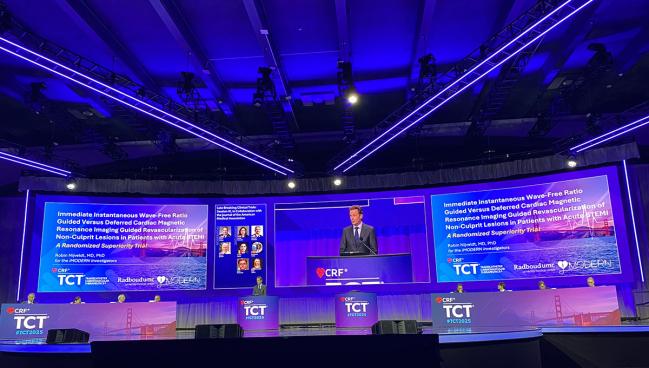
SAN FRANCISCO, CA—A strategy of immediate complete PCI guided by instantaneous wave-free ratio (iFR) is not superior to deferring PCI on the basis of cardiac stress magnetic resonance imaging (CMR) among patients with STEMI and at least one nonculprit lesion, according to the iMODERN trial.
The risk of the primary composite endpoint of all-cause death, recurrent MI, or hospitalization for heart failure at 3 years was similar in patients randomized to the iFR and CMR groups (9.3% vs 9.8%; HR 0.95; 95% CI 0.65-1.40).
Current European and US guidelines recommend complete PCI at the time of primary PCI so long as patients are hemodynamically stable, but Robin Nijveldt, MD, PhD (Radboud University Medical Center, Nijmegen, the Netherlands), who presented the findings today in a late breaking clinical trial session at TCT 2025, said that might not be necessary.

“The guidelines now guide you to do everything in one session and not in staged; [it is] preferred to do everything immediately,” he said during a media briefing. “And this is, I think, a very good study, well performed to prove that that’s not the case—that it doesn’t help.”
Ajay Kirtane, MD (NewYork-Presbyterian/Columbia University Irving Medical Center), who moderated the press conference, noted that CMR is “not widely prevalent or available” despite its high sensitivity. “It’s a very good test for doing it, if you can do it, but it’s a slightly different paradigm in terms of how that works,” he explained.
Shamir Mehta, MD (McMaster University/Population Health Research Institute, Hamilton, Canada), who led the COMPLETE trial, believes the new findings are “very consistent with the data that we have” from not only COMPLETE, which demonstrated the superiority of complete revascularization over culprit-lesion PCI, but also DANAMI-3-PRIMULTI, CVLPRIT, PRAMI, and COMPARE-ACUTE.
“Overall, those results are essentially neutral and this fits in very nicely with that,” he said during the press conference.
To TCTMD, Robert Jay Widmer, MD (Baylor Scott & White Health, Dallas, TX), a member of the American College of Cardiology Interventional Council, said the new data indicate that “you can defer [revascularization of nonculprit lesions] safely up to maybe those 40-ish days,” though what exactly “complete” PCI is and how it’s defined can remain up for interpretation based on the strategy used.
He does not use CMR routinely, Widmer said. “We have kind of gotten away from even doing post-ACS stress tests after STEMI looking at the nonculprit vessels. So really everybody does it invasively now. I don’t know if anybody’s going to go back to a different kind of stress test.”
Widmer’s main takeaway from the study is that it might “dissuade people from using physiology in the acute setting,” he said. “There’s no need to break out a new physiology wire and take a bunch of time at two o’clock in the morning to investigate things. I think you can open the culprit artery and then take a step back and see what you need to do.”
iMODERN Findings
For the trial, which was simultaneously published in the New England Journal of Medicine, Nijveldt and colleagues included 1,146 patients (mean age 63 years; 78% male) with STEMI and at least one nonculprit lesion who were successfully treated with primary PCI at 41 international sites. They were randomly assigned to immediate complete PCI with iFR guidance (n = 558) or deferred PCI with CMR guidance (n = 588). Notably, 65 patients in the CMR group received bailout iFR.
Double the proportion of patients in the iFR group had a positive nonculprit lesion compared with CMR patients (43.7% vs 21.8%), and similarly, more than double had PCI of a positive lesion (42.6% vs 18.7%). The mean time to the deferred procedure in the CMR arm was 40 days.
There were no significant differences between the iFR and CMR strategies for all-cause death (HR 1.04; 95% CI 0.58-1.88) or recurrent MI (HR 0.98; 95% CI 0.59-1.63), but researchers did find a lower risk of heart failure hospitalization in the iFR group at 3 years (HR 0.24; 95% CI 0.07-0.84).
There also were no differences in the rates of unplanned revascularization (HR 1.02; 95% CI 0.68-1.55) or stent thrombosis (HR 3.11; 95% CI 0.84-11.49), yet there was an increased risk of stroke/TIA with the deferred CMR strategy over 3 years (1.3% vs 3.7%; HR 0.36; 95% CI 0.15-0.86).
Results were comparable in both the as-treated and per-protocol analyses, though there was no longer a difference in hospitalization for heart failure in either. Subgroup analyses, too, were consistent with the main findings.
Nijveldt said his team will be further investigating the risk of stent thrombosis, which occurred in 1.7% of patients in the iFR group.
“One thing is that if you’re in the cath lab and you’re doing an iFR measurement, that you’re more likely to look at the previously stented coronary artery,” he explained. “Normally, if you’ve done a primary PCI and it has been performed successfully, you close the whole theater and you’re gone and you never know what’s happening in the culprit lesion. So, I think that might explain a few of the differences.”
To TCTMD, Nijveldt acknowledged the limitations of the trial’s pragmatic design. “We wanted to have in the deferred arm less-invasive investigations than in the immediate arm,” he said. “I think this trial comes with a few [pieces of] guidance. Most important is that we are not required to do everything in one session now. So that’s the good news.”
As for how iFR should be used from here, more investigation is needed, he suggested. “I think it is a tool to use, but to be honest, we haven’t compared iFR with FFR or angiography guidance. So I think we don’t have an answer on that question.”
Debating the Merits of CMR
Discussing the study during the session, Carlos Collet, MD (Cardiovascular Center Aalst, Belgium, and Cardiovascular Research Foundation, New York, NY), said the treatment strategy should depend on the severity of the lesion.
“Factor the risk of the intervention in to decide whether to approach the lesion immediately or in a staged procedure,” he said, adding that “deferring invasive management . . . is safe and should be considered as an approach in this particular group.”
Session moderator David Cohen, MD (St. Francis Hospital, Roslyn, NY, and Cardiovascular Research Foundation), noted that CMR is not standard in many hospitals, commenting that his center uses angiography. Nijveldt said that CMR is used more often in Europe where groups feel that it is most reliable for identifying infarcted myocardium.
Still, Cohen grappled with using ischemia to guide decisions in these patients in the first place. “The premise of using an MRI as the decision maker is that we’re looking for ischemia and maybe we’re looking for vulnerable plaque,” he said. “Maybe myocardium is just the wrong place to be looking.”
Collet agreed. “We need to be looking beyond the presence of a functionally significant lesion,” he said. “Invasive pullbacks in your study would have been extremely interesting because we know that focal disease by pullbacks correlates with high-risk plaque. So, we’ll have kind of a physiological surrogate for plaque that is highest risk.”
Next, he continued, is to “go beyond the assessment of the functional significance of the lesion to understand what is the atherosclerotic risk of the lesion that we’re leaving behind.”
The ongoing COMPLETE-2 trial and its OCT substudy will help elucidate further the role plaque morphology has in this field, added panelist Olga Toleva, MD (Georgia Heart Institute, Atlanta).

Yael L. Maxwell is Senior Medical Journalist for TCTMD and Section Editor of TCTMD's Fellows Forum. She served as the inaugural…
Read Full BioSources
Nijveldt R, Maeng M, Beijnink CWH, et al. Immediate or deferred nonculprit-lesion PCI in myocardial infarction. New Engl J Med. 2025;Epub ahead of print.
Disclosures
- The study was funded by Philips Volcano.
- Nijveldt reports receiving grant/research support from Philips Volcano and Biotronik and consultant fees/honoraria from Pfizer, BMS, Sanofi, and Daiichi Sankyo.
- Mehta reports receiving consultant fees/honoraria from Johnson & Johnson and Novartis; grant/research support from Abbott and Amgen; and serving on the DMC for Merck/Schering Plough.
- Kirtane reports receiving grant/research support from Medtronic, Abbott, Boston Scientific, Amgen, Cathworks, Siemens, Philips, Recor Medical, Spectranetics, Cardiovascular Systems Incorporated, Chiesi, Opens, Zoll, Regeneron, Neurotronic, Biotronik, Bolt Medical, Magenta Medical, Canon, SoniVie, Shockwave Medical, and Abiomed.
- Collet reports receiving grant/research support from Abbott, Boston Scientific, Shockwave Medical, Insight Lifetech, HeartFlow, and Medis Medical Imaging and consultant fees/honoraria from Insight Lifetech, Abbott, Boston Scientific, and HeartFlow.
- Widmer reports serving as a consultant to Philips.
- Toleva reports receiving consulting fees/honoraria from Abbott.
Related News

Comments