Latest STS Compensation Data Show Pay Is Up but Still Lags for Female Surgeons
Transparency is needed to improve equity, though it can be awkward to talk about salary, says Thomas MacGillivray.

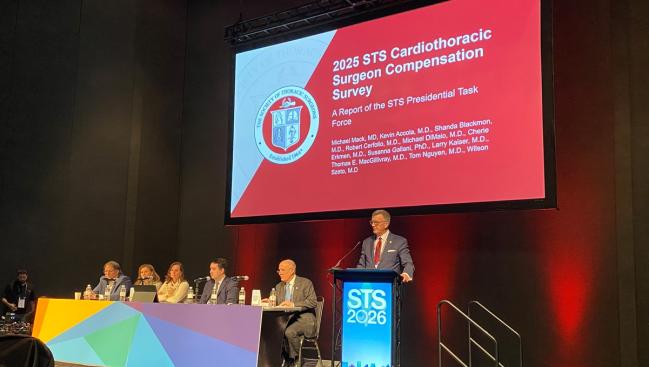
NEW ORLEANS, LA—The third annual survey of member compensation conducted by the Society of Thoracic Surgeons (STS) shows increases in median take-home pay across the board, with tiny strides made in shrinking previously identified gender disparities.
Congenital surgeons reported the highest median total compensation from 2025 at $1.06 million (9,366 relative value units [RVUs]), followed by cardiac surgeons and those in a hybrid practice—both at $1 million (11,000 and 11,250 RVUs, respectively). General thoracic surgeons reported earning $700,000 (7,300 RVUs). Compared with 2024 data, these salaries represent increases of between 4.5% and 7.5%.
When broken down by gender, female surgeons made 84%, 89%, 80%, and 83% of what their male colleagues earned in 2025 when looking at cardiac, general thoracic, hybrid, and congenital practice groups, respectively. These are up from the 67%-89% reported last year. New in the 2025 survey, cardiothoracic surgeons collectively said they would consider accepting considerations like more flexible schedules, autonomy, and working with better colleagues in lieu of monetary compensation.
“The purpose of this survey was to address the challenge of understanding different values and to better translate it into fair market compensation,” said former STS President Thomas MacGillivray, MD (MedStar Washington Hospital Center, Washington, DC), who presented the findings over the weekend at the 2025 STS Annual Meeting.
A second aim, he added, “is to collect accurate data that included the many nuances that comprise compensation in our diverse specialty, including subspecialty, stage of career, gender, race, geographic location, service area, and employment model.”
The field took a “punch in the nose” in 2023 when Cherie Erkmen, MD (Temple University Hospital, Philadelphia, PA), presented and eventually published data showing stark gender gaps in pay for cardiothoracic surgeons, MacGillivray said, explaining the origins of the survey.
“I do think it’s getting better,” he told TCTMD. “It’s not getting better as fast as many of us want it to, but it’s getting better. And there is a commitment to fix it.”
Survey Findings
The 84-question survey was sent to the entire membership of the STS between September 8 and November 2, 2025. The 1,128 people who answered represent a 35% response rate, up 7.5% from the 1,049 respondents from the year before.
Cardiac surgeons made up more than half of respondents (51%), with general thoracic surgeons (24%), those in a hybrid practice (15%), and congenital surgeons (10%) making up the rest. The survey did receive a few responses from transplant surgeons this year, but there were not enough data to accurately present, according to MacGillivray.
The demographics of respondents closely reflect current STS membership. About 12% of respondents to the 2025 survey were female, and the majority identified as white/Caucasian (67%), followed by Asian/Pacific Islander (23%), Hispanic/Latino (6%), multiple ethnicities/other (2%), and Black or African American (3%). Just over half (58%) were employed by a hospital/health system, with 37% employed in academic practice and the remaining 5% in private practice or self-employed.
Surgeon experience was well balanced among respondents, with 21%, 18%, 27%, 25%, and 8% having completed training 0-5, 6-10, 11-20, 21-30, or 31 or more years ago, respectively.
Median compensation was roughly similar across regions, though it was slightly lower for those practicing cardiac surgery, general thoracic surgery, or a hybrid in the northeast US. As was seen before, surgeons employed by a hospital/healthcare system generally took home the highest compensation.
Looking at organizational ownership, 13% of respondents said they worked for a for-profit entity, including 1% at facilities owned or financed by private equity.
Starting salaries also ticked upward. For those 2 years or less out of training, median compensation ranged from $475,000 (up from $441,000 in 2024) in general thoracic surgery to $710,000 (up from $600,000) in cardiac surgery. For those 3-5 years out of training, these figures jumped to $578,000 (up from $500,000 in 2024) in general thoracic surgery and $850,000 (up from $838,000) in cardiac surgery.
On a scale of 1 to 5, with 5 being the highest, the average response rate for physicians when asked about their compensation satisfaction was 3.47, up from 3.38 last year. This figure was largely similar across practice specialties and years in practice.
When asked to rank 11 considerations they would accept in lieu of compensation, the respondents’ top three were flexibility of schedule, more autonomy of work effort, and working with better colleagues. At the bottom of the list were more mentorship, greater prestige, and childcare/tuition support.
This section of the survey surprised MacGillivray the most, he told TCTMD. “Mentorship is priceless, . . . and maybe people just take it for granted and they don’t necessarily see the value of it,” he said.
Further, on a scale of 1 to 5, surgeons said they largely had clarity about their compensation model, with an average response rate of 3.33, and this increased with time in practice: 3.19 for those less than 2 years out to 3.70 for those with more than 31 years of practice.
Lastly, when asked if they receive compensation benchmarks from employers, the average response on a scale of 1 (never) to 5 (always) was 2.32.
MacGillivray stressed the purpose of the survey is primarily to increase transparency and “educate members on the importance of using data to make independent decisions about compensation in other terms of employment.”
‘If I Were Getting Paid Like a Man’
During the discussion, panelist Shanda Blackmon, MD, MPH (Baylor College of Medicine, Houston, TX), commented on the importance of educating early-career surgeons on what they can ask for in addition to compensation when signing a contract.
“Many contracts include things like whether or not cases can be bumped, whether or not your nurse can be taken from the OR, whether or not you were allowed to have access to two ORs so that you can flip-flop between rooms, how much access you have to other types of support and what percent of administrative time is protected for you,” she explained.
Also important to note is that most surgeons are “anchored” to their first base salary, as promotions and raises are often tied to that for the length of their tenure, said panelist Linda Martin, MD (University of Virginia, Charlottesville). “When you think about how much that adds up over the course of your career, I’m sure that I could retire right now if I were getting paid like a man,” she commented.
If I am doing the same work as someone else, I should be compensated exactly the same. Period. And if that’s not happening, it needs to be fixed. Thomas MacGillivray
To TCTMD, STS program chair Marc Pelletier, MD (Yale School of Medicine, New Haven, CT), said, a critique from hospital administrators over the last few years about the survey data is that it is self-reported. He suggested a “selective audit” of 10% of respondents to allow for strengthening of future survey data.
MacGillivray pointed out that this wouldn’t be in the spirit of what the organization originally set out to do with creating a totally anonymous survey, but when he asked for a show of hands in the room during the session of who would be open to submitting a W-2 tax form along with their response, more than half of the room showed support.
While he admitted how “uncomfortable” it can be to discuss compensation when cardiothoracic surgeons are paid much higher than many other important professionals, MacGillivray stressed the importance of using the data to promote equity in the field. “If I am doing the same work as someone else, I should be compensated exactly the same. Period. And if that’s not happening, it needs to be fixed,” said MacGillivray.
Also, he continued, the awkwardness around the conversation “shouldn’t be a reason to not have the information [that is] accurate and actionable for each individual.”

Yael L. Maxwell is Senior Medical Journalist for TCTMD and Section Editor of TCTMD's Fellows Forum. She served as the inaugural…
Read Full BioSources
MacGillivray T. 2025 STS cardiothoracic surgeon compensation survey: a report of the STS Presidential Task Force. Presented at: STS 2026. January 31, 2026. New Orleans, LA.
Disclosures
- MacGillivray reports no relevant conflicts of interest.
Related News



Comments