MAPLE-HCM Is a Win, ODYSSEY-HCM Isn’t: Obstructive vs Nonobstructive Divide
Cardiac myosin inhibitors may soon rival beta-blockers as a first-line monotherapy, at least for obstructive HCM, researchers say.

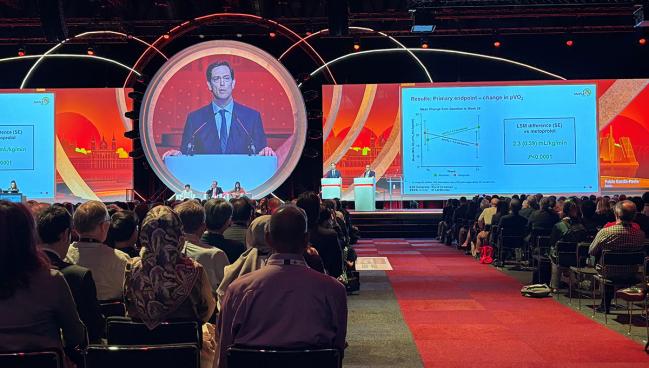
MADRID, Spain—For patients with hypertrophic cardiomyopathy (HCM), research presented today at the European Society of Cardiology (ESC) Congress 2025 demonstrated both the promise and the potential weaknesses of novel cardiac myosin inhibitors. Data from two trials—MAPLE-HCM and ODYSSEY-HCM—illustrate how the novel drugs perform quite differently in patients with obstructive versus nonobstructive disease.
MAPLE-HCM, whose top-line results were released in May 2025, was positive in its comparison of aficamten (Cytokinetics) with the beta-blocker metoprolol in obstructive disease. ODYSSEY-HCM, whose top-line results were released in April 2025, was negative in its comparison of mavacamten (Camzyos; Bristol Myers Squibb) versus placebo in nonobstructive disease. Both were published online today in the New England Journal of Medicine.
“There is a serious unmet need for effective therapies in symptomatic nonobstructive HCM,” ODYSSEY-HCM investigator Milind Desai, MD (Cleveland Clinic, OH), told the media at an ESC press conference. “We have made a lot of strides in obstructive HCM, but this still remains a little bit of an uncharted territory.”
In obstructive disease, dynamic left ventricular outflow tract (LVOT) obstruction “drives a significant proportion of symptoms,” whereas nonobstructive disease is much more heterogeneous, he explained. “If you take the outflow tract out of the equation, is there enough that we can modulate to help symptoms [in nonobstructive HCM]?”
While phase II data leading up to ODYSSEY-HCM were encouraging for mavacamten, positive phase III data did not come to fruition. Still, Desai pointed to “ongoing research in imaging, biomarkers, and a future detailed responder analysis which will hopefully identify a subgroup that benefits from this therapy.”
MAPLE-HCM investigator Pablo García Pavía, MD (Hospital Universitario Puerta de Hierro Majadahonda, Madrid, Spain), meanwhile, pointed out that their trial provides new insight, in that it pits aficamten against a beta-blocker, which has been the main treatment for obstructive HCM for approximately 60 years despite limited evidence.
Aficamten “targets the underlying pathophysiology of hypertrophic cardiomyopathy [by] reducing hypercontractility,” he said, noting that the drug has already shown benefit when added to standard of care. In the current trial, it replaces that standard as monotherapy.
MAPLE-HCM
MAPLE-HCM enrolled 175 patients with symptomatic obstructive HCM (mean age 58 years; 58.3% men, mean LVOT 47 mm Hg at rest and 74 mm Hg after the Valsalva maneuver), randomizing them to receive placebo plus either aficamten (daily dose of 5-20 mg) or metoprolol (daily dose of 50-200 mg).
The primary endpoint of change in peak oxygen uptake at 24 weeks was 1.1 mL/kg/min with aficamten and -1.2 mL/kg/min with metoprolol, for a least-squares mean between-group difference of 2.3 mL/kg/min (P < 0.001). Additionally, patients in the aficamten group had greater improvements in NYHA class, health status on the Kansas City Cardiomyopathy Questionnaire clinical summary score (KCCQ-CSS), LVOT gradient, NT-proBNP level, and left atrial volume index than patients given metoprolol. There was no difference in left ventricular mass index.
Serious adverse events occurred in 8% of the aficamten group and 7% of the metoprolol group.
“Overall, in our opinion, the results of the MAPLE-HCM study support aficamten monotherapy as the newer, first-line therapy of choice for patients with symptomatic obstructive hypertrophic cardiomyopathy,” García concluded.
Aficamten is currently being reviewed by the US Food and Drug Administration, with a decision expected by December 26, according to Cytokinetics.
ODYSSEY-HCM
Mavacamten, already approved by the FDA for obstructive disease based on data from the EXPLORER-HCM trial, came out less favorably in nonobstructive disease.
For ODYSSEY-HCM, investigators enrolled 580 patients (mean age 56 years; 46% women) with symptomatic nonobstructive HCM, randomizing them to mavacamten (starting at 5 mg/day and adjusted to a maximum of 15 mg/day based on LVEF) or placebo (with sham dose adjustment) for 48 weeks.
The trial had two primary endpoints: change from baseline to 48 weeks in peak oxygen uptake and health status on the KCCQ-CCS. For peak oxygen uptake, the least-squares mean change was 0.52 mL/kg/min with mavacamten and 0.05 mL/kg/min with placebo, for a between-group difference of 0.47 mL/kg/min (P = 0.07). For KCCQ-CS, the least-squares mean change was 13.1 points with mavacamten and 10.4 points with placebo, for a between group-difference of 2.7 points (P = 0.06). Additionally, patients in the mavacamten group were more likely to experience reductions in LVEF and interruptions in the trial regimen.
Prespecified subanalyses suggested that “younger patients [and those with] less advanced disease, less duration of disease, less diastolic dysfunction” had trends favoring mavacamten, said Desai, as did those on beta-blockers.
Serious adverse events that resulted in interruption of treatment were more common in the mavacamten versus placebo group (14.6% vs 5.2%), as were adverse events that resulted in permanent discontinuation (5.2% vs 2.8%). Among patients on mavacamten, these included congestive heart failure in 6.6% and atrial tachyarrhythmias in 4.2%.
LVEF < 50% was seen in 21.5% of patients assigned to mavacamten and 1.7% of those assigned to placebo, with LVEF < 30% seen in 2.4% of the treatment arm. Yet LVEF returned to ≥ 50% for all but three patients after interruption of the trial regimen.
What Now?
In the event that aficamten is approved for use in obstructive HCM, there’s the question of which drug—that or mavacamten—would be the preferred choice.
In the obstructive HCM space, García suggested advantages for aficamten would be a shorter half-life, which would enable faster uptitration and easier monitoring, and fewer drug-drug interactions. “Moreover, mavacamten hasn’t shown data as a monotherapy or first-line option for these patients,” he said, adding that if two options are on the market, then provider preference and reimbursement will also matter.
Carolyn Ho, MD (Brigham and Women’s Hospital, Boston, MA), the discussant for both trials in the Hot Line session, said that MAPLE-HCM and ODYSSEY-HCM make the case for why conducting studies that “challenge the status quo and test our hypotheses” is worthwhile.
Already, cardiac myosin inhibitors have shown their ability to improve patients’ “feel and function” in obstructive HCM and increase deferral of invasive septal reduction therapy, said Ho. “They’re the first disease-specific [therapies] that have been developed and [were done so] based on mechanistic insights and improved understanding of the pathobiology of HCM. They finally provide evidence from randomized clinical trials to guide our management.”
Both US and European guidelines now suggest adding these medications after trying beta-blockers or calcium channel blockers if patients continue to have symptoms, she noted.
MAPLE-HCM, which suggests beta-blockers may not provide meaningful benefit in obstructive HCM, should inspire the field to “beware when standard of care evolves out of practice rather than evidence,” said Ho. “Challenging the status quo is needed for progress in medicine.” Being able to adopt cardiac myosin inhibitors as first-line therapy in practice “will require easier initiation and maintenance of therapy and payer support,” she added.
In nonobstructive HCM, the putative mechanisms driving symptoms are “diastolic abnormalities and inefficient energetics,” Ho continued. While in theory the drug class might address these issues, nonobstructive HCM is “more complex and heterogeneous” than obstructive, which “is relatively straightforward.”
So, it will be necessary to see if it’s possible to identify physiologically relevant subgroups of nonobstructive HCM that could benefit from cardiac myosin inhibitors, she commented. “Can [the drugs] improve relaxation and energetics of a pharmacological disease or is their benefit primarily due to relief of LV outflow tract obstruction?
More data are on the way for nonobstructive disease, she said. The ongoing ACACIA-HCM trial of aficamten is expected to release top-line results in early 2026.

Caitlin E. Cox is Executive Editor of TCTMD and Associate Director, Editorial Content at the Cardiovascular Research Foundation. She produces the…
Read Full BioSources
García Pavía P, Maron MS, Masri A, et al. Aficamten or metoprolol monotherapy for obstructive hypertrophic cardiomyopathy. N Engl J Med. 2025;Epub ahead of print.
Desai MY, Owens AT, Abraham T, et al. Mavacamten in symptomatic nonobstructive hypertrophic cardiomyopathy. N Engl J Med. 2025;Epub ahead of print.
Disclosures
- MAPLE-HCM was funded by Cytokinetics.
- García reports serving as a consultant to Alexion Pharmaceuticals, Alnylam Pharmaceuticals, AskBio, AstraZeneca, Attralus, Bayer, BioMarin Pharmaceutical, BridgeBio, Bristol Myers Squibb, Cytokinetics, Edgewise, Intellia, Kardigan, Lexeo, Novo Nordisk, Pfizer, and Rocket Pharmaceuticals; receiving research grants from Alnylam Pharmaceuticals, AstraZeneca, Intellia, Novo Nordisk, and Pfizer; and serving on the scientific advisory board of Neuroimmune.
- ODYSSEY-HCM was funded by Bristol Myers Squibb.
- Desai reports serving as a consultant to Bristol Myers Squibb, Cytokinetics, Edgewise, Tenaya, and Viz.ai.
Related News



Comments