Navajo Meal Program Makes Headway in Heart Failure: MUTTON-HF
A culturally tailored meal plan featuring traditional foods, as well as other support, reduced hospital stays within 90 days.

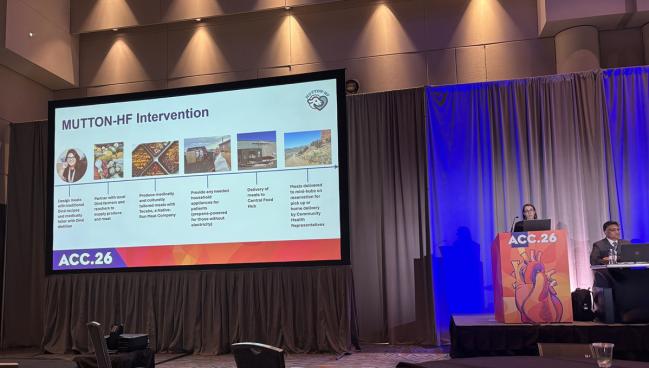
NEW ORLEANS, LA—Providing culturally tailored meals to patients with heart failure (HF) can significantly reduce hospitalizations, according to the MUTTON-HF trial. The innovative but short-term study involved a food-based intervention as well as other support for participants living in the Navajo Nation, also known as Diné Bikéyah.
Lauren Eberly, MD, MPH (Penn Medicine, Philadelphia, PA), senior investigator for MUTTON-HF, presented the data this past weekend at the American College of Cardiology (ACC) 2026 Scientific Session as part of a Featured Clinical Research session.
Two other trials at ACC 2026 also featured the “food as medicine” approach: THRIVE and GoFreshRx, both addressing hypertension.
“We know that the ongoing impacts of settler colonialism have produced adverse structural drivers—particularly food insecurity—that fuel poor cardiovascular health and health disparities among Indigenous populations,” said Eberly. “There is increased focus and momentum in Native communities to reclaim traditional precontact foods to improve health.”
Within this context, the American Heart Association-funded MUTTON-HF trial was designed to provide a locally sourced meal program tailored to the medical and cultural needs of people living in the Navajo Nation. The program incorporated traditional Navajo (Diné) foods and recipes.
To create the multifaceted intervention, MUTTON-HF investigators took several key steps:
- Designing meals using traditional Diné recipes that were medically tailored with a Diné dietician
- Partnering with local Diné farmers and ranchers to source fruit, vegetables, and meat
- Working with Tocabe, a Native-run company, to produce the tailored meals
- Providing household appliances to study participants as needed (16%), including propane-powered equipment for those without electricity
- Delivering meals first to a central food hub, then to mini-hubs on the reservation for either pickup by the participants or home drop-off by community health representatives
Importantly, the meals met the American Heart Association’s Dietary Approaches to Stop Hypertension, commonly known as DASH, and Heart-Check Food Nutrition Requirements.
MUTTON-HF took place in rural, eastern Navajo Nation at two Indian Health Service facilities. The trial enrolled 206 Diné adults with heart failure, randomizing 106 to receive medically and culturally tailored food (14 meals weekly for 8 weeks) and 100 to receive usual care. Four patients dropped out of the study either because they moved away, died, or withdrew, leaving 202 to be analyzed.
Hospitalizations or emergency department visits at 90 days, the study’s primary endpoint, were significantly less common for patients receiving tailored meals compared with usual care (40.6% vs 57.0%; RR 0.72; 95% CI 0.54-0.96; P = 0.02). The difference was driven by hospitalizations overall (12.3% vs 26.0%; RR 0.48; 95% CI 0.26-0.89; P = 0.01) as well as by heart failure hospitalizations (3.8% vs 13.0%; RR 0.29; 95% CI 0.10-0.87; P = 0.02). Benefits were consistent across subgroups based on age, sex, LVEF, and food security.
Numerous secondary endpoints also showed improvements related to food insecurity, financial strain, Kansas City Cardiomyopathy Questionnaire score, body weight (tailored-food participants lost a mean of 3.5 lbs, while controls gained a mean of 2.8 lbs), and creatinine level. There was no difference in adverse events between groups.
Eberly said it’s impossible to fully elucidate the impact traditional foods had on health beyond what could have been done by simply providing nutritious but nontraditional food. Moreover, the provision of household appliances like refrigerators and microwaves could have allowed access to healthier foods independent of the meals themselves.
“Additional research is needed on residual benefits of the intervention and longer-term follow-up to inform optimal-duration decisions,” she pointed out.
MUTTON-HF demonstrates that “leveraging the protective assets of Native communities is critical to advancing holistic Indigenous health and wellbeing,” Eberly concluded, adding that many of the lessons learned here could also be applied in other settings.
We’re hoping this is the first step of advocacy to help this be part of healthcare long-term. Lauren Eberly
Monica Aggarwal, MD (AdventHealth, Winter Park, FL), discussing the results at the Featured Clinical Research session, said she found the degree of food and water insecurity in the community “striking.” Given these challenges, she asked what measures MUTTON-HF had in place during and after the meal program to help maintain positive changes going forward.
Eberly agreed that this is a concern worth heeding. “We see such a big impact,” she said, “and then [the question is] what next?” Specific to the study, all participants at the end received cooking classes to learn how to make the traditional meals on their own from locally available ingredients. Perhaps more important, though, is ongoing research to better understand how to fill the needs of the community and how best—and for how long—to integrate these interventions into care delivery.
“We’re hoping this is the first step of advocacy to help this be part of healthcare long-term,” she commented. Part of this relates to food sovereignty, thinking about not just individual patients but also community health, added Eberly. To this end, the research team continues to work on partnerships with farmers and ranchers.

Caitlin E. Cox is Executive Editor of TCTMD and Associate Director, Editorial Content at the Cardiovascular Research Foundation. She produces the…
Read Full BioSources
Eberly LA. MUTTON-HF (medically utilized tailored traditional food to optimize nutrition in heart failure): a randomized trial of an indigenous food is medicine intervention. Presented at: ACC 2026. March 29, 2026. New Orleans, LA.
Disclosures
- MUTTON-HF was funded by the American Heart Association’s Health Care by Food Initiative.
Related News


Comments