Newer Radiation Shielding System Protects More Than Just Operators
In anthropometric testing, the head of the bed and nursing positions received less scatter with the EggNest versus Rampart.

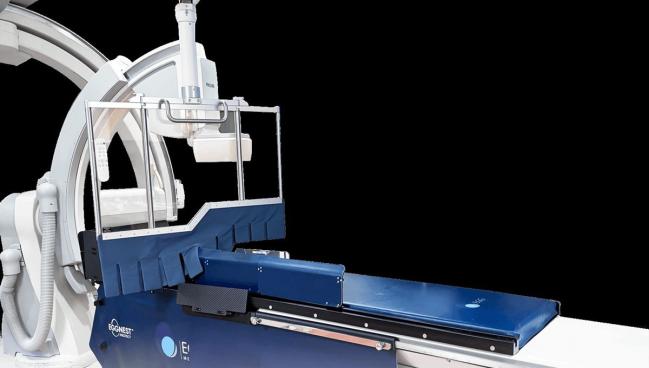
Photo Credit: Egg Medical
EggNest Complete (Egg Medical), a table-integrated shielding system that moves with the patient, reduces scatter radiation in the cath lab as well as a leading competitor, but with the added benefit of protecting other members of the team, new data show.
The study, published recently in JSCAI, simulated radiation exposure at various positions around the cath lab.
When the two shielding systems, the EggNest Complete and Rampart (Rampart IC), were compared to no shielding using an anthropometric phantom, the operator and assistant would be similarly exposed with both systems. However, the average radiation exposures for staff who would be present at the head of the bed and nurses elsewhere in the lab were lower with the EggNest than with Rampart (27 vs 131 μSv/hr; P < 0.01).
Robert F. Riley, MD (Overlake Medical Center, Bellevue, WA), said while he has used both EggNest Complete and Rampart extensively for years, his group wanted to understand the differences between them when it came to exposure for all cath lab staff.
“I need a system that works with any kind of procedure and for all my team members,” Riley told TCTMD. “I started having my nurses come to me and say, ‘Hey, it’s really great that you guys are getting protected with the Rampart, but what about us?’ We know that in this day and age, if you’re going put in the capital to protect folks, you’ve got to protect your entire team.”
That sentiment has been growing of late. A recent survey by the Society for Cardiovascular Angiography and Interventions found that despite more attention being paid to protecting against radiation and avoiding lead-related injuries, there has been a disturbing lack of progress in staff-related radiation and orthopedic injuries. Grassroots efforts by prominent interventional cardiologists have also entered the fray, including a documentary released last year in which many described how their work-related illnesses and injuries impact, and sometimes cut short, their careers in the cath lab.
While the current study by Riley and colleagues evaluated a phantom and measured exposure levels at different heights approximating staff positions, he’s hopeful that real-world data will provide more solid evidence to better elucidate the pros and cons of next-generation radiation shielding systems so everyone on the cath lab team can feel better protected.
I need a system that works with any kind of procedure and for all my team members. Robert F. Riley
In an accompanying editorial, Natalija Odanovic, MD (Yale School of Medicine, New Haven, CT), and colleagues note that without real patients and real staff in the studied positions, the difference in exposures may be slightly overstated.
However, they conducted their own rough calculations of the expected yearly dose exposure for the cath lab positions with EggNest in place, comparing them with the known background radiation doses in different parts of the United States as well as the National Council on Radiation Protection occupational dose limit.
Working with an operator who does 250 hours of fluoroscopy per year during cases, the editorialists estimated staff would receive the equivalent of an additional 1.25 mSv per year on the job, or 2.5% of the nuclear regulatory commission’s annual dose limit, with EggNest in place.
“If used routinely, this would almost completely attenuate the risk of additional radiation exposure without the concomitant orthopedic risk of wearing lead,” they write. “Additionally, it would essentially allow for interventional cardiologists and staff to receive less radiation exposure working in the catheterization laboratory than a segment of the general population that lives in higher altitude.”
Comparing the Systems
For the study, researchers positioned a whole-body phantom, which generated scatter radiation that approximated a large human, with the heart and the upper edge of the diaphragm within the imaging field. Radiation exposure was evaluated with sensors on poles at positions around the fluoroscopy C-arm: operator, electrophysiologist/echocardiographer, assistant, anesthesiologist, and nurse. The poles could be adjusted to a variety of heights and were placed in areas where staff typically stand during procedures.
The Rampart is a motorized shield on wheels that is contoured to the patient’s outline with flexible lead rubber flaps. The EggNest is mounted onto the X-ray table and consists of flexible shielding both below and around the sides and head of the table that moves with the C-arm gantry. It also has flip shields that can be rotated upwards once the patient is on the table to provide an enclosed shielding around them.
Without shielding, the mean scatter radiation dose to the operator was 137 μSv/hr, as compared to 19 μSv/hr with Rampart and 5 μSv/hr with EggNest (P < 0.01 vs no shielding and Rampart). Similarly, scatter levels for the assistant were 44 μSv/hr with no shielding, but just 2 μSv/hr and 1 μSv/hr for Rampart and EggNest, respectively.
For the other cath lab staff, including the anesthesiologist position, which saw the highest exposure rates, reductions in scatter were only seen with EggNest.
Cath Lab Staff Exposure to Radiation, μSv/hr
|
|
No Shielding |
Rampart |
EggNest |
|
Anesthesiology |
256 |
269 |
60 |
|
EP/Echo |
47 |
49 |
11 |
|
Nurse |
58 |
59 |
9 |
The results for these positions were consistent across all standard C-arm angulations and heights.
To TCTMD, Riley cautioned that the study is an early look at what could be a big change to the level of radiation that people who work in cath labs would have to accept as part of doing their jobs. For Odanovic and colleagues, identifying “the regulatory, financial, and logistical barriers of widespread implementation of these technologies is imperative” to promoting adoption of radiation protection strategies that will minimize occupational exposures.
According to Riley, the calculations made by the editorial authors are something to strive for given that the data suggest the reductions are certainly possible.
“When we look at the big picture, whether it’s light lead or no lead, we’re aiming to reduce two things. One is the radiation risk, which is the clear and present danger that we know causes bad things for the people that work in the cath lab. But the second, which is actually more prevalent, is the orthopedic risk of wearing this heavy lead,” he noted. “It’s a big goal, honestly. But if we can get the radiation levels to [the equivalent] of people not working in the cath lab, then that really allows us to go [forward with] lessening that orthopedic load through light or no lead.”

L.A. McKeown is a Senior Medical Journalist for TCTMD, the Section Editor of CV Team Forum, and Senior Medical…
Read Full BioSources
Riley RF, Kidd S, Power J, et al. Comparative effectiveness of 2 next-generation scatter radiation shielding systems. JSCAI. 2025;Epub ahead of print.
Odanovic N, Gonzalez PE, Vora AN. Is egg ready to leave the nest and fly? JSCAI. 2025;Epub ahead of print.
Disclosures
- The study was sponsored by Egg Medical.
- Riley reports serves as an advisor for Egg Medical.
- Odanovic reports no relevant conflicts of interest.
Related News


Comments