Olezarsen Brings Moderately High Triglycerides Under Control: ESSENCE-TIMI 73b
In the phase III trial, the monthly injectable lowered levels by nearly 60 percentage points vs placebo, but will it impact events?

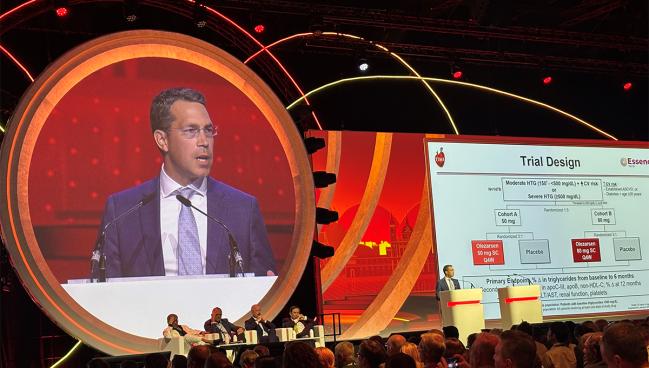
MADRID, Spain—Olezarsen (Ionis Pharmaceuticals), an antisense oligonucleotide that targets APOC3 messenger RNA (mRNA), successfully lowers triglyceride levels compared with placebo by 6 months among patients with moderate hypertriglyceridemia and elevated cardiovascular risk.
The findings, from the ESSENCE–TIMI 73b phase III trial, were reported yesterday at the European Society of Cardiology Congress 2025 and simultaneously published in the New England Journal of Medicine.
These latest results follow the phase IIb Bridge–TIMI 73a trial, released last year.
Olezarsen already has US Food and Drug Administration approval for triglyceride-lowering in adults with familial chylomicronemia syndrome, pointed out Brian A. Bergmark, MD, who served as first author of the study along with Nicholas A. Marston, MD (both from Brigham and Women’s Hospital, Boston, MA). “However, its efficacy and safety in a broader population of patients with hypertriglyceridemia and elevated CV risk are not established. That is what led us to this trial,” he told the media at a press conference.
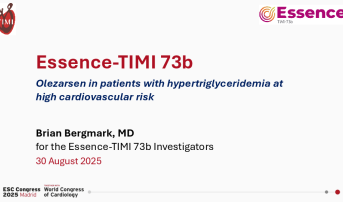
In terms of how olezarsen “fits into the bigger picture of cardiovascular risk reduction,” Bergmark told TCTMD that’s “still unproven.”
Compared with statins and other therapies that target LDL, this drug has a distinct profile and mechanism of action, he explained. It’s not yet known whether reducing triglycerides will in turn decrease cardiovascular events and if the relationship will track in the same way it does with LDL and outcomes.
Although “this trial gives us good information about what exactly is happening to the lipids,” as yet unknown is whether there will even be an outcomes trial in moderate hypertriglyceridemia, Bergmark added.
ESSENCE–TIMI 73b
Researchers enrolled 1,349 patients (median age 64 years; 40% women; 95% white) who had moderate hypertriglyceridemia, defined as a triglyceride level of 150 to 499 mg/dL, plus elevated risk. At baseline, the median triglyceride level was 238.5 mg/dL. Nearly all patients (96%) were already on standard lipid-lowering therapy.
Participants were randomized in a 3:1 ratio to receive monthly subcutaneous injections of olezarsen at doses of 50 mg (n = 254) or 80 mg (n = 766) or to matching placebo (n = 329) for a treatment period of 12 months, followed by a 13-week safety follow-up period.
The primary outcome—the least-squares mean percent change in triglyceride level from baseline to 6 months—was -58.4 percentage points with olezarsen 50 mg and -60.6 percentage points with olezarsen 80 mg compared with placebo (P < 0.001). After 12 months, these values were -50.7 in both of the treatment groups compared with placebo (P < 0.001).
At 6 months, 85.0% of the olezarsen 50-mg group, 88.7% of the olezarsen 80-mg group, and 12.5% of the placebo group achieved a normal triglyceride level of < 150 mg/dL (P < 0.001 vs placebo).
Additionally, compared with placebo, the olezarsen groups had significantly greater reductions between baseline and 6 months for apoC-III, non-HDL cholesterol, VLDL cholesterol, remnant cholesterol, and apoB as well as an increase in HDL. There was no impact on LDL. Adverse events were evenly distributed among the three groups but there were more injection-site reactions in the olezarsen arms, though these tended to be mild, said Bergmark.
The Future
Bergmark noted that two phase III trials are evaluating olezarsen in patients with severe hypertriglyceridemia, and that specific to the ESSENCE–TIMI 73b trial, a longer-term open-label extension program continues in this population.
Børge Nordestgaard, MD (Copenhagen University Hospital, Denmark), discussing the results at the Hot Line session, described ESSENCE–TIMI 73b as a “very, very important” trial.
In trials of hypertriglyceridemia, he wants to see not only large decreases in triglycerides, but also in atherogenic particles, such as apoB and VLDL, as well as remnant cholesterol. The latter is the cholesterol content of triglyceride-rich lipoproteins. “That is a fantastic thing to test in a phase III trial. . . . What you also want to look at is nothing bad happens,” commented Nordestgaard, adding that ESSENCE–TIMI 73b fits the bill in both those regards.
Máxima Mendez, MD (Cli-Lipid, Santo Domingo, Dominican Republic), a member of the American College of Cardiology’s Prevention of Cardiovascular Disease Council, told TCTMD the population studied in ESSENCE–TIMI 73b is quite clinically relevant. Globally, about one-third of people have triglyceride levels above 150 mg/dL.
Olezarsen isn’t the only medication designed to help patients with high triglycerides, though, she observed. In addition, there’s the antisense oligonucleotide volanesorsen (originally developed by Ionis Pharmaceuticals) as well as the small interfering RNA therapeutics plozasiran and zodasiran (Arrowhead Pharmaceuticals) and icosapent ethyl (Vascepa; Amarin), the pharmaceutical grade omega-3 fatty acid formulation tested in REDUCE-IT.
“It’s been a challenge to have therapies that demonstrate reduction of triglycerides will [result in] reduction in cardiovascular disease,” Mendez said, adding that so far, “we have not been successful.”
The data on olezarsen are promising, she agreed, especially the fact that nearly nine in 10 patients saw their triglycerides drop to less than 150 mg/dL by 6 months. “This is very important information, because this is the first drug that reached this level of reduction, and I like the idea that it’s injected,” said Mendez.

Caitlin E. Cox is Executive Editor of TCTMD and Associate Director, Editorial Content at the Cardiovascular Research Foundation. She produces the…
Read Full BioSources
Bergmark BA, Marston NA, Prohaska TA, et al. Targeting APOC3 with olezarsen in moderate hypertriglyceridemia. NEJM. 2025;Epub ahead of print.
Disclosures
- The trial was sponsored by Ionis Pharmaceuticals.
- Bergmark reports receiving grant support through his institution from Abbott Vascular, Ionis, Pfizer, Philips, Inari, AstraZeneca, and Amgen as well as consulting/personal fees from Shockwave, Abbott Vascular, Abiomed, Boston Scientific, Bain Life Sciences, Bolt, Morgan Stanley, Teleflex, SpectraWAVE, Boston Clinical Research Institute, and Endovascular Engineering.
Related News


Comments