PARTNER 3 at 7 Years: Stable Outcomes, No Signs of Valve Failure With TAVI
The data are largely in line with those seen at 5 years, but the follow-up reassures there’s no concern about valve durability.

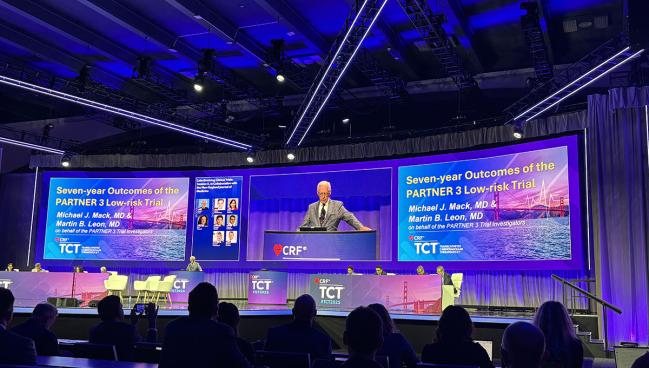
SAN FRANCISCO, CA—Longer-term follow-up from the PARTNER 3 trial shows that both surgery and TAVI continue to provide similar clinical outcomes in low-risk patients with symptomatic severe aortic stenosis at 7 years.
The data, presented today as a late-breaking trial at TCT 2025 and published simultaneously in the New England Journal of Medicine, also provide some reassurances about the durability of the balloon-expandable bioprosthetic valve (Sapien 3; Edwards Lifesciences), with investigators reporting no differences in the risk of bioprosthetic valve failure (BVF) or need for aortic valve reintervention.
“I don’t see a reason for this to change practice,” coprincipal investigator Michael Mack, MD (Baylor Scott & White Health, Plano, TX), told TCTMD. “It gives more confidence in both therapies. This is the first time we’ve had systematic follow-up of surgical valves also. The question about whether this moves TAVR into younger patients—it doesn’t give any evidence because only 7% of the PARTNER 3 patients were under 65. We know that biologic valves, no matter how they’re delivered, surgery or TAVR, don’t last as long in the younger population.”
Nonetheless, these data suggest that Sapien 3 is holding up until 7 years, said Mack.
The longer-term data continue to show the safety and durability of TAVI in a low-risk cohort, agreed Benjamin Hibbert, MD, PhD (Mayo Clinic, Rochester, MN). “There is no penalty to pay in terms of hard clinical outcomes, and valve performance is equivalent,” he told TCTMD.
Like Mack, Hibbert said that because TAVI is now established for managing aortic stenosis in the low-risk population, there’s been a “march” into younger patients. However, valve durability is a bit of a “straw-man argument” when it comes to treating younger, low-risk patients with TAVI instead of surgery because anatomic suitability for repeat interventions and comorbidities are going to drive the treatment choice in younger patients, he said.
“Given these very reassuring results, it’s time to embark on a definitive trial” in a young population, said Hibbert. “TAVR has a seat at the table in the discussion of lifetime management in patients with longer expected survival.”
Cardiac surgeon Michael Reardon, MD (Houston Methodist DeBakey Heart & Vascular Center, TX), one of the panelists during the late-breaking session, said that TAVI is associated with lower early mortality and stroke risk, plus faster recovery, but the question has always been whether those outcomes would hold up as the field moved into the lower-risk demographic. These PARTNER 3 data show that it does.
“We have stable clinical outcomes, but most importantly, there’s no difference in biologic valve failure, which has been one of the big issues we’ve been looking for,” he said.
Some Catch-up at 7 Years
The PARTNER 3 trial included 1,000 patients (mean age 73.4 years; 70% male) with an STS predicted risk of mortality of less than 4% (mean STS-PROM score 1.9%) treated at 71 centers. As reported by TCTMD in 2019, TAVI was shown to be superior to surgery when it came to the primary composite endpoint of death from any cause, stroke, or rehospitalization at 1 year.
Follow-up at 5 years showed there was an attenuation of this early benefit, but there was no significant difference in the risk of the primary endpoint between treatments. Valve hemodynamics also were similar between the TAVI and surgical groups, and there was no difference in the risk of BVF.
Seven-year follow-up was available for 92.7% of patients randomized to TAVI and 86.1% of those treated with surgery. Investigators also performed a virtual status sweep using publicly available data (eg, obituaries and media reports), family phone calls, and medical records to improve the completeness of follow-up.
At 7 years, the primary endpoint of death from any cause, stroke, or rehospitalization occurred in 37.2% of patients randomized to surgery and 34.6% of those treated with TAVI (HR 0.87; 95% CI 0.70-1.08). When they assessed the hierarchical composite of all-cause mortality, disabling stroke, nondisabling stroke, or rehospitalization days using the win ratio, there was also no difference between the treatments.
The risk of all-cause mortality was 19.5% in the surgery group and 16.8% in the TAVI group (HR 1.17; 95% CI 0.86-1.59). Among the 84 patients picked up in the vital status sweep, mortality was numerically higher in the surgery arm (13 vs 3 deaths).
At 5 years, the PARTNER 3 investigators reported that the all-cause mortality curves crossed around the 3-year mark such that deaths were numerically higher with TAVI compared with surgery. By 7 years, the curves separated a little more, but again the difference was not statistically significant. Speaking with TCTMD, Mack said they’ve also performed a landmark analysis—which will be presented at an Edwards Lifesciences-sponsored symposium—showing that TAVI “wins” in the first year and then the advantage turns to surgery from 1 to 7 years.
“There is catch-up occurring with surgery so that by 7 years things are roughly equal in all components of the primary endpoint,” he said.
Cardiovascular mortality was no different between treatments: 10.3% with TAVI and 7.8% with surgery (P = 0.27). Similarly, death from noncardiovascular causes was no different: 10.2% with TAVI and 7.7% with surgery (P = 0.21). There was no difference in the risk of stroke or rehospitalization.
Clinical valve thrombosis per the VARC-3 definition was higher in the TAVI group, but rates of new atrial fibrillation remained lower. The mean aortic gradient was higher with TAVI than surgery (13.1 vs 12.1 mm Hg; P = 0.02) but there was no difference in aortic valve area. Importantly, both of these measures were stable from 1 to 7 years. Paravalvular regurgitation (PVR) was also stable from 1 to 7 years, and it appeared to have no impact on all-cause mortality. For example, there was no difference in all-cause mortality at 7 years in TAVI-treated patients with none/trace PVR and those with mild PVR at 30 days.
Finally, the rate of all-cause BVF was 7.3% in the surgery arm compared with 6.9% in the TAVI group, a nonsignificant difference. Similarly, the rate of aortic valve reintervention was nearly identical in the two arms.
Philippe Généreux, MD (Morristown Medical Center, NJ), one of the PARTNER 3 investigators, was encouraged by the 7-year data.
“We were all wondering if there was a difference in valve durability and reintervention,” he said. “This should be very reassuring for patients. We now have data up to 7 years to say that both therapies offer similar results. The rate of reintervention was low and everything was comparable. For me, I think it’s good news for the field in general.”
Valve Thrombosis, Not BVF, Higher
Speaking during the late-breaking clinical trials session, Stefan Blankenberg, MD (University Heart & Vascular Center, Hamburg, Germany), said the long-term analysis is important to confirm the sustainability and durability of TAVI in the low-risk population.
He did urge some caution around the rate of clinical valve thrombosis, which was 2.8% with TAVI and 0.5% with surgery. Between 5 and 7 years, there was one additional case of valve thrombosis in both treatment arms. However, this higher rate of valve thrombosis did not translate into a higher risk of stroke or BVF in the study, said Blankenberg.
To TCTMD, Généreux said the biggest limitation of their data is the disproportionate loss to follow-up with surgery. While the vital status sweep captures some of the patients who died, it doesn’t account for other endpoints, including stroke and rehospitalization.
Mack agreed that this is a drawback of their data, noting that patients in heart valve trials who are treated with surgery are more commonly unavailable as they figure they’ve received usual care and “there’s less enthusiasm on their part to come back for follow-up.”
Investigators are continuing to follow patients in PARTNER 3 for 10 years.

Michael O’Riordan is the Managing Editor for TCTMD. He completed his undergraduate degrees at Queen’s University in Kingston, ON, and…
Read Full BioSources
Leon MB, Mack MJ, Pibarot P, et al. Transcatheter or surgical aortic-valve replacement in low-risk patients at 7 years. N Engl J Med. 2025;Epub ahead of print.
Disclosures
- Mack reports serving as coprincipal investigator on trials funded by Abbott and Edwards Lifesciences. He also serves as trial study chair for a Medtronic-funded study.
- Hibbert reports consulting for Edwards Lifesciences and Abbott and grant support from Occlutech.
- Reardon reports consulting for Medtronic, Boston Scientific, W.L. Gore & Associates, and Siemens Healthineers. He serves on advisory boards for JValve, High Life, Boston Scientific, Medtronic, and W.L. Gore.
- Blankenberg reports consulting for Bristol Myers Squibb, Boehringer Ingelheim, and Daiichi-Sankyo/Eli Lilly and Company.
- Généreux reports consulting for Edwards Lifesciences.
Related News

Paolo Centofanti
Paolo Centofanti