SAVR Bests TAVI for 5-Year Survival in Combined RCT, Observational Data
The findings sparked a debate about the merits of RCTs vs other study designs—one surgeon urged others to “read a textbook.”
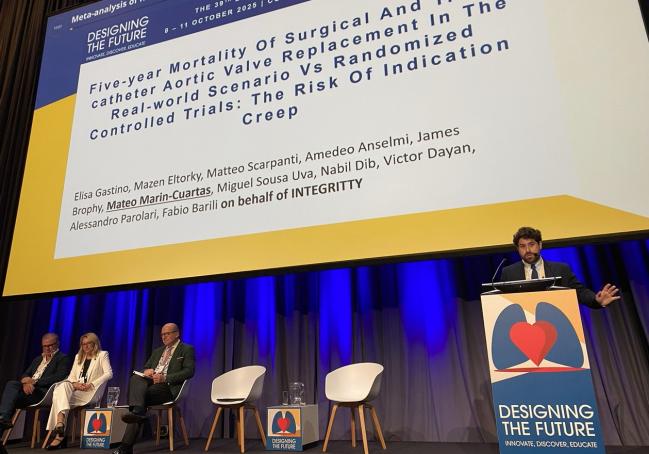
COPENHAGEN, Denmark—Five-year survival following surgical aortic valve replacement (SAVR) for aortic stenosis is superior to that of TAVI, according to an analysis combining data from more than three dozen randomized controlled trials and observational studies.
The risk of death was higher with TAVI in the real-world studies, but there was no difference in mortality between SAVR and TAVI when the analysis was restricted to randomized trials alone.
The findings highlight the need for guideline writers to take into account more observational data into their future recommendations, according to Mateo Marín-Cuartas, MD (Leipzig Heart Center, Germany), who presented the study here at the 2025 European Association for Cardio-Thoracic Surgery (EACTS) meeting on behalf of the INTEGRITTY group.
“We don’t want to say: ‘RCTs are best and observational data are bad,’” he said. “We actually think that we might want to combine them to analyze and make decisions. Guidelines are based on RCTs because they are, let’s say, the cleanest way to run a comparison of different strategies because of the lack of biases. Of course, . . . real-life data is still biased because once we decide that a patient undergoes TAVR, we are taking a decision and we are selecting a patient.”
This isn’t the first time surgeons have engaged in the debate over which type of research should guide practice decisions, or even point out the benefits and drawbacks of each.
Michael Borger, MD, PhD (Leipzig Heart Center), who served as the EACTS chairperson for the recently published European valvular heart disease guidelines and was not involved in the new study, stressed that the guidelines must reflect the highest quality published data.
“There’s indication creep that occurs outside of randomized studies, but it’s not the task of the guidelines task force to control indication creep,” he told TCTMD, referring to patients treated in observational studies that do not match the criteria of controlled studies. “That has to be left to payers, to societies, [and] to patient advocates. Our task is to interpret the data and to give the best evidence-supported recommendations that we can.”
It’s true that RCTs “have the highest value in the management of patients,” session moderator Alicja Zientara, MD (Universitätsklinikum Freiburg, Germany), told TCTMD. “On the other hand, we have to ask ourself if we are probably artificially designing RCTs that are not necessarily reflecting the reality in our clinical practice.”
5-Year Findings
For the study, Marín-Cuartas and colleagues looked at more than 60,000 patients undergoing TAVI or SAVR as part of 10 randomized controlled trials—PARTNER 1A, 2A, and 3; US CoreValve High Risk Study, SURTAVI, UK TAVI, DEDICATE-DZHK6, VIVA, NOTION, and the Evolut Low Risk trial—and 28 observational analyses between 2007 and 2025.
At 5 years, the overall mortality risk was about one-third higher among patients who had TAVI compared with SAVR (HR 1.34%; 95% CI 1.30-1.39). There was no survival difference when the analysis was restricted to RCTs (HR 0.98; 95% CI 0.91-1.06), though there was a 43% increased risk of death for TAVI versus SAVR in the combined observational data (HR 1.43; 95% CI 1.37-1.48).
This finding held true in a landmark analysis that focused on outcomes from 6 months after the procedure, leading the researchers to question if there might be some indication creep where “we are [enrolling] patients in RCTs that are prone to have favorable outcomes for TAVI,” Marín-Cuartas said.
Among SAVR patients alone, there was no difference in mortality between those enrolled in RCTs compared with observational studies (HR 0.77; 95% CI 0.38-1.58). However, when TAVI patients were analyzed, those in randomized trials had a significantly lower risk of death at 5 years (HR 0.37; 95% CI 0.18-0.79) than those in observational studies.
‘There’s Something Missing’
In response to questions about longer-term data given the limited story the 5-year evidence can tell, Marín-Cuartas said only NOTION has published 10-year outcomes at this point. There are 10-year postapproval data from PARTNER 2, which were released by the US Food and Drug Administration, but “it’s not the official source of information,” he said. Until more follow-up is complete and published, “we can actually not answer that question.”
Seven-year data from the low-risk PARTNER 3 study are scheduled to be presented at TCT 2025 later this month.
Audience member Eduardo Saadi, MD, PhD (UFRGS Hospital de Clinicas de Porto Alegre, Brazil), referenced how the European guidelines recently lowered the age cutoff from 75 to 70 years when deciding between SAVR and TAVR. “Do you think that this study may impact clinical practice, at least in Germany, considering the new guidelines?” he asked.
Officially, yes, Marín-Cuartas said. “But to be honest, unofficially, I have talked to many interventional cardiologists that were already performing [TAVI]” in patients in their early 70s with favorable anatomy who come in asking for it, he added. “It’s been an option already for years.”
Stefano Salizzoni, MD, PhD (Università degli Studi di Torino, Italy), another audience member, also was bothered that guidelines aren’t developed from real-world data. “We have data at 5 years that shows . . . that AVR is better than TAVR,” he commented. “Why do we have this guideline? I’m confused. There’s something missing.”
Marín-Cuartas, who served on the writing committee for the valvular heart disease guidelines, acknowledged he is “sometimes also confused.”
This bewilderment can be remedied, Borger asserted during the discussion.
“Read a textbook,” he urged. “Any textbook says that the higher level of evidence is randomized trials over retrospective studies,” Borger continued. “Retrospective studies do not account for unmeasured bias. Randomized trials do.”
Salizzoni lamented that there will “never” be published randomized data showing better outcomes of SAVR over TAVI, but Marín-Cuartas urged a paradigm shift in thinking. “We should stop complaining about that because it’s how it is, and we should work on future randomized evidence if we want for our specialty to exist in this current form,” he said.

Yael L. Maxwell is Senior Medical Journalist for TCTMD and Section Editor of TCTMD's Fellows Forum. She served as the inaugural…
Read Full BioSources
Marín-Cuartas M. Five-year mortality of surgical and transcatheter aortic valve replacement in the real-world scenario vs randomized controlled trials: the risk of indication creep. Presented at: EACTS 2025. October 9, 2025. Copenhagen, Denmark.
Disclosures
- Marín-Cuartas reports no relevant conflicts of interest.
Related News


Comments