Rampart Radiation Protection System Doesn’t Slow STEMI Care
Door-to-balloon times were no higher than when cath lab staff donned traditional lead aprons in this single-center experience.


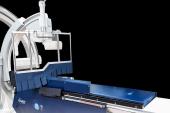
Median door-to-balloon time was 31.0 minutes when the Rampart system was in place and 31.1 minutes when only lead aprons were used, with a nonsignificant difference of 1.51 minutes between groups after adjustment (P = 0.21), researchers report in a study published online recently in JSCAI.
“Radiation exposure is a well-recognized occupational hazard in interventional cardiology, and recently we’ve been coming up with these more comprehensive enhanced radiation protection systems. But there’s very little data to show how we can integrate them into time critical workflows like STEMI care,” lead author Osama Hallak, MD (Ascension St. Vincent Heart Center, Indianapolis, IN), told TCTMD.
“As interventional cardiologists,” he added, “the onus is on us to ensure that implementation of any new technology, no matter how trendy, does not negatively impact quality metrics, especially something as fundamental as door-to-balloon time.”
This new study, the first to examine a potential impact of these radiation protection systems on door-to-balloon times in STEMI, indicates that “operator safety and high-quality STEMI care are not competing priorities,” Hallak said. “With thoughtful integration, we can achieve both things. We can protect the operators, protect the people in the lab, and at the same time, give high-quality care to patients, [even] during STEMI when every minute matters.”
Cutting Down on Radiation
Prolonged exposure to radiation among interventional cardiologists and other personnel in the cath lab has been associated with development of cataracts and cancer, and the lead aprons worn for protection have frequently caused orthopedic injuries. In a recent survey, most respondents reported musculoskeletal pain and at least one orthopedic injury related to wearing lead and/or working in the cath lab.
Enhanced systems developed in recent years have been shown to reduce radiation exposure and lessen orthopedic strain compared with lead aprons, but most studies evaluating them have focused on their impact during elective procedures, creating a gap in knowledge about whether operator safety could be improved without delaying reperfusion in the time-critical STEMI setting.
In this single-center study, Hallak and his colleagues retrospectively examined door-to-ballon times among 174 patients with STEMI undergoing PCI (mean age about 64 years; 67.8% men), with half treated with the Rampart system in place and half treated with operators and cath lab staff protected by lead aprons.
We can protect the operators, protect the people in the lab, and at the same time, give high-quality care to patients. Osama Hallak
After adjustment for potential confounders, including bleeding, vasopressor use, intubation, mechanical support, electrical instability, access type, and prior revascularization, the difference in door-to-balloon times between groups fell within the 5-minute noninferiority margin. The findings were consistent in additional analyses.
Though the subgroups were small, the Rampart system wasn’t associated with increased door-to-balloon times in more complex patients like those with cardiogenic shock or respiratory failure.
Investigators also found “no compelling evidence of a learning curve or improved door-to-balloon times once staff increased familiarity with the system, impacting the primary outcome.”
Commenting for TCTMD, Robert Riley, MD (Overlake Medical Center, Bellevue, WA), said the market for enhanced radiation protection devices has expanded over the past 3 or 4 years, with the field continuing to explore how to integrate them into practice.
There are several things to consider when thinking about using one of these systems, he said. They must protect everybody in the cath lab, not just the operators; they should be capable of seamlessly integrating into workflows; they must be versatile across different procedures; and they must be backed robust data supporting their use.
The retrospective nature of the current study is helpful, Riley said, because it reflects real-world practice and not a carefully controlled environment cultivated by industry. Still, retrospective, single-center studies are always considered hypothesis-generating, he added. “I don’t think we can make definitive claims from this, but I do think it’s a great starting point.”
The heart of this study touches on workflow integration, Riley said. “What I think is mission critical in terms of takeaways from this article is that you can integrate these enhanced radiation protection devices into your practice with minimal impact on critical patient outcomes like door-to-balloon time, which we know is a metric of success in terms of taking care of patients with STEMIs and in terms of lowering their mortality in the short and long term.”
He questioned whether the results can be generalized to less-experienced centers and said these results will have to be reproduced at other sites with different workflows and environments.
You can integrate these enhanced radiation protection devices into your practice with minimal impact on critical patient outcomes like door-to-balloon time. Robert Riley
Although there wasn’t a significant learning curve observed in this study, Hallak said there is the potential for one with any emerging technology like enhanced radiation protection devices. Early adoption, he said, requires coordination among all the members of the care team and strong protocols to ensure that the technology doesn’t delay care.
As such, the outcomes at any individual center will depend on how deliberately the system is implemented, Hallak said. “Ultimately, he said, “I think it’s very easy to integrate it into the workflow without it causing much delay.”
Use of systems like the Rampart “breeds an overall safety culture in the cath lab. And I think reducing cumulative radiation exposure and orthopedic strain has long-term implications for career longevity,” Hallak added.
It’s possible that improving the work environment in the cath lab by improving radiation protection could also have a broader impact on the field, he said, noting that there were many slots left unfilled during the second annual interventional cardiology match last month. “Making the specialty safer and more sustainable long term is an important step in making it more appealing to the next generation,” stressed Hallak

Todd Neale is the Associate News Editor for TCTMD and a Senior Medical Journalist. He got his start in journalism at …
Read Full BioSources
Hallak O, Mehringer M, Alkowatli H, et al. Impact of a novel radiation protection system on door-to-balloon time during STEMI intervention. JSCAI. 2025;Epub ahead of print.
Disclosures
- Hallak reports no relevant conflicts of interest.
Related News

Comments