Too Few HF Patients on Guideline-Directed Medical Therapy in VA System
Costs aren’t the only barrier to achieving optimal medication adherence, the data indicate.

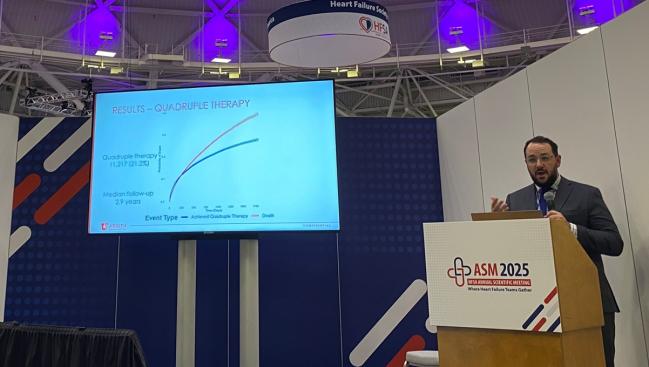
MINNEAPOLIS, MN—Fewer than one-quarter of patients who have heart failure with reduced ejection (HFrEF) and no clinical contraindications to guideline-directed medical therapy (GDMT) are on “quadruple therapy,” according to a new analysis of retrospective data from the Veterans Affairs (VA) healthcare system.
While high drug costs contribute to overall poor adherence to the four pillars of heart failure treatment—beta-blockers, mineralocorticoid receptor antagonists (MRAs), sodium glucose cotransporter-2 (SGLT2) inhibitors, and angiotensin receptor-neprilysin inhibitors (ARNIs)—researchers say other hurdles like fragmented healthcare, transient contraindications, and limited clinician knowledge exist, as well.
“Even a small amount of medication co-pay provides an 8% lower adjusted rate of achieving quadruple therapy, and this is substantial because even in the VA, I feel like it’s touted that medication co-pays are not an issue,” said Josh Jacobs, PharmD, PhD (University of Utah, Salt Lake City), who presented the findings at the Heart Failure Society of America 2025 Annual Scientific Meeting. “It’s even an issue within our streamlined healthcare systems such as the VA.”
Over a median follow-up period of 2.9 years, only 21.2% of all adults with incident HFrEF treated within the VA between 2020 and 2023 with no baseline contraindications had filled prescriptions for all four components of GDMT. There were no differences by sex in terms of who was likely to adhere to therapy, but compared with white patients, those who identified as Black, Hispanic, and “other” ethnicities were less likely to be on GDMT.
It’s an important issue, said Jacobs, as HFrEF patients continue to have an unnecessarily high risk of death, particularly in the first year of diagnosis.
Co-payments and Silos
The VA has a ranking system that determines, based on income, service record, and other factors, how much each individual contributes to their cost of care. Patients ranked as “lower priority” on that scale are less likely to be on GDMT compared with those with top priority. Top-priority patients have no medication co-pays, while those with lower priority generally pay “about $32 per month” in co-payments, Jacobs explained.
For those who do achieve quadruple therapy, the median time to do so is 197 days, Jacobs added. “We’re decently quick at it, [though] still a few months delayed.”
While even small co-payments appear to be a barrier, he pointed to “silos even within the VA” that might be leading some patients to go underprescribed and undertreated. Additionally, more than 90% of patients within the study developed some type of temporary contraindication to medications related to blood pressure and heart rate.
“This is a very simplistic way of looking at it, but I think it brings up a certain point where even if there’s transient contraindications or clinical reasons why not to, we should keep trying to push the envelope a little bit when patients are more stable,” said Jacobs.
As far as which clinicians are doing the GDMT prescribing, within the VA it seems to be “split” between cardiologists and primary care, though this could be related to the fact that primary care physicians take ownership of refills, Jacobs said. “There’s actually a large amount of [advanced practice providers] and pharmacists who were in charge of prescriptions within the VA system,” he added, noting that of the 21.2% who achieved GDMT adherence, about 8% were managed by pharmacists.
Ultimately, “not everyone’s going to tolerate everything right away,” Jacobs concluded. While rapid uptitration of all four drug classes works for some, “we need to phenotype the patients for what therapy works best for them. So even if we can’t start all four right away, maybe there’s some [way to start sequentially], maybe we can rechallenge individuals when they’re more stable down the line.”
Six months “may seem like a long time and it is an issue, I think the bigger issue is the fact that not everyone’s getting on all the medications regardless of how long it takes,” he stressed.

Yael L. Maxwell is Senior Medical Journalist for TCTMD and Section Editor of TCTMD's Fellows Forum. She served as the inaugural…
Read Full BioSources
Jacobs J. Time-to-quadruple therapy for heart failure with reduced ejection fraction in the Veterans Health Administration. Presented at: HFSA 2025. September 27, 2025. Minneapolis, MN.
Disclosures
- Jacobs reports no relevant conflicts of interest.
Related News


Comments