Treatment Based on ABC-AF Risk Scores Doesn’t Improve AF Outcomes
This highlights the need to prospectively study these types of tools before implementing them in routine care, researchers say.

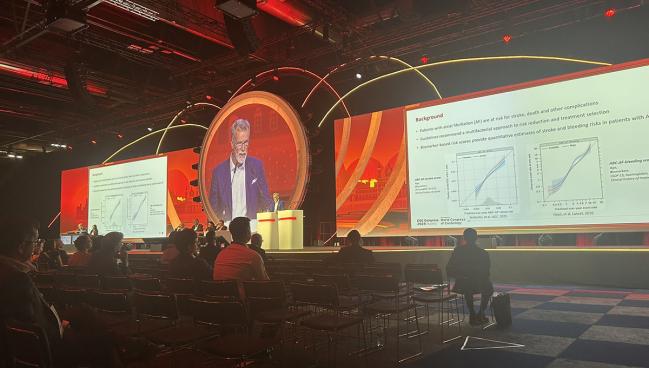
MADRID, Spain—A tailored treatment strategy based on the ABC-AF stroke and bleeding risk scores is no better than usual care for patients with atrial fibrillation (AF) and a low-to-moderate risk of stroke, according to the results of a randomized trial.
The rate of stroke or death over a median follow-up of 2.6 years in fact was numerically, but not significantly, higher in the intervention arm (3.18 vs 2.76 per 100 patient-years; P = 0.12), Jonas Oldgren, MD, PhD (Uppsala University, Sweden), reported recently at the European Society of Cardiology Congress 2025.
“We believe that these results emphasize the need for prospective testing of the utility of risk stratification and precision medicine tools in different clinical settings before implementation in routine care,” he said.
The findings were published simultaneously in Circulation.
The ABC-AF Study
Guidelines, including the latest out of Europe, recommend a multifactorial approach to risk reduction and treatment selection in patients with AF, Oldgren noted. Prior research has shown that biomarker-based risk scores—like the ABC-AF-stroke and ABC-AF-bleeding scores—improve risk estimates compared with established clinical scores, like CHA2DS2-VASc.
Oldgren and his colleagues set out to evaluate how guiding treatment decisions on the basis of the ABC-AF risk scores would impact outcomes among adults with AF who were included in the AURICULA AF quality registry. The investigators initially planned to include 6,500 patients, but enrollment was stopped early due to a trend toward higher mortality among patients with a CHA2DS2-VASc score of 3 or higher in the active arm and because there were indications that the tailored treatment strategy would be futile based on an informal assessment.
The trial ultimately included 3,933 patients (median age 74 years; 34% women). Roughly half (51.3%) had paroxysmal AF and 11.2% had a history of stroke/TIA. At baseline, 85.7% were already taking oral anticoagulation. With a median CHA2DS2-VASc score of 3, this was not a high-risk population, Oldgren noted.
For patients randomized to the individualized-therapy arm, treating physicians received individualized information on ABC-AF risk scores for stroke and bleeding, along with treatment recommendations that included the preferred direct oral anticoagulant (DOAC). For those in the control arm, management was left to the discretion of the site investigators.
After randomization, use of oral anticoagulation was high in both arms, with a significantly greater proportion on treatment in the tailored-treatment arm (98% vs 93%; P < 0.0001). Use of antiplatelet therapy declined in both groups, whereas use of statins increased, albeit to a greater extent in the intervention arm.
The primary outcome was a composite of stroke or death, with no between-group difference in that outcome, or a number of other endpoints, seen throughout follow-up.
Individualized vs Usual Care: Event Rates per 100 Patient-Years
|
|
Individualized (n = 1,971) |
Usual (n = 1,962) |
HR (95% CI) |
|
Stroke or Death |
3.18 |
2.67 |
1.19 (0.96-1.48) |
|
Stroke |
0.87 |
0.74 |
1.18 (0.78-1.79) |
|
Death |
2.44 |
2.02 |
1.21 (0.94-1.55) |
|
Major Bleeding |
2.82 |
2.61 |
1.08 (0.86-1.36) |
|
Stroke, Death, or Major Bleeding |
5.21 |
4.55 |
1.44 (0.96-1.36) |
The results for the primary outcome were similar across subgroups and, in a post-hoc analysis, across ABC-AF risk categories.
Eyeing Better Stroke Prevention Schemes
The discussant for the trial, Paulus Kirchhof, MD (University Heart and Vascular Center Hamburg, Germany, and University of Birmingham, England), said the ABC-AF study was the first of its kind, testing an AF management approach guided by a validated biomarker-based risk score. There was high adherence to therapy, and it was planned with adequate power to answer the question.
The study was limited, however, by the early termination, the low rate of stroke, the small difference in use of oral anticoagulation between trial arms, and other issues, Kirchhof said. The lower-than-expected stroke rate, he said, could be due to an overall trend of diagnosing not only more AF in general in contemporary practice, but more low-burden AF.
“I think the next steps will actually be to measure more biomarkers,” Kirchhof said. “Include genetics, include AF burden, and even apply [artificial intelligence] to come up with better stroke prevention schemes that are valid for the 21st century.”
Oldgren agreed. “I think we will do even better in the future, but we need to test the utility [of guided treatment approaches] in prospective trials,” he said. “We tend to go from risk stratification tools or precision medicine tools and then look at which treatments are available. But we do not test the entire system.”
To him, it is still worth developing improved risk scores, despite the neutral results of the ABC-AF study.
“We still can use more precise, quantifiable risk scores to tease out those patients with really high risk—for instance, still high risk for stroke while on an oral anticoagulant—to consider a left atrial appendage occluder or something else,” Oldgren said at a press conference. “But I think most of all, we need to learn how to use . . . and test precision medicine tools before implementation into clinical care.”

Todd Neale is the Associate News Editor for TCTMD and a Senior Medical Journalist. He got his start in journalism at …
Read Full BioSources
Oldgren J, Hijazi Z, Arheden H, et al. Biomarker-based ABC-AF risk scores for personalized treatment to reduce stroke or death in atrial fibrillation – a registry-based multicenter randomized controlled study. Circulation. 2025;Epub ahead of print.
Disclosures
- The trial was funded by grants from the Swedish Research Council, the Swedish Heart Lung Foundation, the Swedish Foundation for Strategic Research, and Roche Diagnostics, which also supplied instruments, biochemical assays, and laboratory support.
- Oldgren reports institutional research grants from Amgen, AstraZeneca, Bayer, Novo Nordisk, and Roche Diagnostics; advisory board fees from Regeneron; and lecture fees from Pfizer, paid to his institution.
- Kirchhof reports receiving consulting fees/honoraria from 3M Medica, AstraZeneca, Bayer, Boehringer Ingelheim, Boston Scientific, Bristol Myers Squibb, Cardiome, Daiichi-Sankyo, Johnson & Johnson, MEDA Pharma, Medtronic, Merck, Otsuka, Pfizer, Sanofi Aventis, Servier, Siemens, and Takeda; receiving research grants from the British Heart Foundation, the European Union, Fondation Leducq, the German Federal Ministry for Education and Research (BMBF), the German Heart Foundation (DHF), the German Research Foundation (DFG), 3M Medica, Cardiovascular Therapeutics, Daiichi-Sankyo, Pfizer/BMS, MEDA Pharma, Medtronic, Omron, Sanofi, and St. Jude Medical/Abbott; and having patents filed by the University of Birmingham and owned by UKE.
Related News



Comments