Anticoagulation Alone Is Best in AF Patients a Year or More Out From PCI
In ADAPT AF-DES, adding clopidogrel in the chronic phase of coronary disease had no ischemic benefit and increased bleeding.

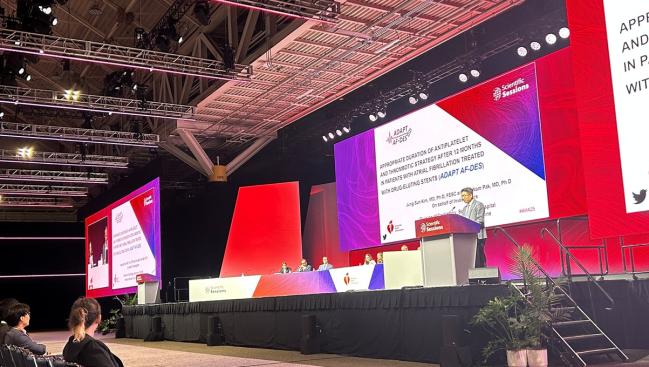
NEW ORLEANS, LA—Patients with atrial fibrillation (AF) who have stable coronary disease at least a year after undergoing PCI fare better when treated with direct oral anticoagulant (DOAC) monotherapy rather than a combination of a DOAC and clopidogrel, results from the ADAPT AF-DES trial show.
Overall net adverse clinical events (NACE) favored DOACs alone due to a lower risk of major or clinically relevant nonmajor bleeding, with the advantage meeting criteria for both noninferiority and superiority compared with the dual approach, Jung-Sun Kim, MD, PhD (Severance Hospital, Yonsei University College of Medicine, Seoul, Republic of Korea), reported here at the American Heart Association 2025 Scientific Sessions.
None of the other clinical outcomes differed between groups, although the rate of all-cause death was numerically higher in patients treated with both a DOAC and clopidogrel (4.0% vs 2.9%).
The findings, published simultaneously online in the New England Journal of Medicine, add to mounting evidence—from trials that include OAC-ALONE, AFIRE, PRAEDO-AF, EPIC-CAD, and AQUATIC—that antiplatelet therapy should be avoided in patients with AF and stable coronary disease once they are several months to years past PCI. Current guidelines recommend oral anticoagulation alone beyond 1 year after PCI in this scenario.
Gilles Lemesle, MD, PhD (CHU de Lille, France), lead author of the AQUATIC trial, discussed the ADAPT AF-DES results after Kim’s Main Event presentation. He shared results of a meta-analysis of the five prior trials, published simultaneously online in Circulation, showing a significantly higher NACE risk driven by a greater risk of bleeding and a nonsignificantly elevated risk of all-cause death with dual therapy.
Now, ADAPT AF-DES has “confirmed that no antiplatelet therapy should be used in chronic coronary syndrome patients receiving oral anticoagulation,” Lemesle said. “There is no benefit in terms of atherothrombotic events, and it harms a lot in terms of bleeding and death.”
The ADAPT AF-DES Trial
ADAPT-AF-DES, conducted at 32 centers in South Korea, included 960 patients (mean age 71.1 years; 21.4% women) who had AF, a CHA2DS2-VASc score of 2 or higher, and stable coronary disease and who were at least a year out from PCI involving implantation of a DES. They were randomized to DOAC monotherapy or dual therapy with a DOAC and clopidogrel. The DOACs most frequently used in the trial were apixaban (in about 62%) and rivaroxaban (in about one-third).
At baseline, the mean CHA2DS2-VASc score was 4.1, and roughly 60% of patients had persistent or permanent AF. About two-thirds of patients presented with ACS at the time of the index PCI, with roughly 25% of all interventions classified as complex. The median time between DES implantation and randomization was 32.8 months.
The primary NACE endpoint was a composite of all-cause death, MI, stent thrombosis, stroke, systemic embolism, or major or clinically relevant nonmajor bleeding, assessed at 12 months. The rate was 9.6% with DOAC monotherapy and 17.2% with dual therapy, an absolute difference of 7.6% (95.2% CI -11.9% to -3.3%). The difference established both the noninferiority of DOAC monotherapy versus dual therapy, with a 3% margin, and its superiority (P < 0.001 for both).
The only NACE component that differed between trial arms was major or clinically relevant nonmajor bleeding, which occurred in 5.2% of those treated with DOAC monotherapy and 13.2% of those treated with dual therapy (HR 0.38; 95% CI 0.24-0.60).
The primary NACE results were consistent across subgroups.
Timing Questions Remain
Kim pointed to several limitations of the trial, including the open-label design; the use of a noninferiority analysis, which suggests that the superiority results should be interpreted cautiously; the predominant use of apixaban and rivaroxaban, and not other DOACs; and the inclusion of a population from a single East Asian country.
In addition, the follow-up duration of 1 year may be too short to detect differences that may emerge over longer periods of time, he said, noting that trial participants will be followed out to 2 years.
Lemesle said the main novelty of ADAPT AF-DES compared with the prior trials is that its antiplatelet therapy exclusively involved clopidogrel, whereas the earlier studies almost all included aspirin. And it confirmed that bleeding risk is higher when using dual antithrombotic therapy, with no accompanying reduction in ischemic events.
In fact, there was a trend toward a higher rate of MI, as in the AQUATIC trial, he said, highlighting the potential contribution of bleeding to this finding. “These bleedings may lead to drug discontinuation, and then it may increase atherothrombotic events at the end,” he suggested.
The major remaining question, Lemesle said, is when antiplatelet therapy should be stopped after PCI in AF patients who require ongoing oral anticoagulation. It could be at 6 months as studied in AQUATIC, at 12 months as studied in the other trials, or even longer, he said, noting that, on average, patients were randomized into these studies more than 3 years after PCI.

Todd Neale is the Associate News Editor for TCTMD and a Senior Medical Journalist. He got his start in journalism at …
Read Full BioSources
Lee S-J, Yu HT, Lee Y-J, et al. Therapy for atrial fibrillation in patients with drug-eluting stents. N Engl J Med. 2025;Epub ahead of print.
Disclosures
- The trial was funded by the Cardiovascular Research Center and Samjin Pharmaceutical.
- Kim reports serving as a proctor for Abbott Korea; serving as a speaker for Philips; receiving institutional grants/contracts from Biosensors International Group, Daiichi Sankyo, Dio Medical, Samjin Pharmaceutical, Qualitech Korea, and Yuhan Pharmaceutical; and holding stock in Raywatt.
- Lemesle reports no relevant conflicts of interest.
Related News



Comments