AQUATIC: More Than 6 Months After PCI, Don’t Use Aspirin With OAC
The “antithrombotic sweet spot” means continuing with oral anticoagulation alone in the chronic phase, Renato Lopes says.

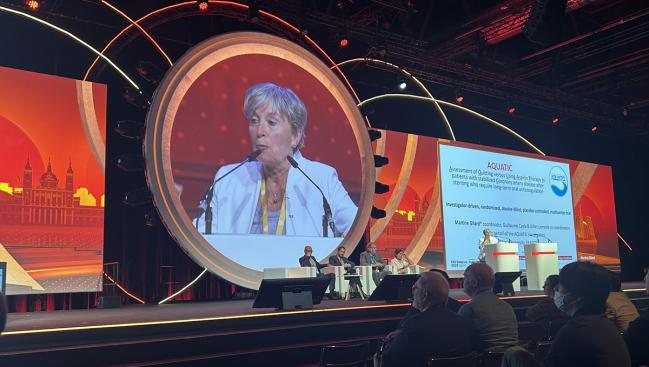
MADRID, Spain—Aspirin is harmful for patients with a chronic coronary syndrome, a high atherothrombotic risk, and an indication for oral anticoagulation (OAC) who are more than 6 months out from PCI, the French AQUATIC trial shows.
Compared with OAC alone, the combination of aspirin and an anticoagulant worsened clinical outcomes, driven by a higher risk of cardiovascular death, and increased major bleeding, Martine Gilard, MD, PhD (CHU Brest, France), reported here at the European Society of Cardiology Congress 2025.
These findings, published simultaneously online in the New England Journal of Medicine, come from the first double-blind, placebo-controlled trial exploring the impact of adding aspirin in patients with chronic coronary syndromes and need for long-term anticoagulation. They confirm the results of prior trials and extend them to a higher-risk European cohort consisting entirely of patients who had undergone PCI.
Gilard said the message is clear: “Stented patients on oral anticoagulation should not receive long-term aspirin even if they are at high atherothrombotic risk.”
The findings of the trial are not surprising, Roxana Mehran, MD (Icahn School of Medicine at Mount Sinai, New York, NY), vice president of the American College of Cardiology, commented to TCTMD. She noted, however, that some clinicians are still keeping their stented patients on a combination of aspirin and oral anticoagulation long-term.
“We as clinicians are difficult to change. If patients are doing well and they’re on an oral anticoagulant plus an aspirin because [their physicians are] worried about the stent, they just keep them on it,” Mehran said.
That’s despite the fact that guidelines and consensus documents have started to shift toward OAC monotherapy long term in these types of patients. “We see this over and over again in every single thing—it just takes time to change a clinician’s behavior of how they’re prescribing medicine and how they’re viewing the data,” she said.
Mehran predicted that the move away from aspirin will continue over the next few years. “Bleeding avoidance strategies are pretty important, and one of them is to drop aspirin, especially if you’re on an oral anticoagulant and more than 6 months outside of your stent procedure,” she said, noting that the requirement for antiplatelet therapy has diminished due to improvements in stent technology and in post-PCI outcomes overall.
The AQUATIC Trial
Patients who have both a chronic coronary syndrome and an indication for chronic OAC—commonly atrial fibrillation (AF)—have greater risks of both atherothrombotic and bleeding events, Gilard said, and the optimal antithrombotic regimen remains debated.
Prior trials—including OAC-ALONE, AFIRE, PRAEDO-AF, and EPIC-CAD—have indicated that antiplatelet therapy on top of OAC increases bleeding without providing a clear benefit on ischemic events. But those trials, Gilard noted, have been open-label, have included low-risk patients (some without a history of stenting), and have been conducted in Asian populations that can have atherothrombotic and bleeding risks that differ from Western populations.
The AQUATIC trial further explored the optimal antithrombotic regimen among patients enrolled at 51 French centers. Participants had chronic coronary syndromes, had received stents more than 6 months prior to enrollment, were currently treated with long-term oral anticoagulation, and had high atherothrombotic risk, defined as having undergone PCI for ACS or having at least one of the following factors: diabetes, chronic kidney disease, peripheral artery disease, multivessel coronary disease, complex PCI, or a history of stent thrombosis.
Stented patients on oral anticoagulation should not receive long-term aspirin even if they are at high atherothrombotic risk. Martine Gilard
Investigators aimed to enroll 2,000 patients, but the trial was stopped early based on the recommendation of the data and safety monitoring board due to excess mortality in the aspirin arm of the trial. Ultimately, the trial included 872 patients (mean age 72 years; 85.3% men) randomized to OAC plus aspirin 100 mg once daily or OAC plus placebo.
The median time from participants’ last PCI to enrollment was 3 years, with 27.7% having had their last procedure in the prior 6 to 12 months. Nearly three-quarters (72.1%) had a history of MI.
The indication for anticoagulation was AF in 89.0%, a history of venous thromboembolism in 4.8%, a mechanical heart valve in 1.1%, and other reasons in 5.1%. A direct oral anticoagulant (DOAC), most commonly apixaban (Eliquis; Bristol Myers Squibb), was used by 89.7%.
Before the trial, 67.7% of participants were being treated with a combination of a single antiplatelet and OAC, with the rest on OAC monotherapy.
The primary efficacy outcome was a composite of CV death, MI, stroke, systemic embolism, coronary revascularization, or acute limb ischemia. Through a median follow-up of 2.2 years, this occurred in 16.9% of patients taking aspirin plus OAC and 12.1% of those taking OAC alone (adjusted HR 1.53; 95% CI 1.07-2.18). The difference was primarily related to a higher rate of CV death in the aspirin arm (7.6% vs 4.3%), with no significant differences in the other individual outcomes or in stent thrombosis (0.2% in each group).
All-cause death also was higher when aspirin was added (13.4% vs 8.4%; adjusted HR 1.72; 95% CI 1.14-2.58).
The key safety outcome was ISTH major bleeding, which occurred more frequently in the presence of aspirin (10.2% vs 3.4%; adjusted HR 3.35; 95% CI 1.87-6.00).
Finding the Sweet Spot
Renato Lopes, MD, PhD (Duke University Medical Center, Durham, NC), the discussant for the study at the meeting, noted that anticoagulant-treated patients with AF who undergo PCI are commonly seen in clinical practice. Treating them is tricky, he said, because of the increase in major bleeding when combining antiplatelet and OAC therapies.
“This is a true lifelong issue that has not been fully addressed and affects millions of people,” Lopes said.
He said AQUATIC expands on the results of the prior trials, but he highlighted some issues to consider. Because the majority of patients had AF and were taking a DOAC, the applicability of the results to other patient groups, including those taking vitamin K antagonists, is uncertain. In addition, about 10% of patients did not complete follow-up, which is higher than current standards, Lopes said.
Nonetheless, Lopes came to a conclusion similar to Gilard’s. He calculated a number needed to harm with aspirin of 46 patients, which translates to 30,000 to 50,000 deaths caused by the antiplatelet each year among patients with coronary disease taking OAC.
“This trial really illustrates well why we need and we do randomized trials,” he said. “In this case, to find the antithrombotic sweet spot that in this population means stopping aspirin and continuing with OAC alone.”
Mehran said that with the availability of DOACs, “it’s really a no-brainer” to go with OAC alone because these agents have a better bleeding profile versus vitamin K antagonists, are effective at reducing ischemic events, and provide some thrombin inhibition as well. “There is this sort of dual pathway that I think makes aspirin less needed.”

Todd Neale is the Associate News Editor for TCTMD and a Senior Medical Journalist. He got his start in journalism at …
Read Full BioSources
Lemesle G, Didier R, Steg PG, et al. Aspirin in patients with chronic coronary syndrome receiving oral anticoagulation. N Engl J Med. 2025;Epub ahead of print.
Disclosures
- The trial was supported by a grant from the French Ministry of Health and by an unrestricted grant from Bayer Healthcare.
- Gilard reports no relevant conflicts of interest.
- Lopes reports receiving research contracts from Amgen, Bristol Myers Squibb, GlaxoSmithKline, Medtronic, Pfizer, and Sanofi-Aventis and having other financial relationships with Bayer, Boehringer Ingelheim, Bristol Myers Squibb, Daiichi-Sankyo, Novo Nordisk, and Pfizer.
Related News



Comments