Conduction-System Pacing Successful as First-line Option for AV Block: CSPACE
These randomized results are encouraging, although the field awaits longer-term data to see how the leads hold up.


Patients with atrioventricular (AV) block who don’t have an indication for cardiac resynchronization therapy (CRT) do better when treated with conduction-system pacing versus right ventricular septal pacing, according to results of the randomized CSPACE trial.
The rate of a composite clinical outcome was lower with the conduction-system approach, driven primarily by reductions in pacing-induced cardiomyopathy and a need for a biventricular CRT upgrade, researchers led by Chee Loong (Dominic) Chow, MBBS (University of Melbourne, Australia), report.
That benefit came at the cost of more lead revisions.
Taken together, the findings, published online ahead of the August 26, 2025, issue of JACC, support conduction-system pacing as an up-front technique, say researchers. Current practice guidelines contain class 2 recommendations to use such pacing in patients with AV conduction dysfunction who are expected to have a high ventricular pacing requirement, they note.
Speaking with TCTMD, Chow said that it’s become clear that conduction-system pacing—including His-bundle, left bundle branch, and LV septal pacing—can achieve a better ECG result than conventional RV pacing. “But there has been a lack of randomized controlled data to recommend conduction-system pacing as an up-front pacing technique over traditional pacemakers,” he added.
It might be time to consider revising guideline recommendations, which for now are based on nonrandomized evidence, Chow suggested. “I hope that by presenting this randomized controlled data, working groups around the world . . . can perhaps review the guideline recommendation and if the data is sufficient, upgrade it.”
Ratika Parkash, MD (Queen Elizabeth II Health Sciences Center, Dalhousie University, Halifax, Canada), who wrote an accompanying editorial with Kenneth Ellenbogen, MD (Pauley Heart Center, Virginia Commonwealth University, Richmond, VA), told TCTMD it’s not time to do that just yet, calling CSPACE an initial study.
“If we put everything together, it may not move the needle significantly,” she said, adding that larger studies powered to show reductions in heart failure likely are needed to support class 1 guideline recommendations.
However, CSPACE provides much-needed randomized data on important clinical outcomes and it “gives us more impetus to do this for patients,” Parkash said. Conduction-system pacing is already being used, she added, “and now we are getting to a point where we can actually tell our patients, ‘Okay, this is what we’re achieving by doing this.’”
The CSPACE Trial
CSPACE, conducted at two metropolitan hospitals in Melbourne, enrolled 202 patients (mean age 77 years; 33% women) with a pacing indication for AV block but no CRT indication, randomizing them to some type of conduction-system pacing (left up to the implanters) or RV septal pacing.
The most common pacing indications were complete heart block (40.1%) and symptomatic second-degree AV block (36.1%). At baseline, average LVEF was 60.9% and mean QRS duration was 124 ms.
Procedure time, fluoroscopy time, and radiation dose all were greater with conduction-system pacing. Procedural success was 88.1% in the conduction-system pacing group and 100% in the RV septal pacing group. Chow described the success rate with conduction-system pacing as “quite high,” adding that “hopefully this will encourage people to pursue this and not be deterred just by the nature of the population.”
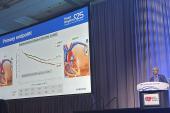
The primary outcome was a composite of pacing-induced cardiomyopathy, the need for an upgrade to biventricular CRT, heart failure hospitalization, or mortality. After a mean follow-up of 25.2 months, this was significantly less frequent in patients treated with conduction-system versus RV septal pacing (7.17 vs 20.69 events per 100 person-years; HR 0.35; 95% CI 0.19-0.64).
That difference was attributed to significantly lower rates of pacing-induced cardiomyopathy (4.58 vs 14.69 events per 100 person-years; HR 0.31; 95% CI 0.15-0.67) and CRT upgrade (0 vs 1.92 events per 100 person-years; HR 1.65e-9; 95% CI 0-∞). There were no significant differences between groups in heart failure hospitalization (0.48 vs 2.92 events per 100 person-years; HR 0.16; 95% CI 0.02-1.37) or all-cause mortality (2.86 vs 4.72 events per 100 person-years; HR 0.61; 95% CI 0.22-1.69).
Lead revision was more common with conduction-system pacing (7.9% vs 1.0%; P = 0.017), with five patients having macro-dislodgement and three chronically rising thresholds. With RV septal pacing, one patient had a rising threshold.
Chow noted that all these cases were manageable. “After revision, their thresholds came right down to a very appropriate, satisfactory level,” he said. “So they’re not irreversible complications, but it is an important secondary outcome that should be acknowledged and recognized.”
Roughly one-quarter of patients in each group developed new-onset atrial fibrillation (P = 0.971).
Implications and Unanswered Questions
Chow pointed out that patients who require pacemakers for standard AV block are commonly seen in clinical practice, “and to demonstrate superiority of one technique over the other is . . . quite helpful.”
Although procedure time, fluoroscopy time, and radiation dose favored traditional RV pacing, these parameters do improve with experience with conduction-system pacing, he noted. “Unless implanters are encouraged to try it, it’s not going to get better. So I think we should take these results and be encouraged.”
Moreover, the findings have implications beyond individual patients, Chow said. “Of course we’re very happy that the patients can avert heart failure, but overall, the health economic impacts of reducing heart failure diagnoses, reducing the need for biventricular upgrade, are . . . worth noting.”
We want to see longevity in those leads. Ratika Parkash
Information missing from CSPACE, Parkash said, are ECG and echocardiographic data to provide greater insights into the mechanisms behind conduction-system pacing, as well as longer-term results to see how well the leads hold up over time. “We want to see longevity in those leads. We want to see them not fracturing in the septum,” she said.
Though preliminary data on various leads suggest good long-term durability, further research will be necessary. “If we’re going to do this on everybody everywhere, we’ve got to have some definitive data, some harder outcomes, to really change and drive clinical practice,” Parkash said.
Chow noted that the CSPACE investigators plan on following these patients for 5 years. In the meantime, “even though it’s an immediate-to-short-term result,” he said, “it’s a very positive, very encouraging result to just encourage implanters to explore this technique.”

Todd Neale is the Associate News Editor for TCTMD and a Senior Medical Journalist. He got his start in journalism at …
Read Full BioSources
Chow CL, Wong C, Sutherland N, et al. Clinical outcomes of conduction system pacing vs right ventricular septal pacing in atrioventricular block: the CSPACE randomized controlled trial. JACC. 2025;86:563-573.
Parkash R, Ellenbogen KA. Mounting evidence for conduction system pacing in atrioventricular block ushers in a new era. JACC. 2025;86:574-576.
Disclosures
- The study received unrestricted funding from the National Heart Foundation (Australia) and the National Health and Medical Research Council.
- Chow reports support from a National Health and Medical Research Council scholarship and a National Heart Foundation grant.
- Parkash reports having received research grants from Medtronic and Abbott.
- Ellenbogen reports having received funding from Medtronic, Boston Scientific, and Zoll.
Related News

Comments