DOUBLE-CHOICE: Minimalist Anesthesia for TAVI Comparable to Standard Care
The trial showed this is a safe strategy, which may help overcome barriers to implementation in some centers, one expert says.

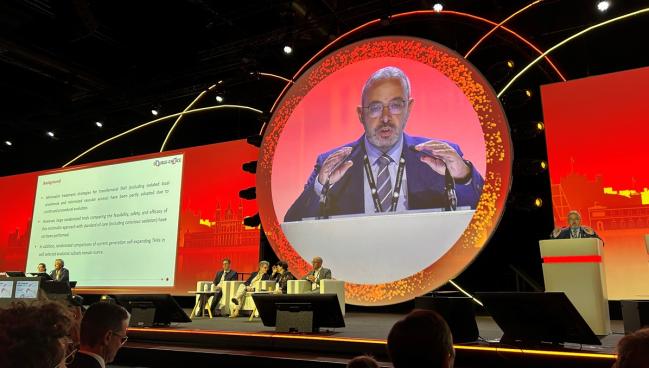
MADRID, Spain—A minimalist-anesthesia approach that forgoes sedation appears to be a good option for patients with severe aortic stenosis undergoing transfemoral TAVI, the DOUBLE-CHOICE trial shows.
At 30 days, the rate of all-cause mortality, vascular or bleeding complications, infections requiring antibiotic treatment, or neurologic events was 22.9% among patients treated using the pared-down approach and 25.8% among those managed with a standard strategy combining local anesthesia and conscious sedation.
The difference fell within the prespecified noninferiority margin of 6%, establishing support for the minimalist strategy (P = 0.003).
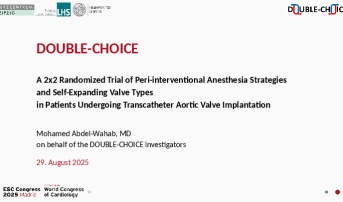
Eliminating sedation, as well as cutting back on use of urinary catheters and central venous and arterial lines, “appears to be feasible, safe, and efficient, although patients are potentially exposed to more discomfort and a higher stress level during the procedure,” Mohamed Abdel-Wahab, MD, PhD (Heart Center Leipzig at Leipzig University, Germany), reported here at the European Society of Cardiology Congress 2025.
Nearly one in every five patients crossed over from the minimalist to the standard approach, mostly due to pain or agitation. “Further analyses may—and should—help to identify subgroups where this approach is most or maybe least suited,” Abdel-Wahab said during a press conference.
The results were published simultaneously in Circulation.
Commenting on the findings, Stefan Toggweiler, MD (Heart Center Lucerne, Switzerland), said the rate of crossover from the minimalist to the standard approach was “quite high,” which he suggested might be because the anesthesiologist is routinely required to be in the room when TAVI is performed in Germany, where DOUBLE-CHOICE was conducted. “If you have the anesthetist in the room, . . . I think the threshold for initiating sedation is quite low.”
The goal, Toggweiler said, should be to perform TAVI without an anesthesiologist or anesthesia nurse present, as that will lower costs. At his center, for instance, he estimated that use of such a “lean” anesthesia approach without sedation reduces costs by about $1,000 per procedure.
This strategy also helps in planning procedures at centers with limited anesthesia capabilities, which can contribute to long waiting lists for TAVI, he added.
“I know many physicians would like to change from a standard to a minimalistic program, but they face very strong political and historical barriers,” Toggweiler said. “Now, this trial provides scientific evidence that this is a safe strategy and may thus help these physicians to achieve the change and to really start with a minimalistic program.”
The DOUBLE-CHOICE Trial
Minimalist protocols for transfemoral TAVI that eliminate sedation on top of local anesthesia have been adopted amidst continued evolution of the procedure, although there have been no large RCTs pitting the approach against the standard of care, which includes conscious sedation.
The DOUBLE-CHOICE study, conducted at 10 German centers, was a 2x2 factorial trial evaluating anesthesia strategies and also comparing two different self-expanding transcatheter heart valve types—the Acurate neo2 (Boston Scientific) and the Evolut Pro/Pro+/FX (Medtronic). Participants had symptomatic severe aortic stenosis, an indication for TAVI, suitability for transfemoral access, and anatomy amenable to treatment with either type of valve.
For the anesthesia part of the trial, investigators randomized 752 patients (median age 83 years; 58.5% women) at intermediate surgical risk (median STS score of 4.6%). Those randomized to the minimalist approach received local anesthesia without sedation, with use of central venous and arterial lines, as well as urinary catheters, discouraged. LV wire pacing, on the other hand, was encouraged. Standard care involved local anesthesia plus conscious sedation, with use of central venous and arterial lines and urinary catheters based on local standards.
In the minimalist arm, 19.5% of patients required a conversion to the standard approach. Of this group, 36.1% had pain, 22.2% procedural complications, and 13.9% agitation.
Regarding the primary composite endpoint, there were numerical advantages for the minimalist approach across most components, although none of the differences was significant. Secondary endpoints generally occurred at similar rates in the two arms, but patients who did not receive sedation reported more anxiety and stress during the procedure (P < 0.001).
To account for the high rate of crossover, the researchers also looked at per-protocol and as-treated analyses for the primary composite outcome, which showed greater differences favoring the minimalist approach. Abdel-Wahab noted, however, that these analyses were biased due to the fact that some of the patients who crossed over had complications.
Thomas Pilgrim, MD (Bern University Hospital, Switzerland), the discussant for the study, highlighted the need to have the appropriate system in place to offer minimalist TAVI, which “requires more preparation, more experience, and more expertise” than the standard approach. He noted that all participating sites in DOUBLE-CHOICE were high-volume centers with experienced heart teams and well-established treatment pathways. “At the same time, there was a high level of expertise in evaluating clinical risk and anatomical complexity.”
There is also a need to lower the crossover rate of nearly 20%, Pilgrim said. “Minimalist TAVI is feasible in the right setting and the right patient, but we need tools to optimize patient selection.”
The patient will understand everything that is discussed in the lab, and so communication becomes really important. Stefan Toggweiler
Toggweiler said it is possible use a minimalist approach in nearly all patients, noting that his center has a crossover rate below 5%. “What you have to learn as a team is that the patient is completely awake. The patient will understand everything that is discussed in the lab, and so communication becomes really important,” he said.
Even though an anesthesiologist isn’t in the room during TAVI at his center, there is a cath lab nurse who continually checks on the patient during the procedure and administers drugs if needed.
Centers interested in getting started with the lean approach to anesthesia could begin by trying it on healthier patients who are expected to have uncomplicated procedures and then expand from there, Toggweiler advised. “But the ultimate goal,” he added, “should be that you have all patients going through the same process.”
A Comparison of Self-Expanding Valves
The part of the trial comparing the Acurate neo2 and Evolut valves randomized 835 patients (median age 83 years; 57.9% women). Predilatation was more common with the Acurate neo2 (94.9% vs 61.9%; P < 0.001), with similar rates of postdilatation (30.1% vs 29.2%; P = 0.8).
The main endpoint for this comparison was a 30-day composite of all-cause mortality, stroke, moderate or severe prosthetic valve regurgitation, and permanent pacemaker implantation. The rate was about half with the Acurate neo2 (15.4% vs 30.4%), a difference that met criteria for both noninferiority and superiority (P < 0.001 for both).
There were low rates of all-cause mortality, stroke, and regurgitation with both devices, with the difference between groups driven by a lower rate of pacemaker implantation with the Acurate neo2 (11.2% vs 26.5%).
The clinical implications of this finding are unclear considering that manufacturer Boston Scientific decided to stop selling the Acurate neo2 valve in May following the disappointing results of the ACURATE IDE study and other trials.
“The Acurate neo2 valve has been recently withdrawn, but we believe that reductions in pacemaker implantation observed with this device indicate that aspects of its design could be used to inform future valve development,” Abdel-Wahab told the media.

Todd Neale is the Associate News Editor for TCTMD and a Senior Medical Journalist. He got his start in journalism at …
Read Full BioSources
Feistritzer H-J, Ender J, Lauten P, et al. Peri-interventional anesthesia strategies for transcatheter aortic valve implantation: a multicenter, randomized, controlled, non-inferiority trial. Circulation. 2025;Epub ahead of print.
Disclosures
- DOUBLE-CHOICE was funded by the Dr. Rolf M. Schwiete Foundation and the German Heart Research Foundation.
- Abdel-Wahab reports that his hospital received speaking honoraria and/or consulting fees on his behalf from Boston Scientific, Edwards Lifesciences, and Medtronic.
Related News

Comments