ENCIRCLE: Good Results With Sapien M3 Transseptal TMVR
Operators are excited about a device that avoids transapical access, a limitation of other systems, says Gilbert Tang.

SAN FRANCISCO, CA—Transcatheter mitral valve replacement (TMVR) with the novel Sapien M3 device (Edwards Lifesciences) is associated with low rates of adverse clinical outcomes and sustained reductions in mitral regurgitation (MR) in patients who are not eligible for other interventions, the single-arm ENCIRCLE trial shows.
The rate of all-cause death or heart failure (HF) hospitalization at 1 year, the primary endpoint, was 25.2%, coming in significantly lower than the performance goal of 45% derived from contemporary RCTs comparing mitral transcatheter-edge-to-edge repair (M-TEER) with optimized medical therapy (P < 0.0001).
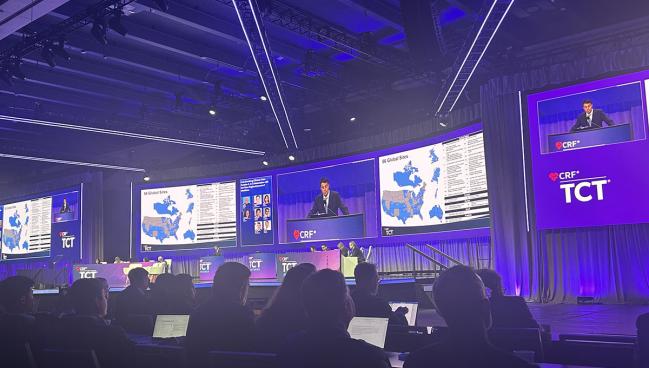
David Daniels, MD (Sutter Health California Pacific Medical Center, San Francisco), reported the ENCIRCLE trial today at TCT 2025. The findings were published simultaneously online in the Lancet.

All patients started the trial with MR grade ≥ 3+, but about 96% had MR grade 1+ or less by 30 days. The reduction in MR severity, which was sustained out to 1 year, was accompanied by significant improvements in patient-reported outcomes, including overall Kansas City Cardiomyopathy Questionnaire (KCCQ) score and NYHA functional class, and in 6-minute walk distance.
“The ENCIRCLE study is the first pivotal trial of a fully percutaneous TMVR [device] to achieve its primary endpoint,” Daniels concluded during a late-breaking clinical trial session. “The SAPIEN M3 system is a novel treatment option for patients who are unsuitable for mitral surgery or M-TEER, with low 30-day and 1-year mortality.”
TMVR has emerged as a treatment option for patients with symptomatic mitral valve disease who aren’t good candidates for surgery or other transcatheter therapies. There is one US Food and Drug Administration-approved TMVR system—Tendyne (Abbott). The device was approved earlier this year with a tightly defined indication: patients with moderate-to-severe MR, severe mitral stenosis, or moderate MR with moderate-or-greater mitral stenosis caused by mitral annular calcification (MAC) who are deemed unsuitable for surgery and have anatomy that is unfavorable for TEER.
Tendyne is delivered via a transapical approach. On the other hand, the Sapien M3 valve, which has CE Mark approval in Europe but has not been cleared by the FDA, is delivered via a fully percutaneous, transseptal approach.
Gilbert Tang, MD (Mount Sinai Health System, New York, NY), lead author of accompanying editorial in the Lancet, told TCTMD that “what the community has been frustrated by is that transapical is not the solution for TMVR because of the morbidity involved and the high mortality associated with that.”
The ENCIRCLE findings show that, at least numerically, outcomes appear to be better with the transseptal Sapien M3 system than with Tendyne and other transapical systems, Tang said. “It’s very exciting to have a TMVR system that’s transfemoral and percutaneous, that’s able to reduce the MR to a high degree. And actually these patients do feel better afterwards. So I think that is why people are so excited about this.”
The ENCIRCLE Trial
ENCIRCLE, conducted in 56 centers in the United States, Canada, the United Kingdom, the Netherlands, Israel, and Australia, included patients who had moderate-to-severe or severe MR (≥ 3+) and NYHA functional class ≥ II symptoms. All were deemed by a heart team to be unsuitable for surgery or commercially available transcatheter options because of clinical, anatomic, or technical considerations.
The main cohort included 299 patients (median age 77 years; 49% female), most with secondary MR (58.3%). The mean STS predicted risk of 30-day mortality for mitral valve replacement was 6.6%, with 28.8% of patients being considered high risk with a score of 8% or higher. Three-quarters of patients had congestive heart failure, 70% had atrial fibrillation (AF), 18.7% had had a prior stroke or TIA, and 8.7% had undergone a prior surgical mitral valve repair. MAC was detected in 24%.
The device implant was completed in 96% of patients. There were no conversions to surgery, implants of a second valve, or left ventricular outflow tract (LVOT) obstructions resulting in hemodynamic compromise. No patients died during the procedure, although there were two deaths and four strokes that occurred during the initial hospitalization. Patients were anticoagulated for at least 6 months after the procedure.
At 30 days, the mortality rate was 0.7%, which was about one-tenth of the STS predicted risk. By 1 year, 13.9% of patients had died and 16.7% had been hospitalized for HF.
The ENCIRCLE study is the first pivotal trial of a fully percutaneous TMVR [device] to achieve its primary endpoint. David Daniels
Most patients (73%) had an improvement in NYHA class, and 88% were in class I/II by 1 year. Overall KCCQ score improved by a mean 18.4 points and 6-minute walk distance by a mean 14.4 meters.
The safety of the procedure was similar to what’s been seen with TEER, the researchers say. Through 1 year, 5.5% of patients required a new pacemaker, 6.7% had clinically significant valve thrombosis, 39.4% had any MVARC-defined bleeding, 18.5% had MVARC major or worse bleeding, and 9.3% had a stroke, including disabling strokes in 3.9%. Moreover, hemolysis requiring reintervention occurred in 7.1%. The majority of these cases (81%) resolved after reintervention, but the remaining patients had ongoing hemolysis at the time of death.
Daniels noted that this was “an overall sick patient population,” pointing to the baseline STS score. In addition, he said, patients had a high bleeding risk both because of protocol-mandated anticoagulation for at least 6 months and because most patients had a requirement for anticoagulation due to AF.
Still, “patients with inadequate anticoagulation, irrespective of type, had a higher stroke risk, underlying the need to be sure our patients were taking anticoagulation when possible,” Daniels said, noting that patients who were not sufficiently anticoagulated also had a higher rate of device-related thrombosis.
Daniels emphasized that “this wasn’t a patient population that could reasonably be treated by other means. We had patients who really . . . were unsuitable for TEER and unsuitable for surgery.” Although either of those options could have been used, he added, the patients “were really, in the judgment of the investigators and based on our experience, not going to have a good outcome with either one of those.”
Expanding Treatment Options
Michael Young, MD (Dartmouth Hitchcock Medical Center, Lebanon, NH), a site investigator for ENCIRCLE, told TCTMD that there are many patients who don’t have a lot of options—either surgical or transcatheter—because of age, frailty, or anatomical complexity.
“The exciting part about this is it just adds another tool in the toolbox for us to treat these patients who are sick, symptomatic, and in heart failure,” said Young, who is a member of the American College of Cardiology Vascular Disease Council. “I think it expands our capabilities to treat anatomies that we haven’t been able to really treat well before.”
Moving forward, it will be important to ensure that the Sapien M3 remains durable over time and that the right oral anticoagulation regimens are used for the appropriate amount of time, Young said.
TMVR definitely has a role in patients who are not suitable for TEER and also with anatomy amenable for replacement. Gilbert Tang
Regarding the relatively high rates of stroke and hemolysis observed, he noted that Sapien M3 is a first-generation device, adding that future iterations and new products should mitigate those risks. Those events also are somewhat related to the older and sick population studied in ENCIRCLE, he said.
Young predicted that, if approved, TMVR with the Sapien M3 system initially would expand on the number of patients with severe MR who could be treated rather than cut into the population being treated with M-TEER. “You’ll see probably a slower but real rise in the number of patients who can be treated,” he said.
In his editorial, Tang points to several issues that will influence the adoption of TMVR in the future, including the high screen failure rates, management of stroke and device thrombosis, the prevention of hemolysis related to paravalvular leak, and longer-term clinical and echocardiographic outcomes.
“Being able to optimize device and procedural safety, as well as establish valve durability, will determine how quickly TMVR moves from promise to practice,” he writes.
For now, the key takeaway for Sapien M3, Tang told TCTMD, “is that you have to choose the anatomy very carefully and also do the procedure in an optimized manner such that you do not have paravalvular leak. Because if you have paravalvular leak, you can risk hemolysis and that will be a very bad outcome for the patient.”
Overall, “TMVR definitely has a role in patients who are not suitable for TEER and also with anatomy amenable for replacement,” Tang said, adding, however, that “there will still be a significant percentage of patients who, unfortunately, will not be optimal candidates for TEER and TMVR. We need to improve on the technology to be able to tackle that population.”

Todd Neale is the Associate News Editor for TCTMD and a Senior Medical Journalist. He got his start in journalism at …
Read Full BioSources
Guerrero ME, Daniels DV, Makkar RR, et al. Percutaneous transcatheter valve replacement in individuals with mitral regurgitation unsuitable for surgery or transcatheter edge-to-edge repair: a prospective, multicountry, single-arm trial. Lancet. 2025;Epub ahead of print.
Tang GHL, Zaid S, Hahn RT. Transfemoral TMVR: turning promise into practice. Lancet. 2025;Epub ahead of print.
Disclosures
- ENCIRLE was funded by Edwards Lifesciences.
- Daniels reports acting as a consultant and proctor for Edwards Lifesciences.
- Tang reports having has received speaking honoraria and serving as a physician proctor, consultant, advisory board member, TAVR publications committee member, RESTORE study steering committee member, APOLLO trial screening committee member and IMPACT MR steering committee member for Medtronic; having received speaking honoraria and serving as a physician proctor, consultant, advisory board member, ENVISION trial screening committee member and TRILUMINATE trial anatomic eligibility and publications committee member for Abbott Structural Heart; having served as an advisory board member for Boston Scientific, a consultant and physician screening committee member for Shockwave Medical, and a consultant for Philips, Edwards Lifesciences, Peija Medical, and Shenqi Medical Technology; and having received speaking honoraria from Siemens Healthineers.
- Young reports consulting and speaking for Boston Scientific and Edwards Lifesciences.
Related News


Comments