HELP-MI SWEDEHEART: Routine H. Pylori Screening Doesn’t Lessen Bleeding After MI
The data do, however, hint at the benefit of a more tailored approach focusing on groups with higher bleeding risks.

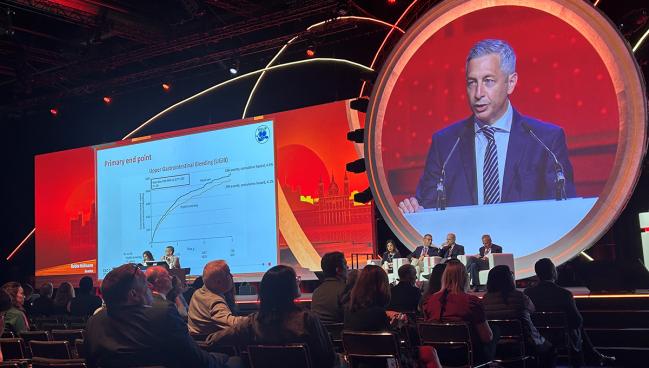
MADRID, Spain—Routine screening for Helicobacter pylori infection across a broad range of patients hospitalized with acute MI does not significantly reduce rates of upper GI bleeding, the HELP-MI SWEDEHEART trial shows.
Through a median follow-up of 1.9 years, the rate of upper GI bleeding was 4.1% among patients who underwent screening for the infection and 4.6% among those who didn’t (rate ratio 0.90; 95% CI 0.77-1.05), Robin Hofmann, MD, PhD (Karolinska Institutet, Stockholm, Sweden), reported here at the European Society of Cardiology Congress 2025.
However, the findings, published simultaneously online in JAMA, indicate a possible benefit of screening for H. pylori when infection prevalence is higher, use of proton pump inhibitors (PPIs) is lower, and patients have a higher baseline risk of bleeding.
Such screening cannot “generally be recommended in all patients,” Hofmann said at a press conference. “However, H. pylori testing during the hospitalization period for myocardial infarction appears to be a meaningful addition to usual care in patients with elevated risk of upper gastrointestinal bleeding, for example, as indicated by concomitant anemia or kidney failure. Further analyses and new studies are needed to define the optimal target population.”
The HELP-MI SWEDEHEART Trial
Over the past several decades, there have been improvements in the risk of subsequent cardiovascular events after an MI, Hofmann said. The trend has plateaued a bit in recent years, possibly due to increases in bleeding complications, particularly outside the hospital, he added, noting that the upper GI tract is the most frequent source of bleeding.
H. pylori, one of the most common infections in the world, comes with an increased risk of upper GI bleeding, which is exacerbated by antiplatelet therapies used to treat patients with coronary disease.
In HELP-MI SWEDEHEART, investigators tested whether routine screening for H. pylori would have an impact on upper GI bleeding post-MI. The trial included 18,466 patients (median age 71; 29% women) with type 1 MI who were discharged alive and registered in the SWEDEHEART registry. They came from 35 hospitals in Sweden that were organized into 18 clusters around existing PCI networks.
Those clusters were randomized to H. pylori screening with urea breath testing on top of usual care or usual care alone for 1 year, after which the assignments were switched.
One-third of patients had had a prior MI and 27% had a history of PCI. At admission, roughly one-quarter of patients were taking aspirin and one-quarter were taking a PPI. At discharge, PPI use was high in both groups—56.3% among those in the screening arm and 49.3% in the control arm.
In the screening group, 70.1% actually underwent breath testing for H. pylori, revealing a prevalence of infection of 23.6%. Nearly all patients who tested positive (96.6%) were prescribed standard triple therapy with antibiotics and PPIs for eradication.
Overall, screening did not significantly reduce the rate of upper GI bleeding or a variety of secondary clinical outcomes, with the results holding up in sensitivity analyses.
The findings were largely consistent across subgroups, although there were indications that screening could lessen bleeding in certain patient groups, such as the 14% with anemia (P = 0.03 for interaction), or the 24% with kidney failure (P = 0.08 for interaction).
Per-protocol analyses also hinted at a beneficial impact of screening, although the findings were not statistically significant.
‘A Clinically-Relevant Positive Trial’
Paul Ridker, MD (Mass General Brigham, Boston, MA), the discussant for the study, said, “I’m going to actually argue that while technically it’s published as a neutral study, I actually think this might be a clinically-relevant positive trial,” noting that there’s good biologic rationale for conducting H. pylori screening.
He said the most important part of the study, from a clinical perspective, is the subgroup analysis showing that patients with at least mild anemia appeared to benefit from screening. “The very patients I’m most concerned about, [those] I don’t want to bleed, are there.”
There are some remaining questions, Ridker said, pondering what might have happened if the prevalence of infection or adherence to screening had been higher or if the use of PPIs hadn’t been so frequent at baseline or discharge, particularly in the control group.
To conclude, he agreed with the assessment that the results of HELP-MI SWEDEHEART cannot rule out a benefit of screening under certain scenarios.
At this point, H. pylori screening “should probably not be introduced for everyone, everywhere,” Hofmann said following Ridker’s comments. “But if you have an individual at higher risk of bleeding . . . it would be reasonable to test and eradicate,” he said, again referencing patients with anemia or renal failure.
He pointed out during the press conference, too, that the breath test used to detect infection is simple, noninvasive, and inexpensive.

Todd Neale is the Associate News Editor for TCTMD and a Senior Medical Journalist. He got his start in journalism at …
Read Full BioSources
Hofmann R, James S, Sundqvist MO, et al. Helicobacter pylori screening after acute myocardial infarction: the cluster randomized crossover HELP-MI SWEDEHEART trial. JAMA. 2025;Epub ahead of print.
Disclosures
- The study was funded by grants from the Swedish Research Council, the Swedish Heart Lung Foundation, and Region Stockholm.
- Hofmann reports receiving grants from the Swedish Heart Lung Foundation and Region Stockholm, as well as lecture and advisory board fees from AstraZeneca and MSD/Pfizer outside the submitted work.
- Ridker reports no relevant conflicts of interest.
Related News



Comments