INFINITY-SWEDEHEART: ‘Unlocking’ Device Bests DES Over Time
Bioadaptor was designed to restore normal vessel function and reduce late stent-related complications. It’s working so far.

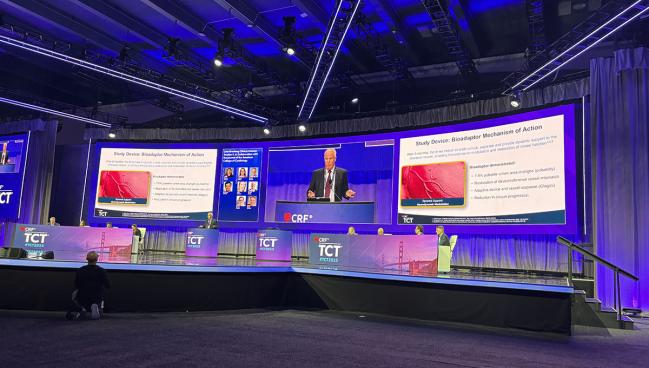
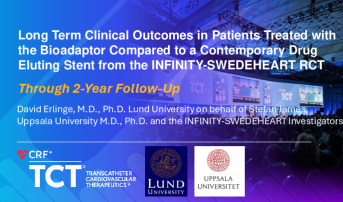
SAN FRANCISCO, CA—Use of a novel “unlocking” coronary device is associated with nearly a 50% reduction in the risk of target lesion failure between 6 months and 2 years, according to a landmark analysis of the INFINITY-SWEDEHEART randomized trial presented this week at TCT 2025.
The DynamX Bioadaptor (Elixir Medical), a device that doesn’t quite fit within the existing molds of current DES, drug-coated balloons (DCBs), or bioabsorbable scaffolds, also was associated with a lower rate of TLF in the subset of patients who presented with acute coronary syndromes.
Investigators led by David Erlinge, MD, PhD (Lund University, Sweden), have already shown the device is noninferior to a conventional DES (Resolute Onyx; Medtronic) at 1 year in 2,400 patients treated at 20 sites in Sweden. This analysis, he said, is designed “to prove the biological function of opening up the Bioadaptor.”
The sirolimus-eluting device is made up of three metallic helical strands joined circumferentially by a thin PLLA-bioresorbable polymer. The polymer is resorbed over 6 months, which unchains the scaffold and disconnects the three helical strands. Unlocking the scaffold is meant to help the vessel get back to normal function while the disengaged cobalt-chromium strands provide scaffolding support.
In the first 6 months, the device behaves like any other DES, said Erlinge. Once unlocked, the hope is that the new technology can mitigate the 2% to 4% annual risk of stent-related events associated with conventional DES.
The prespecified primary endpoint of TLF—a composite of cardiac death, target-vessel MI, and clinically driven target lesion revascularization—between 6 months and 2 years was 1.47% in the Bioadaptor group and 2.81% in the DES arm (HR 0.52; 95% CI 0.29-0.93). Numerically, rates of the individual components of TLF favored the Bioadaptor. Rates of definite/probable stent thrombosis were low in both arms (0.43% with Bioadaptor vs 0.51% with DES). In ACS patients, there was also a significant reduction in the risk of TLF with Bioadaptor.
“It’s rather fascinating how the curve starts to diverge around 6 months and that divergence is maintained up to 2 years,” said Erlinge.
Minimizing Risk of Late Events
Donald Cutlip, MD (Beth Israel Deaconess Medical Center, Boston, MA), who discussed the trial after the late-breaking science presentation, said the “leave nothing behind” strategies have struggled to show that they reduce the late complications seen with DES.
“We haven’t really shown that we make a difference, and this is the first trial to do that,” he said. “My main concern is what this will look like over time.”
Despite the inclusion of ACS patients, Cutlip said the investigators included a relatively low-complexity population, noting that patients with severe calcification, chronic total occlusions, and left coronary artery disease were excluded.
One question that emerged during discussions is where the device might fit in the future. Earlier this week at TCT, the SELUTION DeNovo investigators showed that a sirolimus-coated balloon (Selution; Cordis) was as good as a DES at 1 year when used in a broad population of patients with de novo coronary disease. Cutlip, who led the SELUTION4ISR study, said “it’s going to be about the late data” when it comes to how well DCBs, Bioadaptor, and, potentially, new bioabsorbable scaffolds, perform against contemporary DES.
Robert Byrne, MBBCh, PhD (Mater Private Hospital, Dublin, Ireland), a panelist during the late-breaking science session and media briefing, told TCTMD the different technologies will complement, rather than replace, DES. Róisín Colleran, MBBCh (Mater Private Hospital), another panelist, said that the field has reached a pinnacle where new devices are challenged to show an advantage over contemporary DES.
“I think we’re probably moving more towards hybrid strategies,” agreed Colleran, noting that it will be advantageous to have a range of devices in addition to DES available for use.
She questioned the lack of data on 2-year outcomes, saying that while the landmark analysis was appreciated, it’s unusual to see those results without the context of the full 2-year results.
In response, Erlinge said the landmark analysis was the prespecified focus of their trial as they wanted to determine when the clinical events occur. In the other BIOADAPTOR randomized trial, which included 445 patients, there was a significant reduction in the risk of TLF at 2-year and 3-year follow-up.
However, given the equivalence of the two devices in the first 6 months in INFINITY-SWEDEHEART, it likely takes away any significant advantage with Bioadaptor at the 2-year mark, said Erlinge. He expects to see a clinical benefit with the device emerge over time, with INFINITY-SWEDEHEART planned for 5-year follow-up.
The DynamX Bioadaptor device received CE Mark approval in 2019 in Europe and was granted breakthrough device designation from the US Food and Drug Administration in 2024 for the treatment of ischemic coronary heart disease.

Michael O’Riordan is the Managing Editor for TCTMD. He completed his undergraduate degrees at Queen’s University in Kingston, ON, and…
Read Full BioSources
Erlinge D, on behalf of the INFINITY-SWEDEHEART investigators. Long-term clinical outcomes in patients treated with the Bioadaptor compared to a contemporary drug-eluting stent from the INFINITY-SWEDEHEART RCT. Presented at: TCT 2025. October 27, 2025. San Francisco, CA.
Disclosures
- Erlinge reports consulting for Amgen, AstraZeneca, Chiesi, Sanofi-Aventis, Novo Nordisk, InfraredX/Nipro, and Kaminari Medical.
Related News


Comments