Sirolimus DCB in Peripheral Disease Makes Strides in Hard Outcomes: SirPAD
For femoropopliteal and BTK patients, the sirolimus balloon was associated with fewer limb events at 1 year than POBA.

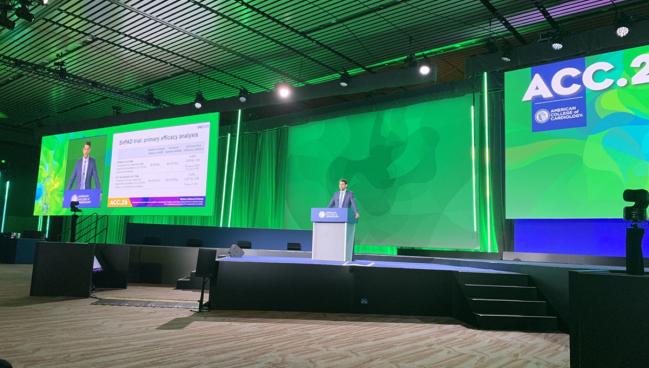
NEW ORLEANS, LA—A balloon coated with sirolimus yields better clinical outcomes than an uncoated balloon when used in endovascular interventions for symptomatic peripheral vascular disease, according to results of the SirPAD trial of patients with femoropopliteal or below-the-knee (BTK) PAD.
At 1 year, rates of the primary outcome of major adverse limb events (MALE) were 8.8% in those treated with the MagicTouch sirolimus drug-coated balloon (DCB; Concept Medical) and 15% in those treated with any commercially available uncoated balloon (P for noninferiority < 0.001; P for superiority = 0.009).
SirPAD is now the largest RCT to show a benefit of sirolimus-based therapy in an all-comers PAD population, said Stefano Barco, MD, PhD (University Hospital Zurich, Switzerland), in a late-breaking trial presentation this week at the American College of Cardiology 2026 Scientific Session.
The results were simultaneously published in the New England Journal of Medicine.
Douglas Drachman, MD (Massachusetts General Hospital, Boston), who wasn’t involved in the research, said he was impressed by the impact the DCB had on hard outcomes in a population where over 40% had chronic limb-threatening ischemia (CLTI), particularly since not all severe vascular disease of that type presents the same.
“If someone has a deep penetrating ulcer in the heel, it’s a little different than a superficial ulcer on the toe,” he said, adding that such heterogeneity can make adjudication of MALE difficult. In the trial, MALE was defined as the composite of unplanned major amputations affecting the target limb or target-lesion revascularization for CLTI.
Barco said all major and minor amputations were thoroughly adjudicated, noting that “the incidence of any amputation—planned or unplanned—was reduced in the sirolimus group.”
This trial puts to rest the question of whether or not there’s an efficacy signal with sirolimus. Sahil Parikh
Commenting for TCTMD, Sahil Parikh, MD (NewYork-Presbyterian/Columbia University Irving Medical Center, New York, NY), agreed with Drachman that the results are the most impressive so far for a limus-based treatment in all comers with PAD.
“I think this trial puts to rest the question of whether or not there’s an efficacy signal with sirolimus,” he added. While Barco said no formal assessment of primary patency was done in the trial, Parikh said the results are suggestive of patency advantages beyond the positive shift in hard outcomes.
The trial, he added, now puts this DCB in position to potentially change clinical practice, at least for European vascular specialists who have access to it. In the United States, MagicTouch is currently in pivotal Food and Drug Administration Investigational Device Exemption trials.
Paclitaxel-coated DCBs, which have long been the gold standard therapy in PAD, have come under fire in recent years due to a meta-analysis suggesting a long-term mortality signal. No study has confirmed the observations from the original meta-analysis, and studies from Parikh and others have all but refuted it with evidence from numerous data sets, including a patient-level, pooled meta-analysis with 5-year follow-up that showed no evidence of an increased risk of death.
In the United States, Parikh said the majority of endovascular operators seem satisfied with the validations of paclitaxel safety and with the decision of the FDA in August 2023 to lift the previously placed restrictions.
Limus-based therapies, including sirolimus, became the focus of increasing interest while the vascular community tried to understand the paclitaxel signal and while waiting for the restrictions on paclitaxel DCB use to be eased. As Barco noted in his presentation, however, no endovascular therapy, including paclitaxel-based technologies, has ever shown a reduction in MALE. Plus, he added, paclitaxel isn’t indicated for use in BTK lesions, leaving open the door for sirolimus to carve new territory in PAD treatment.
“The reason [paclitaxel] has never been shown to reduce MALE is that most of the studies were done with surrogate outcomes and focusing on patients with claudication rather than with critical limb ischemia,” Barco said.
‘A Very Promising Trend’
SirPAD investigators randomized 1,252 patients (median age 75 years; 35.1% women) at 44 vascular care centers in Switzerland. Approximately 40% of patients had undergone a prior endovascular revascularization, about two-thirds were on antiplatelet therapies, one third were on an anticoagulant, and 66% were on lipid-lowering therapy.
The median length of index target lesion was 150 mm, and PAD was limited to the femoropopliteal arteries in about 70% of patients in both treatment groups.
The rate of any unplanned amputation affecting the target limb or revascularization of the target lesion for critical or noncritical limb ischemia (the composite secondary outcome) was 23.0% in the sirolimus DCB group and 30.8% in the uncoated-balloon group (P for superiority = 0.002). Additionally, the individual components of the composite secondary outcome were lower with sirolimus than the uncoated balloon.
While no clinical improvement of one or more Rutherford categories was seen at 6 months, there was a 4-percentage point advantage for the sirolimus DCB at 1 year.
All-cause death rates were 11.8% in the sirolimus-treated group and 12.8% in the uncoated-balloon group at 1 years (superiority P = 0.67). No differences were seen between groups in serious adverse events or serious adverse device effect.
Speaking in a media briefing, Osama Ibrahim, MD (Vanderbilt Health, Tullahoma, TN), said SirPAD represents “a remarkable accomplishment” in a disease space that affects close to a quarter of a billion individuals globally.
“This is a very promising trend that we are seeing,” he said, adding that not many investigators would have been willing to mount a trial with the complexity of peripheral disease patients included in SirPAD.
“I look forward to the implications of this technology [for] below-the-knee, especially with the reduction we’ve seen in major amputation,” Ibrahim said.
The ongoing LIMES trial is assessing the Magic Touch device in German and Austrian patients presenting with documented chronic CLTI, defined as Rutherford clinical category 4, 5 or 6, in the target limb. All patients in that trial have lesions located below the P3 segment of the popliteal artery to the tibiotalar joint.
To TCTMD, Parikh said subgroup analyses from the BTK cohort of SirPAD could give an early peak into what to expect from LIMES.
He added that SirPAD confirms the observations seen in the SIRONA trial, which demonstrated noninferiority of the MagicTouch device in comparison to seven commercially available paclitaxel-based DCBs in the treatment of femoropopliteal lesions.
“So, what we can say now is MagicTouch is approximately equal to paclitaxel, which is much better than plain balloon angioplasty in the [superficial femoral artery],” Parikh said. “For BTK, this is still an open question . . . and that’s the space with the most unmet need at the moment. For below-the-knee, limus agents are very promising.”

L.A. McKeown is a Senior Medical Journalist for TCTMD, the Section Editor of CV Team Forum, and Senior Medical…
Read Full BioSources
Barco S, Engelberger RP, Held U, et al. Sirolimus-coated balloon angioplasty for infrainguinal artery disease. N Engl J Med. 2026;Epub ahead of print.
Disclosures
- Barco reports receiving consult fees/travel from Boston Scientific, Penumbra, Concept Medical, INARI, and Viatris.
- Parikh reports serving on advisory boards for Abbott, Boston Scientific, Cordis, Medtronic, and Philips; receiving institutional research funding from Abbott, Boston Scientific, Surmodics, TriReme Medical, Shockwave Medical, Reflow Medical, Acotec, R3 Vascular, and Concept Medical; consulting for Terumo, Inari, Penumbra, Canon and Abiomed; and having equity in Advanced Nanotherapies, eFemoral, and Encompass Vascular.
Related News
Comments