Smartwatch Increases AF Diagnosis in Older, High-risk Patients: EQUAL
Though the trial demonstrates the feasibility of the approach, future research is needed to assess the clinical impact.

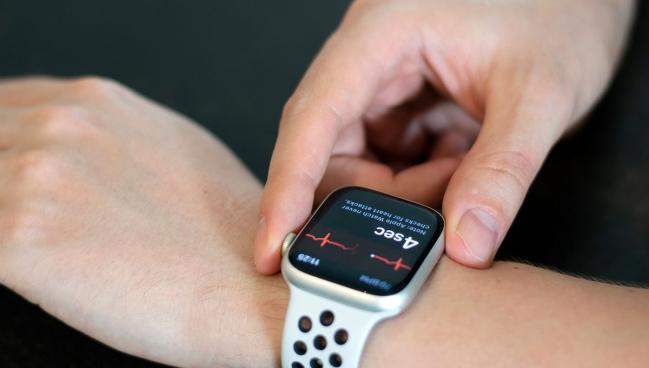
The use of consumer smartwatches within telemonitoring boosts new diagnoses of atrial fibrillation (AF) compared with standard approaches in older patients who are at high risk for stroke, the randomized EQUAL trial shows.
Patients assigned to wear an Apple Watch equipped with both photoplethysmography (PPG) and single-lead ECG functions were more likely than those randomized to standard care to have AF episodes lasting at least 30 seconds detected during 6 months of follow-up (9.6% vs 2.3%; HR 4.40; 95% CI 1.66-11.66), lead author Nicole van Steijn, MD (Amsterdam University Medical Centre, University of Amsterdam, the Netherlands), and colleagues report.
Most of the episodes uncovered in the smartwatch arm (57.1%) came in the absence of symptoms, whereas all episodes in the control arm were symptomatic, according to results published online this week in JACC.
“By embedding consumer wearables into telemonitoring workflows, this study provides a scalable model for integrating digital screening into routine cardiology practice,” the investigators write. “While this trial establishes feasibility and diagnostic benefit, the clinical impact of treating screen-detected or subclinical AF awaits confirmation in ongoing outcome trials.”
They note that ongoing trials like REGAL and SAFER will provide additional insights into whether treatment of screen-detected AF will ultimately reduce risks of stroke, heart failure, or cognitive decline. Prior trials, like STROKESTOP and LOOP, have had mixed results.
EQUAL is “an interesting study and it’s where we need to be, because the diagnosis of atrial fibrillation is moving from a traditional office-based, hospital-based diagnosis to medical-grade ambulatory devices to now consumer-grade wearables,” T. Jared Bunch, MD (University of Utah Health, Salt Lake City), commented to TCTMD. “A lot of the diagnosis now is made outside of the medical environment by a technology that people can buy. And so we really have to understand how these tools can be of benefit and who they can benefit, and then how to integrate them into a traditional medical workflow.”
Bunch is on the executive committee of the Heartline study, which will be reported as a late-breaking clinical trial at the upcoming American College of Cardiology 2026 Scientific Session at the end of March. That study is examining, in more than 34,000 older adults, how an app-based program with the Apple Watch impacts early diagnosis of AF and clinical outcomes.
The EQUAL Trial
Michiel Winter, MD, PhD (Amsterdam University Medical Centre, University of Amsterdam), senior investigator of EQUAL, pointed out that the European AF guideline recommends screening for AF in patients who have a high risk for stroke, including those who are at least 65 years old and have a risk factor or are 75 years or older. “But the guideline does not explicitly say how we should screen those patients. And so, in the real world, we don’t because we don’t know how to [do it best],” he told TCTMD.
Implantable loop recorders reliably detect AF, but they’re invasive. Noninvasive approaches like handheld single-lead ECG devices and wearable ECG patches work as well, but they also have limitations that include, respectively, the need for active participation or potential skin irritation.
Wearable devices like smartwatches are another noninvasive option. The Apple Heart Study, for instance, showed that the Apple Watch could detect AF in an all-comers population. Until EQUAL, however, there had been no randomized controlled trials evaluating smartwatch-based screening for AF specifically in an older population at high risk for stroke and using a device with both PPG and ECG functionality.
EQUAL, conducted at two secondary care centers in the Netherlands, included 437 patients 65 and older (mean age 75 years; 46.7% women) who had an elevated stroke risk defined by a CHA2DS2-VASc score of at least 2 in men and 3 in women (median overall was 3). Patients were randomized to standard care according to physician discretion or to AF monitoring with a smartwatch.
Patients in the intervention arm were given an Apple Watch Series 5 or 8 and asked to wear it at least 12 hours per day while awake. They were instructed to record a 30-second ECG when they had symptoms or received an irregular pulse notification from the watch. These recordings were transmitted to the HartWacht telemonitoring app, where they were reviewed within 24 hours by an eHealth team consisting of two trained cardiac nurses. Suspected arrhythmias were discussed with a supervising cardiologist and, if confirmed as AF or another clinically relevant arrhythmia, prompted a phone call with the patient to assess symptoms. All treatment decisions were made by the treating cardiologist.
Patients wearing the smartwatch submitted a median of 21 ECG tracings during the 6-month study. Roughly a quarter of patients (27.4% in the intervention arm and 22.9% in the control arm) underwent standard forms of rhythm monitoring.
Smartwatch monitoring boosted the AF detection rate by an absolute 7.3% over 6 months, translating into a number needed to screen of 14. Winter said his team was happy to see similar detection of AF in this study compared with prior studies using implantable loop recorders. “It’s much easier to screen, obviously, using these devices than the implantable loop recorders,” he noted.
Of the 37 patients who had at least one smartwatch ECG initially labeled AF, 20 were diagnosed with clinical AF and 17 were not, yielding a positive predictive value of 54%.
All patients diagnosed with AF were started on oral anticoagulation.
There was a numerically, but nonsignificantly, lower rate of emergency department visits in the smartwatch arm (5.9% vs 8.3%; OR 0.70; 95% CI 0.34-1.47). There were two major adverse cardiovascular events in each group: one stroke and one cardiovascular death in the smartwatch arm and two NSTEMIs in the control arm. The study, however, was not powered to detect differences in clinical outcomes.
“I think that the most important thing is that we have shown feasibility of population-based screening using a smartwatch in a high-risk population for atrial fibrillation for the first time,” Winter said.
What’s Next?
Bunch said that an important question that patients ask when they come in with an AF alert from their smartwatch is about the response. “What’s the impact of the diagnosis from this technology really is going to be the next field of research,” he said, adding that Heartline will help provide some insights.
The effects of anything that follows device-detected AF has to be weighed against the potential for anxiety that can be induced in patients when they receive an alert, Bunch noted, who said that it’s not uncommon to have inaccurate readings from smart devices. “I think those issues are a matter of technology to solve,” he added, “and it is getting better and better at . . . diagnosing atrial fibrillation.”
Overall, “for people over 65 that have high blood pressure, diabetes, higher stroke risk, coronary artery disease, a higher risk for atrial fibrillation, [wearables are] extremely valuable tools to diagnose atrial fibrillation,” said Bunch. “This trial showed that we can’t rely on symptoms alone to use tools that we need to prompt to activate, that these wearable devices can help in those patients.”
EQUAL had relatively short follow-up, but about 10% of these patients had AF detected within 6 months, Bunch underscored. “With those rates of diagnosis in higher-risk patients, we should be able to really help them be more healthy, lower AF-related comorbidities, improve survival, and help them feel better,” he said. “I think this is a very nice study in these high-risk patients that has the potential to really impact how we manage patients.”

Todd Neale is the Associate News Editor for TCTMD and a Senior Medical Journalist. He got his start in journalism at …
Read Full BioSources
Van Steijn NJ, Blommestijn IS, Blok S, et al. Enhanced detection and prompt diagnosis of atrial fibrillation using Apple Watch: a randomized controlled trial. JACC. 2026;Epub ahead of print.
Disclosures
- The Bob Vlake Foundation provided direct financial support for the study (cash contribution) and Apple loaned the Apple Watch devices used in the research.
- Van Steijn and Winter report receiving a travel grant from Apple to cover travel expenses to present at a scientific conference.
Related News


Comments