Triple Agonist Appears Promising for Patients With Severe Hypertriglyceridemia
The drug, given as a weekly subcutaneous injection, reduced both triglycerides and liver fat in the phase II trial.

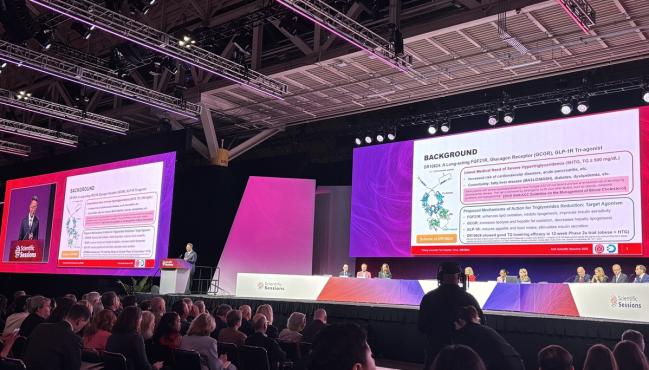
NEW ORLEANS, LA—DR10624, an investigational drug designed to reduce triglycerides among patients with severely high levels, performed well in a phase II trial, researchers announced today at the American Heart Association 2025 Scientific Sessions.
The drug, delivered as a weekly subcutaneous injection, targets three receptors linked to how the body processes fats and sugars—fibroblast growth factor 21 (FGF21), glucagon, and glucagon-like peptide-1 (GLP-1). In the double-blind study, it lowered not only triglycerides but also liver fat.
“DR10624 was safe, tolerable, and efficacious in patients with severe hypertriglyceridemia,” Jianping Li, MD, PhD (Peking University First Hospital, Beijing, China), said in a press conference. He noted that the condition “is a risk factor for acute pancreatitis, cardiovascular disease, and liver disease.”
Karol Watson, MD, PhD (UCLA Health, Los Angeles, CA), during the media briefing, said she’s excited to see results from the study, which addresses an important clinical need. “As someone who runs a lipid clinic, I can tell you hypertriglyceridemia is becoming our most vexing problem,” she commented, asking Li to elaborate on which mechanisms might be driving the benefits.
Li said the fundamental question is which of the three receptors contributes the most to triglyceride reduction: “Is it because of fatty acid oxidation, decreased lipogenesis, or lipolysis? I think it’s very hard, based on the current data, to [understand], but to me, I think most of the effects come from FGF21.”
Changes in lipid levels suggest that very low density lipoprotein cholesterol is being converted to LDL, he explained. Given this, it would make sense for patients to also take statins in addition to DR10624, Li and Watson agreed. Notably, the medication also has yet to be compared head-to-head against other triglyceride-lowering therapies.
All Three Doses Outperformed Placebo
At 35 centers in China, the phase II trial enrolled 79 patients (mean age 46 years; 88.6% male) with severe hypertriglyceridemia (500-2,000 mg/dL) who were stable on background lipid-lowering therapies or taking none. Median body mass index was 27.9 kg/m2, 25.3% had type 2 diabetes, median triglyceride level was 832.5 mg/dL, and median liver fat content was 12.0%.
Participants were randomized to weekly DR10624 at one of three doses (12.5 mg, 25 mg, or 50 mg titration) or placebo for 12 weeks.
With each of the three doses, patients saw decreases in fasting triglyceride levels between baseline and 12 weeks, the study’s primary endpoint. Median changes were -74.5% for 12.5 mg, -66.2% for 25 mg, and -68.9% for 50 mg, all significantly greater than the 8.0% reduction seen with placebo. Most patients (89.5%) taking DR10624, as compared with only a quarter of those taking placebo, saw their triglycerides drop below 500 mg/dL.
As someone who runs a lipid clinic, I can tell you hypertriglyceridemia is becoming our most vexing problem. Karol Watson
DR10624 also decreased liver fat content, with median relative reductions of -63.2% with 12.5 mg, -53.7% with 25 mg, and -67.0% with 50 mg. With placebo, the reduction was -8.4%.
Improvements were seen in levels of total, HDL, non-HDL, and triglyceride-rich lipoprotein cholesterol. LDL increased, Li noted, while apolipoprotein B held steady.
As with other medications that target GLP-1, the most common side effects were gastrointestinal.
Limitations of the study, said Li, are that it was small, of short duration, and conducted only in China. “Additional clinical studies are needed, which should include more participants from diverse parts of the world and last for a longer period in order to confirm the findings in this phase II trial,” he noted.
The current results, Li said, support further study of DR10624 in larger cohorts of patients with severe hypertriglyceridemia as well as those with metabolic dysfunction-associated steatohepatitis.

Caitlin E. Cox is Executive Editor of TCTMD and Associate Director, Editorial Content at the Cardiovascular Research Foundation. She produces the…
Read Full BioSources
Li J. DR10624, a first-in-class, FGF21 receptor/glucagon receptor/GLP-1 receptor triple agonist, rapidly and significantly reduced triglycerides, atherogenic lipids and liver fat in patients with severe hypertriglyceridemia: primary results from a randomized phase 2 trial. Presented at: AHA 2025. November 8, 2025. New Orleans, LA.
Disclosures
- Li reports no relevant conflicts of interest.
Related News


Comments