COVID-19: TCTMD’s Dispatch for April Week 3
We’re curating a list of COVID-19 research and other useful content, and updating it regularly.


Since March 2020, TCTMD reporter Todd Neale has been writing up breaking news and peer-reviewed research related to COVID-19 every weekday. In July 2021, we transitioned to Mondays, Wednesdays, and Fridays. If you have something to share, tell us. All of our COVID-19 coverage can be found on our COVID-19 Hub.
April 21, 2022
 One of the largest studies to date, pooling national registry data on more than 23 million people in four Nordic countries, affirms that the risk of myocarditis after mRNA-based COVID-19 vaccination—though low overall—was higher among people who received the Moderna shot than it was with the one from Pfizer/BioNTech. Males ages 16 to 24 were most likely to develop vaccine-associated myocarditis within 28 days of vaccination and “the risk is clearly higher for Moderna,” senior author Rickard Ljung, MD, PhD, told TCTMD’s Todd Neale. The study was published yesterday in JAMA Cardiology.
Two days ago, a federal judge in Florida struck down the mask mandate for passengers on planes, trains, buses, and other forms of public transportation. Yesterday, the Biden administration appealed the decision with the backing of the US Centers for Disease Control and Prevention (CDC), which maintains mask-wearing remains “necessary” to protect the public. The court decision “set off a rush among airlines, some public transit systems and even Uber and Lyft to abandon mask requirements. Some pilots announced the abrupt change midflight, prompting celebration—but also anxiety—among virus-weary passengers,” the New York Times reports.
A new AP/NORC poll, meanwhile, suggests that the majority of Americans still support mask requirements on transport. “Fifty-six percent of Americans favor requiring the public [to wear] masks on planes, trains, buses, and other means of public transportation, compared with 24% who oppose and 20% who don’t have an opinion about the requirement. Americans are also more likely to favor than oppose requiring people at crowded public events and workers who interreact with the public to wear face masks.”
Researchers writing in Nature Medicine have a theory as to why a third dose of an mRNA vaccine may help protect against severe infection from Omicron, even though the vaccine itself was not specifically designed to protect against this strain. The answer, they say, likely lies in increased memory B cell potency and breadth after a third vaccine dose.
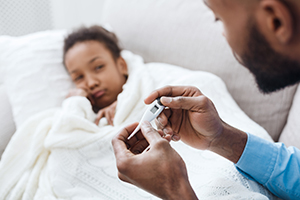 When the Omicron variant first rose to dominance between mid-December 2021 and the end of February 2022, rates of hospitalization due to infection were roughly twice as high among unvaccinated children ages 5 to 11 as they were among those who’d had their jabs, researchers report in Morbidity and Mortality Weekly Report. What’s more, fully 30% of hospitalized children had no underlying medical conditions and nearly one in five were admitted to intensive care. “Non-Hispanic Black children represented the largest group of unvaccinated children,” the authors note. “Children with diabetes and obesity were more likely to experience severe COVID-19.” A New York Times story has more.
In an audio interview in the New England Journal of Medicine, editors discuss what physicians need to know about the effects of COVID-19 on children and adolescents to provide advice to parents.
Also in the NEJM this week, two long-acting antibodies derived from B cells donated by patients who recovered from SARS-CoV-2 infection, being developed as a combination intramuscular injection by AstraZeneca, show promise for reducing severe illness in adults at risk due to subpar vaccine efficacy and/or COVID-19 exposure. Interim results from an ongoing, randomized, phase III trial of the monoclonal antibody combination tixagevimab and cilgavimab (AZD7442), showed that a single dose of the agent reduced the incidence of symptomatic COVID-19 by a relative 77% on or before day 183, as compared with participants taking placebo. “Extended follow-up at a median of 6 months showed a relative risk reduction of 82.8% (95% CI 65.8-91.4),” the authors write. “Five cases of severe or critical COVID-19 and two COVID-19-related deaths occurred, all in the placebo group.”
Prior symptomatic infection with COVID-19 in unvaccinated individuals appears to confer an 85% lower risk of acquiring subsequent COVID-19, as compared with unvaccinated people without prior infection. “This level of protection is similar to that reported for mRNA vaccines,” authors of a new cohort study write in JAMA Network Open. “The findings that patients with prior COVID-19 had 88% protection against hospitalization for COVID-19 and 83% protection against COVID-19 not requiring hospitalization suggest that natural immunity was associated with similar protection against mild and severe disease.”
 Just months after issuing authorizations for the use of monoclonal antibodies to prevent progression of disease in confirmed SARS-CoV-2 infection, health authorities around the world have been second-guessing their decisions or retracting authorizations altogether. Sotrovimab is the latest agent to lose its luster; back in January, the US Food and Drug Administration (FDA) dropped its authorizations for both REGEN-COV (casirivimab and imdevimab) and the combination treatment of bamlanivimab and etesevimab because of “markedly reduced activity” against the Omicron variant BA.1. In a BMJ news analysis, Elisabeth Mahase explains why these biologicals are not performing as well against Omicron substrains as they did against the earlier variants, and what the future holds for this class of treatment.
April 18, 2022
Economic stimulus packages helped the birth rate rebound, resulting in only a short-lived global downturn in babies being born between the end of 2020 and the first half of 2021, according to a report from the Financial Times. By late 2021, the United States, the Nordics, Australia and Israel all reported birth rates “returning to, and in some cases exceeding, the prepandemic trend in what demographers said was a catch-up effect.”
China’s President Xi Jinping continues to insist on a “COVID zero” strategy and is continuing with lockdowns in many major cities even as new data released today show retail and property sales declining plus urban unemployment rising, Bloomberg reports. In Shanghai, tensions are boiling over among citizens who have been in lockdown for weeks. Reuters says some are lashing out, accusing neighbors of being COVID positive and insisting they be sent to centralized quarantine despite negative at-home tests.
Late last week the US Food and Drug Administration (FDA) issued an emergency use authorization for a COVID-19 breath test, the first of its kind. In a study of over 2,400 individuals with and without symptoms, the InspectIR COVID-19 Breathalyzer (InspectIR Systems) had 91.2% sensitivity and 99.3% specificity to detect the virus in samples, with a negative predictive value of 99.6%. The FDA says the test can be performed in doctors’ offices, hospitals, and mobile testing sites, noting that the breathalyzer instrument is about the size of a piece of carry-on luggage.
In Brazil, where President Jair Bolsonaro has maintained a denialist attitude toward COVID-19, a new study shows 30% higher COVID-19 infection rates and 60% higher mortality in areas of the country where he won the electoral vote. The study is scheduled to be presented next week at the European Congress of Clinical Microbiology & Infectious Diseases.
Having a psychiatric disorder is associated with increased risk of breakthrough COVID-19 infection in fully vaccinated individuals, according to a large study of US veterans published last week in JAMA. In the group of mostly men, the highest risks were in those age 65 and older, with larger effect sizes seen in those with adjustment disorder and substance use disorders across all age groups.
 The United Kingdom has a new COVID-19 vaccine with the approval of the first whole-virus inactivated vaccine (VLA2001, Valneva). The UK’s Medicines and Healthcare products Regulatory Agency (MHRA) says the lab-grown vaccine only needs to be stored at temperatures similar to that of a domestic refrigerator, making it appropriate for use in areas where storage at very low temperatures is not possible.
A third dose of a mRNA COVID-19 vaccine is not more likely to cause more severe adverse events than a two-dose regime, according to data from electronic health records of nearly 50,000 people published in JAMA Network Open. The third dose was associated with increased reporting of low-severity adverse events such as fatigue, lymphadenopathy, nausea, and headache, however.
A new type of vaccine designed to elicit a deeper T-cell response against SARS-CoV-2 may offer hope for immunocompromised patients who often do not have enough of a demonstrable antibody response after receiving currently available vaccines. As STAT reports, researchers at the American Association for Cancer Research conference last week said their study of 14 people, 12 of whom had leukemia or lymphoma, showed a measurable T-cell response in 93% at 28 days.
A survey about vaccine hesitancy in pregnancy found that the two primary concerns were related to the long-term effects of the vaccine and belief in the ability of maternal vaccination to confer immunity to infants. Writing in JAMA Network Open, researchers suggest that local and national health campaigns should provide real-time access to the growing scientific evidence showing transplacental and breastmilk antibody transfer after vaccination, adding: “It is also important to continue research maintaining vaccination in pregnancy registries and publish data on long-term health outcomes of vaccinated pregnant people and their infants.” 
Data from the National Patient-Centered Clinical Research Network (PCORnet) reassures that the overall risk of cardiac complications is low after both SARS-CoV-2 infection and mRNA COVID-19 vaccination. As Shelley Wood reports, the study published in Morbidity and Mortality Weekly Report found that even among males aged 12 to 17, the risk of cardiac complications after testing positive for SARS-CoV-2 was higher than after vaccination.


Todd Neale is the Associate News Editor for TCTMD and a Senior Medical Journalist. He got his start in journalism at …
Read Full BioRelated News


Comments