COVID-19: TCTMD’s Dispatch for December Week 2
We’re curating a list of COVID-19 research and other useful content, and updating it regularly.


Since March 2020, TCTMD reporter Todd Neale has been writing up breaking news and peer-reviewed research related to COVID-19 every weekday. In July 2021, we transitioned to Mondays, Wednesdays, and Fridays. If you have something to share, tell us. All of our COVID-19 coverage can be found on our COVID-19 Hub.
December 17, 2021
Countries around the world are imposing new travel restrictions and dropping others in an effort to contain Omicron. The United Kingdom is reporting its highest daily case count of the entire pandemic to date (78,610 on Wednesday), prompting France to imposed a ban on nonessential travel to and from its neighbor. Spain announced it would be closing its borders to unvaccinated UK travelers. Canada has reinstated a blanket ban on nonessential travel, ended the ban it had imposed on 10 African countries, but brought back mandatory negative, pre-arrival tests.
While Omicron is believed to be behind the spike in cases seen in many parts of the globe, in South Africa vaccines as well as high levels of prior exposure appear to be limiting the variant’s impact. Hospitalizations and deaths are up in South Africa, due to surging Omicron and Delta, but according to health minister Joe Phaahla, quoted in the Guardian: “We believe that it might not necessarily just be that Omicron is less virulent, but . . . coverage of vaccination [and] natural immunity of people who have already had contact with the virus is also adding to the protection. That’s why we are seeing mild illness.” Summer temperatures in the southern hemisphere may also be limiting spread, unlike the trends seen in northern hemisphere countries, where social interaction has headed indoors.
A new report from the Imperial College London COVID-19 response team indicates that Omicron is likely to cause infections similar those caused by the Delta variant, but that the strain is more than five times more transmissible. “The study finds no evidence of Omicron having lower severity than Delta, judged by either the proportion of people testing positive who report symptoms, or by the proportion of cases seeking hospital care after infection,” a press release states. “However, hospitalization data remains very limited at this time.” Worryingly, protection against Omicron afforded as a result of prior COVID-19 infection may be as low as 19%.
The US Centers for Disease Control and Prevention (CDC) has endorsed advice from its Advisory Committee on Immunization Practices (ACIP) that preferentially recommend an mRNA vaccine over Johnson & Johnson’s COVID-19 shot. “The US supply of mRNA vaccines is abundant—with nearly 100 million doses in the field for immediate use, a CDC release explains. “This updated CDC recommendation follows similar recommendations from other countries, including Canada and the United Kingdom.”
As a STAT story explains, ACIP made the recommendation unanimously after reviewing evidence indication that there have been 54 cases of thrombosis with thrombocytopenia syndrome (TTS) in the US, leading to nine confirmed deaths (and an additional two suspected deaths). “About 17 million doses of the vaccine have been used in the United States,” Helen Branswell reports. Though cases have been reported across a range of ages, “the highest rate is among women in their 30s and 40s. In that age group, there have been approximately two deaths from TTS per 1 million doses of J&J vaccine administered.”
The Novavax adjuvanted, recombinant spike protein nanoparticle vaccine (NVX-CoV2373) demonstrated more than 90% efficacy against infection and 100% efficacy against moderate or severe illness in the randomized, placebo-controlled PREVENT-19 trial of nearly 30,000 subjects in the US and Mexico, researchers reported yesterday in the New England Journal of Medicine. Follow-up in the trial was just 3 months and Alpha was the most commonly sequenced variant. “Most breakthrough cases were caused by contemporary variant strains,” they note.
Also in the NEJM, the MOVe-OUT randomized trial with molnupiravir (Merck Sharp and Dohme), a small-molecule ribonucleoside prodrug of N-hydroxycytidine, showed that the agent reduced the risk of serious disease or death in at-risk, unvaccinated adults who contracted COVID-19. Hospitalization or death among patients randomized to molnupiravir was 6.8% as compared with 9.7% in placebo-treated patients (95% CI -5.9 to -0.1).
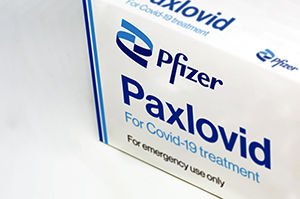 The European Medicines Agency (EMA) has authorized preapproval use of Pfizer’s protease inhibitor Paxlovid (PF-07321332 and ritonavir) for adults with COVID-19 who do not require supplemental oxygen and who are at increased risk of progressing to severe disease. The drugs should be administered in combination within 5 days of symptoms and taken twice daily for 5 days.
Of note, both Paxlovid and molnupiravir are orally bioavailable medications, something that a NEJM editorial predicts will become “essential tool[s] for physicians in the management of this horrible disease.”
The EMA has also extended indications for Sobi’s Kineret (anakinra) and issued a new authorization for the monoclonal antibody GlaxoSmithKline’s Xevudy (sotrovimab) for the treatment of COVID-19. The latter is authorized “in adults and adolescents (from 12 years of age and weighing at least 40 kilograms) who do not require supplemental oxygen and who are at increased risk of the disease becoming severe.”
In what may be a rare silver lining for breakthrough infections in the fully vaccinated, a research letter in JAMA indicates that while COVID-19 is typically mild in these cases, it does confer a big boost to immunity. Moreover, vaccine boosters “with antigenic inserts matching the emerging SARS-CoV-2 variants” could bolster immunity still further.
The American Heart Association has announced a $10 million dollar research initiative to study lingering effects of COVID-19 on the heart and lungs. “The Mechanisms Underlying Cardiovascular Consequences Associated with COVID-19 and Long COVID grants will fund researchers to identify and study the underlying basic mechanisms that cause cardiac, vascular and cerebrovascular complications among COVID-19 patients,” a statement reads. “Additionally, studies will look at why some people (estimated at 10% to 30% of patients) are more susceptible to the lingering effects of the virus well beyond the initial 2-to-3 weeks expected recovery, a condition known as long COVID.” Grant applications can be submitted between now and February 1, 2022.
 As at least one editor of the COVID-19 Dispatch can already attest, dog ownership has softened many of the pandemic’s blows. Now researchers writing in PLOS One make it official: “Our results suggest that dog ownership may have provided people with a stronger sense of social support, which in turn may have helped buffer some of the negative psychological impacts caused by the COVID-19 pandemic.”
TCTMD Managing Editor Shelley Wood contributed today’s Dispatch.
December 15, 2021
Globally, the incidence of COVID-19 cases and deaths declined last week, although Africa saw a 111% increase in new cases and the Western Pacific region had a 7% rise, according to the latest epidemiological update from the World Health Organization (WHO). The Omicron variant continues to spread, however, and it’s now been confirmed in 76 countries. Evidence is still limited, but it appears Omicron has a growth advantage over Delta and that vaccines will not be as effective against it. The WHO says Omicron-related risk “remains very high.”
 In the United States, Omicron is growing in prevalence, with the variant accounting for 2.9% of sequenced cases in the week ending December 11, according to data from the Centers for Disease Control and Prevention (CDC). Delta still accounts for 96.7% of cases, but the proportion related to Omicron is up from zero the week before. The new figure “is likely to increase dramatically, given the pattern in other countries,” STAT reports. “When better-spreading variants enter a new area with other viral iterations circulating, it can take weeks for them to account for even a few percent of all cases. But from there, their prevalence can skyrocket.” Across the Atlantic, a European Union official said Wednesday that Omicron is expected to be the dominant variant in the region by mid-January (Associated Press).
Total COVID-19 deaths in the United States just passed 800,000, a year after the first vaccines became available (Associated Press). And without those vaccines, it could have been much worse, according to an updated report from the Commonwealth Fund: “In the absence of a vaccination program, there would have been approximately 1.1 million additional COVID-19 deaths and more than 10.3 million additional COVID-19 hospitalizations in the US by November 2021.” Millions of infections, and their potential for long COVID, were prevented as well, according to the authors, who write: “These estimates of vaccination impact may seem startlingly high. But they are consistent with the extraordinary effectiveness of vaccines.”
Among the population with confirmed COVID-19, the percentage of asymptomatic infections is 40.5%, according to a meta-analysis of studies covering nearly 30 million individuals published in JAMA Network Open. That proportion was higher in pregnant women (54.1%), air/cruise travelers (52.9%), and nursing home residents or staff (47.5%). “The high percentage of asymptomatic infections highlights the potential transmission risk of asymptomatic infections in communities,” the authors say.
 Some large US healthcare systems, including Cleveland Clinic, HCA Healthcare, and Intermountain Healthcare, are dropping—at least temporarily—vaccine requirements for their workers as legal wrangling over a federal mandate continues, according to the Wall Street Journal. As a story in the New York Times notes, “the moves are likely to slow down efforts to quell the latest surge in infections, potentially worsened by holiday traveling, large gatherings indoors, and the introduction of the Omicron variant.”
Another study—published in Nature Medicine—confirms that the risk of myocarditis is much higher after a SARS-CoV-2 infection than after receipt of a COVID-19 vaccine. The researchers estimated an additional two, one, and six myocarditis events per million people receiving first doses of vaccines from Oxford/AstraZeneca, Pfizer/BioNTech, or Moderna, respectively, and an extra 10 events per million after a second Moderna shot. That compares with an additional 40 myocarditis events per million people with a positive SARS-CoV-2 test. The infection also was tied to increases in pericarditis and cardiac arrhythmias; on the vaccine side, only a second dose of Moderna’s vaccine was linked to arrhythmias.
Final results from a phase II/III trial of Pfizer’s oral COVID-19 treatment—Paxlovid—support earlier interim results, with an 89% reduction in the risk of hospitalization or death in nonhospitalized, high-risk adults with COVID-19 treated within 3 days of symptom onset, the company announced Tuesday. Pfizer avoided what was seen with the oral COVID-19 pill from Merck and Ridgeback Biotherapeutics, in which estimates of efficacy dropped between the interim and final results. STAT has more.
 A booster dose of the Janssen vaccine from Johnson & Johnson may be considered at least 2 months after the first dose in adults, according to new guidance from the European Medicines Agency (EMA). A press release notes that “the risk of thrombosis in combination with thrombocytopenia (TTS) or other very rare side effects after a booster is not known and is being carefully monitored.” On Wednesday, the US Food and Drug Administration (FDA) announced that it has modified fact sheets accompanying the vaccine to include a contraindication in people with a history of TTS following this vaccine or any other adenovirus-vectored COVID-19 vaccine.
A series of papers in PNAS explores the role auxiliary data sources have played in tracking the COVID-19 pandemic: “The articles in this collection demonstrate how data, from medical testing devices, medical insurance claims, internet search trends, app-based mobility data, and online surveys, can provide a realistic and timely understanding of the pandemic's evolution. Modeling efforts using auxiliary data streams not only complement traditional public health surveillance systems but also enhance the resolution and mapping of the pandemic.”
Yet another trial has failed to demonstrate a significant benefit from using convalescent plasma in patients hospitalized with COVID-19. In CONTAIN COVID-19, published in JAMA Internal Medicine, the treatment did not boost the odds of clinical improvement on day 14 or day 28. Exploratory analyses suggested that high-titer convalescent plasma may have helped patients early in the pandemic when remdesivir (Gilead Sciences) and corticosteroids were not being used.
December 13, 2021
 In a technical brief published Friday, the World Health Organization (WHO) said the Omicron variant has been detected in 63 countries and poses a “very high” risk, although clinical data on the severity of illness it causes is limited (Reuters). The WHO noted that there is some early evidence that vaccinated and previously infected people will not have enough antibodies to protect against Omicron, and new data from British scientists—which have not yet been peer-reviewed, seem to support that concern.
Late last week, the UK’s Health Security Agency (HSA) said that Omicron is spreading rapidly across all regions of England and that no infected patient had yet been hospitalized or died (CIDRAP News). That has since changed, however, with Prime Minister Boris Johnson confirming the first Omicron-related death in the country on Monday. The HSA’s “analysis of contacts suggests Omicron is transmitting more easily than Delta, and if the new variant continues to spread at its current rate, it will account for 50% of all infections by the middle of December.”
South African President Cyril Ramaphosa tested positive for COVID-19 on Sunday, causing him to delay a booster shot he was supposed to get this week (Reuters). He has so far only had mild symptoms. Early evidence out of South Africa suggests that Omicron is causing less-severe disease compared with Delta (Associated Press).
In the first 8 days of December, 22 US states reported at least one COVID-19 case related to Omicron, according to data in Morbidity and Mortality Weekly Report. Early indications of clinical consequences are promising: of 43 patients, only one (a fully vaccinated individual) was hospitalized and none died. Overall, 79% were considered fully vaccinated and one-third had received a booster shot. The most common symptoms were cough, fatigue, and congestion/runny nose. Exposures occurred through international and domestic travel, large public events, and household transmission. CIDRAP News has more on the US COVID-19 situation.
 A virus researcher explores the question of whether SARS-CoV-2 will evolve to be milder in an opinion piece in the New York Times. “Will COVID-19 become milder over time? The answer to that question is most likely yes, but it may not have anything to do with the virus evolving to induce milder disease,” he writes. “The combination of prior infections and vaccinations are building immunity in the population. This immunity isn’t perfect because it can’t block infection completely, but it does dampen the disease the virus can induce by shortening the time of infection, reducing the amount of virus that is produced and therefore reducing the symptoms and disease.”
The threat of Omicron has Norway planning new restrictions, Reuters reports: “The situation is serious. The spread of infection is too high and we have to take action to limit this development,” Prime Minister Jonas Gahr Støre said Monday. “Omicron changes the rules.” The Norwegian Institute of Public Health earlier estimated that 90,000 to 300,000 new cases would be seen each day starting in early January without implementation of effective measures.
On Monday, India saw the lowest number of active COVID-19 cases in 18 months (91,456), but a major reduction in mask use is raising concerns (Reuters). “Many people have been standing or sitting close to each other without masks, or covering only their chins, at big rallies held by political parties in several states before elections. Something similar happened before the Delta variant ravaged India from April.”
As physicians battle COVID-19, they don’t appear to have a lot of reliable guidelines to follow: researchers report in JAMA Network Open that few clinical practice guidelines released during the pandemic meet National Academy of Medicine standards for trustworthiness. “Ongoing high-quality efforts to disseminate guidance is needed as the creation of trustworthy clinical management guidelines is one of the highest priorities, especially during medical and public health crises and when evidence bases are quickly accumulating,” according to an invited commentary.
 All of the personal protective equipment being used during the pandemic is having a measurable environmental impact. According to a study in Nature Sustainability, “the proportion of masks in litter increased by > 80-fold as a result of COVID-19 legislation, from < 0.01% to > 0.8%. Gloves and wipes, more prevalent at about 0.2% of litter before the pandemic, doubled to 0.4%, but this has since fallen.” CIDRAP News has more.
In CMAJ, researchers provide recommendations for equitable COVID-19 pandemic recovery in Canada, saying, “The current attention to inequities that have long persisted in Canada may fade as SARS-CoV-2 vaccinations roll out and the immediate harms of COVID-19 subside. Coordinated pandemic responses include efforts to return life to ‘normal’ after the immediate threat, but the COVID-19 pandemic has underscored the need to address inequities rather than resume the unfair status quo.”


Todd Neale is the Associate News Editor for TCTMD and a Senior Medical Journalist. He got his start in journalism at …
Read Full BioRelated News



Comments