COVID-19: TCTMD’s Dispatch for December Week 4
We’re curating a list of COVID-19 research and other useful content, and updating it regularly.


Since March 2020, TCTMD reporter Todd Neale has been writing up breaking news and peer-reviewed research related to COVID-19 every weekday. In July 2021, we transitioned to Mondays, Wednesdays, and Fridays. If you have something to share, tell us. All of our COVID-19 coverage can be found on our COVID-19 Hub.
December 29, 2021
Experts are predicting what a winter of Omicron will look like, and even the most-optimistic scenarios (50% fewer US deaths compared with last year) are not good, STAT reports. “What’s obvious about Omicron is its record-setting spread. Harder to grasp is the extent to which it is intrinsically more contagious than previous variants, versus the extent to which it’s simply better at infecting vaccinated and previously infected individuals.”
Already records for daily case counts are being broken across Europe as the “Omicron variant tears through populations with a swiftness outpacing anything witnessed over the past two years of the pandemic,” the New York Times reports. In the United States, the 7-day average of “cases topped 267,000 on Tuesday.”
In Australia, another daily record for COVID-19 cases was set earlier this week (11,264), according to a Reuters tally, further straining efforts to reopen the economy. “The outbreak has also fueled a resumption of fractious domestic politics which defined much of the pandemic as some states resist calls to remove internal border controls.”
Two reports in New England Journal of Medicine shed light on the Pfizer/BioNTech mRNA vaccines protectiveness against Omicron. In one of the studies, researchers tested serum samples from 40 healthcare workers, half of whom had had two shots (mean 165.6 days after receipt) and half who’d had three (mean 25 days), to see how well the vaccine was able to neutralize Omicron-infected cells. Neutralization efficiency against Omicron was higher by a factor of 100 with three versus two doses, they report. “However, even with three vaccine doses, neutralization against the Omicron variant was lower (by a factor of 4) than that against the Delta variant. The durability of the effect of the third dose of vaccine against Covid-19 is yet to be determined.” A second study, based on the South African experience thus far, suggests a two-dose sequence is slightly less effective at preventing hospitalization in the Omicron era than it had been earlier this fall (70% vs 93%). Investigators note: “The addition of a booster dose of vaccine may mitigate this reduction in vaccine effectiveness.”
This Monday the US Centers for Disease Control and Prevention (CDC) modified its isolation and quarantine guidance for asymptomatic people who test positive for SARS-CoV-2 or who are exposed to an infected person, reducing the duration of both periods from 10 to 5 days, followed by an additional 5 days of wearing a mask when around others. “The Omicron variant is spreading quickly and has the potential to impact all facets of our society. CDC’s updated recommendations for isolation and quarantine balance what we know about the spread of the virus and the protection provided by vaccination and booster doses. These updates ensure people can safely continue their daily lives,” CDC Director Rochelle Walensky, MD, said in a statement. The Associated Press has more, including a look at the confusion and doubt the move has sparked.
The CDC also adjusted its previously released estimate of Omicron’s share of SARS-CoV-2 samples for the week ending December 18, bringing it down from 73% to 23% for that week, indicating that Delta remained dominant up to that point, the New York Times reports. The most up-to-date estimate now has Omicron as the dominant strain, accounting for 59% of cases. Experts said that’s likely to change with subsequent updates as well, and indicated that the “CDC did a poor job communicating the uncertainty of its estimates.”
Part of the reason Omicron appears to be displacing Delta could be that infection with the newer variant enhances immunity to the previous one, suggests a small South African study released as a preprint (Reuters). “The increase in Delta variant neutralization in individuals infected with Omicron may result in decreased ability of Delta to reinfect those individuals,” the researchers say.
 An NBC News analysis of data from the US Department of Health and Human Services shows that hospitalizations for COVID-19 in children are rapidly outpacing those of adults. Pediatric hospitalizations increased by 52% over the last 4 weeks compared with a 29% increase in adults over the same period. Florida, Illinois, New Jersey, New York, and Ohio are leading with the most pediatric cases.
India has approved molnupiravir, the oral COVID-19 pill from Merck and Ridgeback Biotherapeutics, and two additional vaccines for emergency use ahead of an anticipated Omicron-driven surge, Reuters reports. “The emergency approvals come at a time measures are being taken to ramp up oxygen supplies and strengthen the country’s health infrastructure.”
A heart surgeon is reportedly the first healthy person to receive a fourth dose of COVID-19 vaccine as part of a clinical trial (Times of Israel), this one being run at Sheba Medical Center. “I am definitely the first in Israel,” Jacob Lavee, MD, told Israeli media, although he “noted that some immunocompromised people had already received a fourth shot in some countries and conceded it was possible that others have illegally obtained additional vaccines.” An expert panel of Israel’s Health Ministry recently recommended giving fourth shots to medical workers, people older than 60, and those with compromised immune systems.
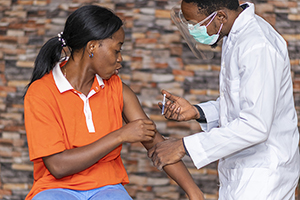 South America is the most-vaccinated region of the world, with 63.3% of its population fully vaccinated, according to the Our World in Data project (Reuters). Europe is close behind, with a rate of 60.7%. At the other end of the spectrum, Africa has seen just 8.8% of its population compete a full vaccination regimen. “Epidemiologists point to several factors to explain the speedy vaccination drive [in South America]. But the most important, they say, has been decades of successful inoculation campaigns that have created the infrastructure needed to deliver jabs en masse, while instilling trust among the population.”
Note: The Dispatch will be back Monday, January 3, 2022.
December 27, 2021
 The Omicron variant’s continued spread around the world is dampening enthusiasm around the upcoming New Year’s celebrations (Associated Press): “Dire warnings abound, caseloads are rising alarmingly fast, air traffic is snarled, and several countries are considering more restrictions to add to the patchwork of lockdowns and other measures already in place around Europe.”
As for travel, the combination of Omicron and poor weather has led to widespread flight cancellations for the fourth straight day (Reuters). “Over 800 flights were canceled within, into, or out of the United States on Monday, data from flight-tracking website FlightAware.com showed.” That’s after more than 3,000 flights were scrapped over the Christmas holiday weekend, stranding travelers across the country.
Outdoor mask mandates have returned to some European countries, including Spain, Greece, and Italy, Politico reports. As part of its announcement last week, Greece also said all public Christmas and New Year’s Eve festivities would be canceled. “Government spokesman Giannis Oikonomou indicated that a new set of measures is in the pipeline for January 3. They will affect entertainment, sporting events, and nonessential activities, but won't go as far as restrictive measures introduced during the first wave, such as lockdowns.”
Late last week, as many people around the world were making Christmas preparations, the New York State Department of Health warned of an increase in pediatric hospitalizations associated with COVID-19, concentrated in New York City and the surrounding areas. In NYC, there was a fourfold rise in admissions among patients younger than 18 beginning the week of December 5. “The risks of COVID-19 for children are real,” said Acting State Health Commissioner Mary T. Bassett, MD, in a statement, urging use of all available infection control, prevention, and mitigation strategies, including vaccination, to protect children.
 France has reported more than 100,000 daily SARS-CoV-2 infections for the first time of the pandemic, and related hospitalizations have doubled there over the past month, the Associated Press reports. “More than one in 100 people in the Paris region have tested positive in the past week, according to the regional health service. Most new infections are linked to the Omicron variant, which government experts predict will be dominant in France in the coming days. Omicron is already dominant in Britain, right across the Channel.”
Some parts of the US also are seeing the highest caseloads of the pandemic, the New York Times reports. “Delaware, Hawaii, Massachusetts, New Jersey, New York, and Puerto Rico are among the areas that have reported more coronavirus cases in the past week than in any other 7-day period, data show.” Even if Omicron causes less-severe illness than prior variants, “experts warn that the surge of infections, combined with the fact that tens of millions of Americans remain unvaccinated, could still create a severe strain on the US health system and lead to many more deaths.”
Following a similar move for Pfizer’s oral COVID-19 treatment Paxlovid, the US Food and Drug Administration last Thursday issued an emergency use authorization for molnupiravir, an oral antiviral treatment from Merck and Ridgeback Biotherapeutics. However, use should be limited, according to an agency official. “Molnupiravir is limited to situations where other FDA-authorized treatments for COVID-19 are inaccessible or are not clinically appropriate and will be a useful treatment option for some patients with COVID-19 at high risk of hospitalization or death,” she said in a statement. STAT has more.
The US Centers for Disease Control and Prevention (CDC) last week released emergency guidance for healthcare facilities to prepare for potential Omicron-driven surges, modifying isolation and quarantine recommendations to limit the impact of staff shortages. Of note, “healthcare workers with COVID-19 who are asymptomatic can return to work after 7 days with a negative test, and that isolation time can be cut further if there are staffing shortages,” the CDC advises. In addition, “healthcare workers who have received all recommended COVID-19 vaccine doses, including a booster, do not need to quarantine at home following high-risk exposures.”
 An Israeli hospital has launched a study to evaluate the impact of a second booster (or fourth dose) of COVID-19 vaccine, Reuters reports. “Results of the trial, likely to be closely watched internationally, will be submitted to Israel’s Health Ministry in about 2 weeks, said a spokesperson for Sheba Medical Centre near Tel Aviv.” An expert panel of Israel’s Health Ministry last week recommended administering fourth shots to medical workers, people older than 60, and those with compromised immune systems.
A single dose of an adenovirus type 5 vector vaccine (Convidecia) developed in China is 57.5% effective against symptomatic COVID-19 and 91.7% effective against severe disease, according to phase III results published last week in the Lancet. Developed by CanSino Biologics Inc and the Beijing Institute of Biotechnology, the vaccine has been approved for emergency use in 10 countries, including Argentina, Chile, Mexico, and Pakistan, where the trial was performed. It remains unclear how the vaccine will perform against newer variants like Delta or Omicron.


Todd Neale is the Associate News Editor for TCTMD and a Senior Medical Journalist. He got his start in journalism at …
Read Full BioRelated News



Comments