COVID-19: TCTMD’s Dispatch for January Week 3
We’re curating a list of COVID-19 research and other useful content, and updating it regularly.

Since March 2020, TCTMD reporter Todd Neale has been writing up breaking news and peer-reviewed research related to COVID-19 every weekday. In July 2021, we transitioned to Mondays, Wednesdays, and Fridays. If you have something to share, tell us. All of our COVID-19 coverage can be found on our COVID-19 Hub.
January 21, 2022
COVID-19 cases numbers are dropping across much of the United States, a Reuters analysis shows. In the past week, infections fell in 19 states, the District of Columbia, and Puerto Rico, with a 40% drop in the Northeast. Nationally, cases fell by a more-modest 7%, as some areas are still experiencing Omicron-driven surges. The Midwest and South saw 11% and 2% increases in cases, respectively, while numbers declined by 3% in the West. Analyses of wastewater support the decline in COVID-19 across the country, CIDRAP News reports.
 The story is different globally, however, with the latest World Health Organization (WHO) update indicating that COVID-19 activity jumped 20% last week compared with the week before, CIDRAP News reports. Cases increased in all regions except for Africa, with the biggest jump in Southeast Asia. Worldwide deaths rose to a smaller degree—a 4% uptick.
Booster doses of the mRNA vaccines provide protection against the Omicron variant, according to new data published in Morbidity and Mortality Weekly Report. One study showed that a third dose was highly effective at reducing COVID-19-associated emergency department/urgent care encounters and hospitalizations when either Delta or Omicron were predominant. And in another study, unvaccinated adults were five times more likely to be infected than those who were fully vaccinated with a booster. Likewise, a third study, published in JAMA, indicated that receiving three doses of an mRNA vaccine—compared with being unvaccinated or receiving two doses—protected against both the Omicron and Delta variants (albeit to a lesser extent for Omicron).
International regulators recently met to discuss COVID-19 vaccines in the context of Omicron and released a report Friday: “Reviewing data on the impact of Omicron, the participants concluded that current vaccines offer less protection against infection and mild disease caused by this variant. However, vaccination continues to offer considerable protection from hospitalization and severe COVID-19 with Omicron, especially after a booster dose. It is becoming increasingly clear that a booster dose is needed to extend vaccine protection.” The regulators also discussed the need for a long-term strategy on COVID-19 vaccines, noting that use of multiple boosters at short intervals is not sustainable.
Europe is prepping to distribute fourth vaccine doses if studies show they’re necessary, Reuters reports, although some countries—including Hungary, Denmark, and Sweden—have already decided to go that route. “The EU drugs regulator said this week it would be reasonable to give a fourth dose to people with severely weakened immune systems, but more evidence was needed.”
 Cannabidiol (CBD) inhibits SARS-CoV-2 infection in cells and mice, and in people there is an association between CBD consumption and a lower rate of positive COVID-19 test results, researchers report in Science Advances. But they offer a careful conclusion: “This study highlights CBD as a potential preventative agent for early-stage SARS-CoV-2 infection and merits future clinical trials. We caution against use of nonmedical formulations including edibles, inhalants, or topicals as a preventative or treatment therapy at the present time.”
France is planning to lift most COVID-19 restrictions next month (including capacity limits on large venues, work-from-home requirements, and outdoor mask mandates), while maintaining the need for a vaccine pass and indoor mask-wearing, Politico reports. French Prime Minister Jean Castex said the vaccine pass will go into effect on Monday. “People will no longer be allowed to show a negative test to enter restaurants, bars, theaters, museums, and stadiums or travel on trains—only proof of vaccination will be accepted,” the story notes.
A World Health Organization (WHO) advisory panel recommended use of a reduced-dose version of the Pfizer/BioNTech vaccine (10 µg) for children ages 5 to 11 (Reuters). The full-dose version (30 µg) is currently available for those 12 and older. “This age group (5-11) is in the lowest priority use group for vaccination except for children who have comorbidities,” the chair of the panel said at a briefing. Vaccination in this younger group has already gone ahead in various parts of the world, including the US, Canada, Israel, and the European Union.
The state of Western Australia has canceled plans to reopen its borders on February 5 in response to surging COVID-19 numbers in the Australia’s eastern states (Reuters). “The country reported 86 deaths from the virus on Friday, figures from the state and territory jurisdictions that have reported so far showed, its deadliest day since the start of the pandemic.”
A JAMA research letter reveals that the risk of breakthrough SARS-CoV-2 infections during the Delta period was lower in people who had received the Moderna vaccine than in those who had received the Pfizer/BioNTech shot. Among infected patients, Moderna recipients had a lower risk of 60-day hospitalizations, with no difference in mortality.
 A viewpoint in Science reviews what is known about the nervous system consequences of COVID-19. Many neurologic complications, including confusion, stroke, and neuromuscular disorders, occur during the acute phase of the disease, the authors note. “Furthermore,” they write, “maladies such as impaired concentration, headache, sensory disturbances, depression, and even psychosis may persist for months after infection, as part of a constellation of symptoms now called long COVID.”
January 19, 2022
 Some experts think that after the Omicron-driven wave of cases recedes across the world, “we may get a bit of a break from the COVID roller coaster,” STAT’s Helen Branswell writes. “By the time it crashes, the immunological landscape in this country—and in much of the world—is going to be profoundly altered. Far more people will have some immunity to COVID-19 than was the case before the wave began. Many will have what is effectively hybrid immunity, from vaccination and infection.” With many caveats, most experts said they wouldn’t predict that a potential break could mean the end of the pandemic, “but they generally agreed that the accumulation of population immunity could slow things down, at least for a while.” Some new modeling suggests, however, that 50,000 to 300,000 more Americans will die before the current surge settles in mid-March (Associated Press).
A top official from the World Health Organization (WHO) said Tuesday that the COVID-19 health emergency could end in 2022 as long as “huge inequities in vaccinations and medicines are addressed quickly,” the AP reports. Michael Ryan, head of the WHO’s health emergencies program, said “that if vaccines and other tools aren’t shared fairly, the tragedy of the virus, which has so far killed more than 5.5 million people worldwide, would continue.”
Following a possible peak in cases in the UK, British Prime Minister Boris Johnson has removed COVID-19 measures that had been put in place to control the spread of the Omicron variant, which included recommendations to work at home, increased mask-wearing, and use of vaccine passes, but not more-restrictive curbs (Reuters). “Johnson's pledge to avoid lockdowns and live with the virus contrasts with a zero tolerance approach to COVID-19 in China and Hong Kong, and tougher restrictions in many other European countries.”
Other parts of the world remain consumed with Omicron-driven surges in cases, however, with some Asian and European countries tightening curbs (CIDRAP News). Japan, for example, will expand restrictions in Tokyo and other parts of the country starting Friday (AP).
Three doses of the Pfizer/BioNTech vaccine may protect against the Omicron variant to a similar degree compared with the protection against earlier variants seen after two doses, according to a study of neutralizing antibodies in serum samples published in Science. CIDRAP News has more.
 The WHO’s top scientist said Tuesday that there is no evidence to support the need for COVID-19 vaccine booster doses in healthy children and adolescents, Reuters reports. “Speaking at a media briefing, Soumya Swaminathan said that though there seems to be some waning of vaccine immunity against the highly-transmissible Omicron variant over time, more research needs to be done to pin down who needs booster doses.”
Pfizer said Tuesday that its oral COVID-19 pill Paxlovid maintained efficacy against the Omicron variant in in vitro testing. “Taken together, these in vitro studies suggest that Paxlovid has the potential to maintain plasma concentrations many-fold times higher than the amount required to prevent Omicron from replicating in cells,” the company said. Last month, the pill became the first oral antiviral treatment for COVID-19 authorized for emergency use by the US Food and Drug Administration (FDA).
In the Annals of Internal Medicine, researchers detail a series of 57 patients who developed the rare complication of thrombosis with thrombocytopenia syndrome (TTS) after receipt of a COVID-19 vaccine, mostly the Janssen vaccine (Johnson & Johnson), in the United States. All involved hospitalization, and two-thirds had a stay in the ICU. Most patients (68%) were discharged home, 17% were discharged to postacute care, and 15% died.
After an initial dip at the beginning of the pandemic, use of ambulatory care services rebounded in the United States, although the steepness of that increase differed based on insurance coverage, researchers report in JAMA. The increase was slower in people covered by Medicaid or those with dual Medicaid-Medicare eligibility than in those with commercial insurance or Medicare Advantage or Medicare fee-for-service coverage.
Results of the ACTIV-4a trial showing that adding P2Y12 inhibitors to usual care does not provide a clinical benefit in COVID-19 patients who are hospitalized but not critically ill, previously presented at the virtual American Heart Association (AHA) 2021 Scientific Sessions last November, have been published in JAMA with an accompanying editorial.
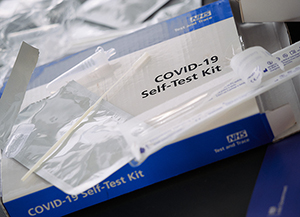 The US government will send four free at-home COVID-19 tests to every residence upon request at COVIDtests.gov, with the website opening up this week for orders. A STAT story discusses whether this move will turn President Joe Biden’s pandemic response around: “Given the complicated distribution logistics, supply chain questions, and uncertainty about where the pandemic will go next, however, there are real questions about whether the push will succeed—or backfire for Biden.”
A news feature published Tuesday in Nature highlights that the true death toll of the pandemic is likely much higher than official tallies: “By January 2022, there had been 5.5 million official COVID-19 deaths worldwide in the pandemic. But models estimate that there have been between two and four times that number of excess deaths—that is, mortality above what was expected—since the start of 2020.”
January 17, 2022
COVID-19 treatments are increasingly available in the United States, but as a study in Morbidity and Mortality Weekly Report makes clear, white patients are getting more than their fair share. “Analysis of data from 41 health care systems participating in the National Patient-Centered Clinical Research Network found lower use of monoclonal antibody treatment among Black, Asian, and Other race and Hispanic patients with positive SARS-CoV-2 test results, relative to white and non-Hispanic patients,” the authors conclude. While inpatient administration of drugs like remdesivir and dexamethasone appeared to be slightly less imbalanced, they write, “equitable receipt of COVID-19 treatments by race and ethnicity along with vaccines and other prevention practices are essential to reduce inequities in severe COVID-19–associated illness and death.”
Inactivated virus-based vaccines appear to provide little to no protection against the Omicron variant despite being the most widely used vaccines in the world, emerging evidence makes clear. China’s Sinovac and Sinopharm vaccines, both of which use inactivated virus vectors, “account for nearly 5 billion of the more than 11 billion COVID-19 vaccine doses delivered globally so far,” while products made in India, Iran, and Kazakhstan make up more than 200 million, a Nature news story summarizing the evidence explains.
As of today, people living in England can stop isolating 5 days, down from 7, after testing positive for COVID-19, so long as they don’t have a fever and have had two negative lateral flow tests on days 5 and 6. But as the BMJ reports, scientists and health professional groups are questioning the advice, saying that this could increase the risk of transmissions to health care workers and colleagues.
In the United States, the Centers for Disease Control and Prevention had already shortened isolation periods to 5 days, back in December, but as a New York Times story notes, that decision—among others—was based on scant data which lacked the rigor usually relied on by the agency. “Because decisions must be made at a breakneck pace, the agency has issued recommendations based on what once would have been considered insufficient evidence, amid growing public concern about how these guidelines affect the economy and education.”
 Costs of hospitalizations for unvaccinated adults in the United States approached $14 billion between June and November 2021, a period in which vaccines were widely available for free, according to an analysis by the Kaiser Family Foundation (KFF). Costs were at their highest in August 2021, reaching $4 billion, but had dipped to $2 billion by November. “These COVID-19 hospitalizations are devastating for patients, their families, and health care providers,” a KFF summary notes. Moreover, they’ve prompted some insurers to reinstate cost-sharing for COVID-19 treatment.
Last week, the US Supreme Court’s conservative majority ruled that the Biden administration’s vaccine or test mandate for large businesses amounts to overstepping its authority. The court has allowed a separate mandate requiring healthcare workers nationwide to be vaccinated if they work at facilities that receive Medicare or Medicaid funding—a ruling affecting approximately 76,000 health care workers. STAT has the story.
Visits to primary care physicians increased among children and adolescents who tested positive for COVID-19 in Norway, as compared with those who tested negative. Visits were up by more than 300% for children age 1 to 5, and by nearly 500% among those aged 6 to 15. Among the youngest children, visits tended to remain higher for several months after their positive test, although the same was not seen in the older children and teens. “For all age groups, the increase in primary care visits was due to respiratory and general or unspecified conditions,” the study, published in the BMJ, concludes. “No increased use of specialist care was observed.”
 Omicron’s spread is continuing to shake up the world of sports, Reuters reports. China has now announced that it will not permit tickets for the Olympic Winter Games to be sold to the general public after already declaring that foreign spectators would be banned. And, after a protracted volley with Australia’s immigration officials over his vaccination exemption, tennis number one Novak Djokovic flew home from Melbourne yesterday after losing his court appeal.


Todd Neale is the Associate News Editor for TCTMD and a Senior Medical Journalist. He got his start in journalism at …
Read Full BioRelated News


Comments