CRISPR-Cas9 Gene-Editing Therapy Shows Early Promise for Dyslipidemia
(UPDATED) The approach is “very exciting,” but one expert says a lot more research is needed, especially around safety, before clinical use.

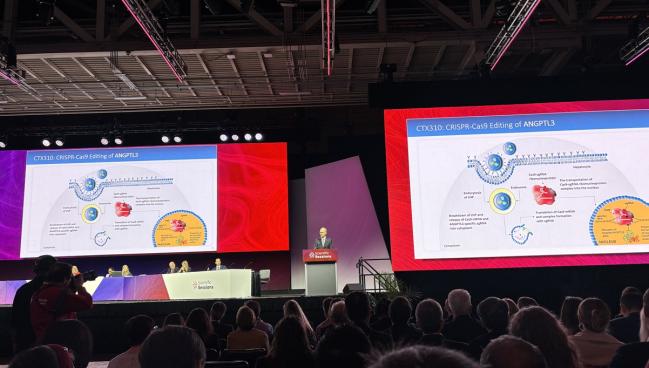
NEW ORLEANS, LA—An investigational CRISPR-Cas9 gene-editing therapy that targets angiopoietin-like protein 3 (ANGPTL3), which has a role in regulating lipid metabolism, appears to safely lower levels of LDL cholesterol and triglycerides in patients with various types of dyslipidemia refractory to lipid-lowering therapy, according to results from a small, phase I study.
Given as a one-time IV infusion, the highest dose of the gene-editing therapy led to mean percent reductions of 48.9% and 55.2% for LDL cholesterol and triglycerides, respectively, through at least 60 days of follow-up. There were also mean percent reductions of 33.4% for apolipoprotein B, 24.1% for HDL cholesterol, and 49.8% for non-HDL cholesterol, Luke Laffin, MD (Cleveland Clinic, OH), reported at a press conference at the American Heart Association (AHA) 2025 Scientific Sessions.
The results, presented by Stephen Nicholls, MBBS, PhD (Victorian Heart Institute, Monash University, Melbourne, Australia), today in a late-breaking session and published simultaneously online in the New England Journal of Medicine, showed that among the 15 patients treated in the study, none had dose-limiting toxic effects or serious adverse events that were deemed related to the therapy, currently called CTX310 (CRISPR Therapeutics).
“These data, although early, really are appropriate to allow further development,” Laffin said, acknowledging the small size of the study. “But thinking about a one-time therapy that can lower LDL cholesterol by about 50% and triglycerides greater than 50% is exciting. It very well may overcome this issue of waning adherence to current [lipid-lowering] therapies.”
Nicholls stressed, however, that “ongoing surveillance will be essential to assess the persistence of safety and lipid-lowering efficacy of CTX310.”
Mimicking Natural Mutations
CTX310 is a lipid nanoparticle-encapsulated formulation of CRISPR-Cas9 messenger RNA and guide RNA that targets hepatic ANGPTL3 to create a loss-of-function mutation. ANGPTL3 inhibits lipoprotein and endothelial lipases, and prior research has shown that individuals with naturally occurring loss-of-function variants of the ANGPTL3 gene have lower lifetime levels of LDL cholesterol and triglycerides and a reduced risk of atherosclerotic cardiovascular disease (ASCVD), without any apparent harmful effects.
This phase I trial, conducted at six sites in Australia, New Zealand, and the United Kingdom, tested the impact of inducing a loss-of-function mutation with CTX310 in a small group of adults (median age 53 years; 87% men) with uncontrolled hypercholesterolemia, moderate-to-severe hypertriglyceridemia, or mixed dyslipidemia that was refractory to maximally tolerated lipid-lowering therapy. The participants met at least one of the following criteria: fasting serum triglyceride level greater than 150 mg/dL, LDL cholesterol level greater than 100 mg/dL (or 70 mg/dL in those with ASCVD), apolipoprotein B level greater than 100 mg/dL, or non-HDL cholesterol level greater than 160 mg/dL.
Mean directly measured LDL cholesterol level was 155 mg/dL at baseline and median triglyceride level was 192 mg/dL. Background lipid-lowering therapy most commonly included a statin (60%), ezetimibe (53%), or a PCSK9 inhibitor (40%).
Prior to receiving the study infusion, patients were pretreated with glucocorticoids and antihistamines. Patients received one of five doses of CTX310 (per kg body weight), infused over a maximum of 4.5 hours: 0.1 mg (n = 3), 0.3 mg (n = 3), 0.6 mg (n = 3), 0.7 mg (n = 2), or 0.8 mg (n = 4).
Though there were no dose-limiting toxic effects or serious adverse events related to treatment, there were three infusion-related reactions on the 0.6- and 0.8-mg/kg doses that involved fever, nausea, and back pain. The infusions were paused; antihistamines, steroids, antiemetics, and analgesia were administered; and the infusions were restarted—all participants completed treatment. Another patient had an allergic reaction on the 0.3-mg/kg dose—a rash that appeared the day after the infusion, was treated with antihistamines, and resolved the next day.
It’s early, but the efficacy in this trial represents a new frontier for drug development. Luke Laffin
One patient, who had elevated liver enzymes at baseline, had a transient increase in aminotransferases with the highest CTX310 dose, with levels reaching three to five times the upper limit of normal. There was a peak at day 4 and a return to baseline levels by day 14. There were no accompanying increases in bilirubin or alkaline phosphatase levels or prothrombin time.
Serious adverse events occurred in two patients: one had spinal disk herniation 7 months after taking the 0.3-mg/kg dose and the other, who was in his 50s, died suddenly 179 days after receiving the lowest dose. The patient who died had a history of familial hypercholesterolemia and had undergone multiple PCIs, as well as CABG.
Secondary endpoints included changes in concentrations of ANGPTL3 and lipids. The mean percent changes in ANGPTL3 level at 30 days were +9.6%, +9.4%, -32.7%, -79.7%, and -73.2% with the 0.1, 0.3, 0.6, 0.7, and 0.8-mg/kg doses, respectively, with changes observed within the first 15 days. Lipid levels declined with the higher doses as well.
Laffin said that moving forward, CTX310 will have to be studied in larger, more-diverse populations and in specific patient groups.
Taking a broad view of the field, he said, “We know that gene editing is now feasible via CRISPR-based therapies for a variety of targets. We know there’s commercial therapies out there already for sickle cell disease. This approach may prove highly effective in cardiovascular disease.
“It’s early, but the efficacy in this trial represents a new frontier for drug development,” he continued, noting that physicians address modifiable risk factors in their patients but have told—and still tell—patients that their genes can’t be changed. “We may be entering an era where that’s no longer the case and we can change your genes.”
‘Very Attractive’ Concept, but Safety Is Key
Kiran Musunuru, MD, PhD (Penn Medicine, Philadelphia, PA), who has been involved in research on CRISPR-Cas9 gene editing and on the impact of ANGPTL3 loss-of-function mutations, said at the press conference that ANGPTL3 is a “very attractive drug target.”
It can be targeted in the bloodstream by therapies like evinacumab (Evkeeza; Regeneron), a monoclonal antibody that was approved by the US Food and Drug Administration as an adjunct to other LDL cholesterol-lowering therapies in patients with homozygous familial hypercholesterolemia. However, evinacumab requires a monthly infusion for life, and other types of therapies targeting ANGPTL3 are delivered periodically as well, he noted.
Regarding the gene-editing approach with CTX310, Musunuru said, “We know that people naturally born with inactivating DNA mutations in ANGPTL3 are protected against heart disease. So what better way to help patients with heart disease or at high risk for heart disease than using gene editing to introduce the same kind of inactivating mutations in their ANGPTL3 gene.”
He said it’s clear the therapy works well, but added that safety will always be a major question in early-phase studies like this one.
The idea of gene editing is very exciting. It’s very important to do. But I think we have to be incredibly cautious. Jeffrey Berger
The modest, transient rise in liver enzymes seen in one patient is “not uncommon for this type of therapy that uses lipid nanoparticles as the delivery vehicle,” Musunuru said, though he pointed to another gene-editing therapy making news to introduce a note of caution. In a study of Intellia Therapeutics’ CRISPR-based therapy for transthyretin amyloidosis, one patient died after suffering severe liver injury a few weeks after treatment.
“There are important differences between the trials—different gene targets, different patient populations, and so forth—but it is formally possible that a hazard seen with Intellia’s therapy might show up in some shape or form in the future with this ANGPTL3 therapy,” he said. “That’s why we do clinical trials, and that’s why when going for a large indication with a common disease like hyperlipidemia, the phase III clinical trial will need to enroll probably thousands of subjects to really be sure about efficacy and. most importantly, safety.”
Commenting for TCTMD, preventive cardiologist Jeffrey Berger, MD (NYU Langone Health, New York, NY), also emphasized the importance of making sure CTX310 and other gene-editing therapies are safe.
“The idea of gene editing is very exciting. It’s very important to do. But I think we have to be incredibly cautious,” he said. “This is a crucial first piece, but a lot more is needed before we start using this type of therapy in the clinical setting.”
In particular, understanding the effect on liver function in larger groups of patients, especially with the highest dose, will be important, Berger said. “And, obviously, whenever there’s any death, you have to really be incredibly careful when you think about bringing this to the market.”
For a one-and-done therapy like this, potential side effects need to be examined with a magnifying glass, Berger stressed, adding that he is “optimistic about the field and this approach.”
Speculating on the potential future applications of gene-editing therapies in cardiovascular medicine, Musunuru said, “The more options, the better.” He predicted that by the 2030s, many such therapies targeting a variety of genes will be available on the market. Some patients will want to continue taking pills, whereas others likely will opt for a one-time treatment, he said. “There's not going to be ‘one size fits all.’”

Todd Neale is the Associate News Editor for TCTMD and a Senior Medical Journalist. He got his start in journalism at …
Read Full BioSources
Laffin LJ, Nicholls SJ, Scott RS, et al. Phase 1 trial of CRISPR-Cas9 gene editing targeting ANGPTL3. N Engl J Med. 2025;Epub ahead of print.
Disclosures
- The study was funded by CRISPR Therapeutics.
- Laffin reports consulting for AstraZeneca, Eli Lilly, Idorsia, Medtronic, Novartis, Novo Nordisk, Recor, Ripple Medical, Stability Health, and Veradermics; having speaking engagements with Cedars-Sinai Medical Center and the University of Chicago; holding stock options from LucidAct Health; and receiving book royalties from or editing for Cleveland Clinic/Belvoir Media, Elsevier, and Springer.
- Nicholls reports consulting for Amarin, Arrowhead Pharmaceuticals, CSL Sequiris, Daiichi Sankyo, Kinkisa Pharmaceuticals, Novo Nordisk, and Scribe Therapeutics and receiving institutional grants/contracts from Amgen, Anthera, AstraZeneca, Boehringer Ingelheim, Cerenis, Cyclarity, Eli Lilly, Esperion, F. Hoffmann-La Roche, Infraredx, LipoScience, NewAmsterdam Pharma, Novartis, Resverlogix, Sanofi-Regeneron, The Medicines Company, and Vaxxinity.
Related News



Comments