Residential Segregation Adversely Affects Black CV Health: REGARDS
While frustrating for physicians, the emerging evidence should spur “hypervigilance” around risks that are socially determined.


Black people living in US states with high residential segregation have a greater risk of dying from coronary heart disease (CHD) than those who live in more integrated areas, according to an analysis from the REGARDS study. For white people, no such association existed.
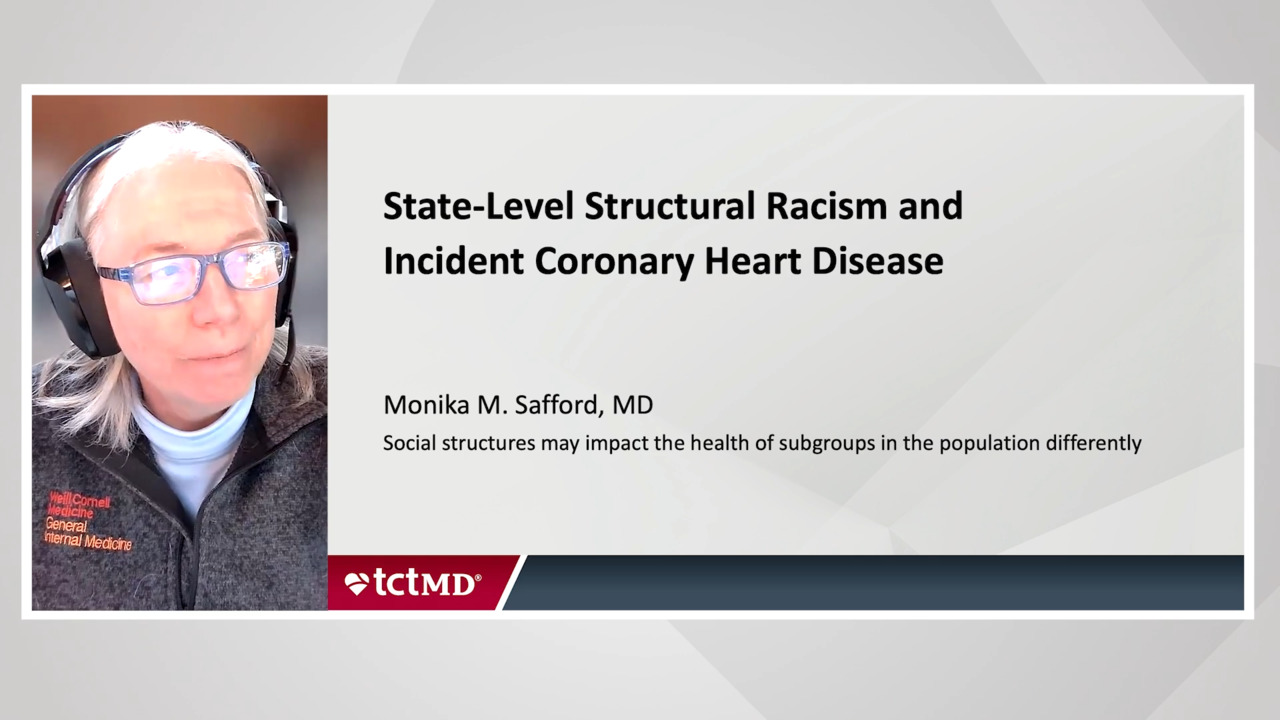
“While that is extremely important and we absolutely must be pursuing that, to not pursue ways to address social determinants of health is to have blinders on and focus only on a piece of a much larger pie,” she told TCTMD. “If we’re really serious about eliminating disparities and improving population health, we as physicians and physician organizations should be doing a lot more advocacy for counteracting these social determinants and drawing attention to the health impacts of these social determinants.”
Although Safford and colleagues saw a strong link between incident fatal CHD events and residential segregation in Black individuals, that relationship did not extend to nonfatal CHD. Explanations for why this would be the case are not yet well understood. However, the researchers say their overall findings are consistent with prior literature and “with the notion that structural factors in our society are root causes of racial inequities that, if causal, could be intervened upon to achieve equity in CHD outcomes.”
Validated Measures Compared
The study, published recently in the Journal of the American Heart Association, included 24,533 participants (mean age 64 years; 58.5% women; 42.4% Black) from the REGARDS study who were free of CHD at baseline. Participants were contacted every 6 months, with events validated via medical records and expert adjudication of MI and cause of death. Nearly half of the population had an annual household income of less than $35,000.
Over a median follow-up of 13 years, the rate of incident CHD events was 7.8% in Black participants and 8.1% in white participants (P = 0.34). Incident nonfatal CHD events occurred at rates of 4.6% and 5.6% (P = 0.001), respectively, while incident fatal CHD occurred at rates of 3.2% and 2.5% (P= 0.002).
To not pursue ways to address social determinants of health is to have blinders on and focus only on a piece of a much larger pie. Monika Safford
Three validated measures of structural racism were compared in Black and white individuals: the percentage of each demographic group living below the federal poverty line in the state; the percentage of uninsured individuals in the state; and a measure of residential racial segregation known as the Dissimilarity Index (DI). The latter measure is an indicator of the proportion of Black people who would have to move such that the demographic composition would match the proportion of Black residents in all areas of that state.
Across all US states, there was a greater proportion of Black versus white residents living in poverty or lacking health insurance. Greater structural racism at the state level according to the DI was associated with incident CHD for Black but not white participants (HR 1.19; 95% CI 1.03-1.37 vs. HR 1.03; 95% CI 0.92-1.16).
Additionally, an above-median DI was associated with incident fatal CHD for Black but not white participants (HR 1.35; 95% CI 1.08-1.68 vs. HR 1.13; 95% CI 0.92-1.40). Even after adjustment for age, sex, region, and the percentage of Black residents in the state, the association between high DI and fatal CHD in Black participants did not significantly change.
To TCTMD, Safford noted that a growing body of evidence is showing the impact of a long legacy of discriminatory housing practices in the United States on current health, with organizations like the American Heart Association and others targeting structural racism as a fundamental driver of CVD disparities with its own standard vocabulary.
Mandated screening for social determinants of health has been a step forward in addressing the impact of structural racism, she said, though it’s hard not to feel frustrated by studies that document a problem that physicians feel is beyond their purview. Safford said studies like hers hopefully help physicians see that they need to be looking deeper at their patients and taking more thorough social histories.
“If they’re on Medicaid, you have low income. Do they have SNAP benefits? What was their level of education? We should be ascertaining that as part of the social history, which is a standard component of the medical history. As soon as you get to two or three social determinants, you have an independent risk for coronary heart disease, for stroke, for the development of hypertension, for diabetes, etc,” Stafford explained.
“It’s really quite sobering,” she added. “It’s right at the same level as smoking cigarettes, which is the most powerful cardiovascular risk factor.”
While knowing where and how to intervene in patients with a complicated social determinants of health history isn’t easy, she said further growing the body of evidence directly connecting them to increased risk is the best way to tease out actionable items that will have optimal impact for patients.

L.A. McKeown is a Senior Medical Journalist for TCTMD, the Section Editor of CV Team Forum, and Senior Medical…
Read Full BioSources
Source(s): Safford MM, Brown T, Bryan J, et al. State-level structural racism and incident coronary heart disease. J Am Heart Assoc. 2025;Epub ahead of print.
Disclosures
- Safford reports a noncompensated role on the advisory board for MedExplain Health outside of the submitted work.
Related News



Comments