Tendyne Safely Reduces MR in Patients With Severe Calcification: SUMMIT-MAC
The device, which is delivered transapically, represents an option for very sick patients who previously have had none.
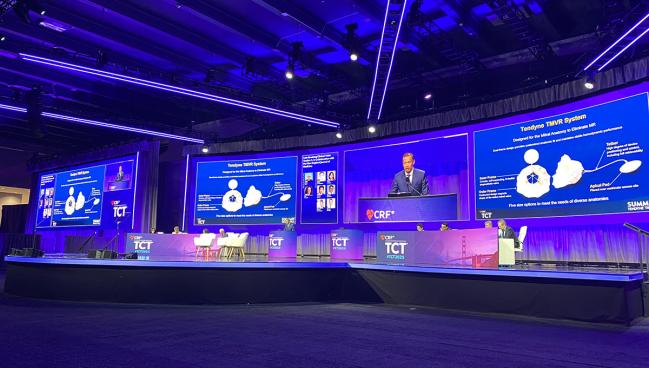
SAN FRANCISCO, CA—Transcatheter mitral valve replacement (TMVR) with the Tendyne system (Abbott) successfully treats mitral regurgitation (MR) or stenosis complicated by severe mitral annular calcification (MAC) while also improving heart failure symptoms and quality of life, according to the prospective SUMMIT-MAC study.
The primary composite endpoint of freedom from all-cause mortality and heart failure hospitalization over 12 months was 60.4%, which was greater than the performance goal of 43% (P = 0.0002).
The transapical device, approved by the US Food and Drug administration earlier this year for patients with mitral valve dysfunction based on data from the SUMMIT trial, represents a therapeutic opportunity for a population of patients who previously had none, researchers say.
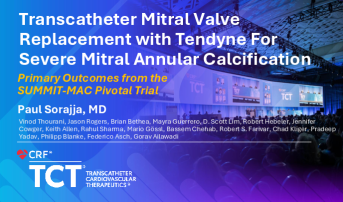
“These are patients who were not qualified for surgery and not qualified for any available transcatheter option,” Paul Sorajja, MD (Banner - University Medical Center Phoenix, AZ), who presented the new findings today in a late-breaking clinical trial session at TCT 2025, told TCTMD. “If you look at this representative picture, this is some of the most extreme pathology that's out there. So, what we showed in this trial is for a group of patients that had no options, [and] we finally have an option that met the study input that was meaningful in terms of clinical benefit.”
Current US guidelines offer no recommendations for TMVR, but Sorajja believes the SUMMIT-MAC data will change that.
In a media briefing, Philippe Généreux, MD (Morristown Medical Center, NJ), called the data “fantastic,” adding that MAC is a problem for both cardiologists and surgeons. “For now, it's a good option, [and] because it's available, we can use it,” he said.
SUMMIT-MAC Findings
For the study, which was simultaneously published in JACC, Sorajja and colleagues analyzed 103 patients (mean age 78 years; 55% women) with severe MAC and MR or mitral stenosis who were treated with Tendyne TMVR at 37 sites between October 2019 and March 2023. At baseline, 97.1% of patients had at least grade 2+ MR and 11.7% had mitral stenosis. Significant frailty was common (85.4%), and the mean Society of Thoracic Surgeons predicted risk of mortality (STS-PROM) score was 7.1%.
The average volume of MAC was 5,679 mm3, and most patients had posterior annular calcification.
Technical success was 94.2% and total procedural time was 120.9 minutes. Balloon predilatation was used in 71% of cases. Patients stayed in the hospital for a median of 7 days and in the ICU for a median of 3.8 days, and all but one patient stayed on anticoagulation for at least 1 month.
Upon discharge, all patients had none/trivial MR on echocardiography. By 1 month, this rate remained high at 98.9%, and by 12 months, 91.4% of patients still reported none/trivial rates of MR. No patients had MR grade 3+ or 4+ at any follow-up visit.
One patient had paravalvular leak (PVL) at discharge, and this was remedied through a tether length adjustment. By 12 months, 2.9% of patients reported moderate PVL. The mean mitral gradient by 12 months was 3.8 mm Hg, which represented a decrease of 1.9 mm Hg from baseline.
The 30-day mortality rate was 6.8%, including two patients who died during the procedure—all deaths were from cardiac causes. Bleeding occurred in 27.2%, including life-threatening bleeds in 6.8%, and access-site bleeding in 5.8%. By 12 months, 21% of patients had died and 30.1% had been hospitalized for heart failure.
Thrombosis was identified in 3.2% and endocarditis in 4.2% of patients after 31 days, but none were linked with thromboembolic or neurologic adverse events. The disabling stroke rate was 3.2% over 12 months. Mitral valve reintervention or reoperation occurred in 5.4% over 12 months.
The study met secondary endpoints for improvements in the Kansas City Cardiomyopathy Questionnaire overall summary score from baseline to 12 months (mean improvement of 18.7 points) as well as in the proportion of patients with NYHA class I or II symptoms (30.6% to 87.5%; P < 0.0001 for both). Researchers saw a mean improvement of 20.6 meters in the 6-minute walk distance (P = 0.0338), but this did not beat the study’s performance goal.
Strengths and Limitations
Roxana Mehran, MD (Icahn School of Medicine at Mount Sinai, New York, NY), who moderated the press conference, said it would be “ideal” if Tendyne didn’t require transapical access. However, she added, “these are really, truly, no-option patients, and this work is fantastic. And, of course, we still see a lot of comorbidities and lots of other events, but the death rate is quite good and I think this is very important.”
Discussing the study during the session, Tsuyoshi Kaneko, MD (Washington University in St. Louis, MO), said the strength of the device lies in its “novelty” as a dedicated option for this population with MAC. However, he pointed to several limitations, including transapical access, as well as the potential that the performance goals might not have been appropriate. Those goals were based on the medical arm of the COAPT trial, which mainly included patients with functional MR. Additionally, he highlighted the 74.6% screen failure rate of SUMMIT-MAC, suggesting that might hamper the generalizability of the device.
Still, Kaneko said, Tendyne “does provide a very important option for a very high-risk cohort that really doesn’t have an option at this time.” The latest European valvular heart disease guidelines give a class 2b (level of evidence C) recommendation for TMVR in patients with severe MV dysfunction and extensive MAC, but a “dedicated device might change this recommendation to a higher class in the future,” he added.
Panelist Mayra Guerrero, MD (Mayo Clinic, Rochester, MN), said the findings represent a “remarkable milestone that will not only transform the practice of interventional cardiology, but most importantly has the potential to transform the lives of countless patients who have been waiting for a treatment option.”

Yael L. Maxwell is Senior Medical Journalist for TCTMD and Section Editor of TCTMD's Fellows Forum. She served as the inaugural…
Read Full BioSources
Sorajja P, Thourani VH, Rogers JH, et al. Transcatheter mitral valve replacement for severe mitral annular calcification: primary outcomes from the SUMMIT-MAC study. JACC. 2025;Epub ahead of print.
Disclosures
- The SUMMIT study was funded and sponsored by Abbott.
- Sorajja reports financial relationships with 4C Medical, Abbott Structural, Adona, AMX Technologies, Arcos, Boston Scientific, ConKay, Coramaze, CroiValve, Cultiv8, Edwards Lifesciences, Egg Medical, EvolutionMed, Foldax, GE Medical, Haemonetics, InQ8, LAZA, Medtronic, Mirus, Philips, Polares, Tricares, vDyne, Unorthodox Ventures, Valcare, and xDot.
- Mehran reports receiving grant/research support from Abbott, Affluent Medical, Alleviant Medical, Amgen, AstraZeneca, BAIM, Beth Israel Deaconess Medical Center, Boston Scientific, Bristol-Myers Squibb, CardiaWave, CERC, Chiesi, Concept Medical, Daiichi Sankyo, Duke, Faraday, Idorsia, Janssen, MedAlliance, Cordis, CPC Clinical Research, Medtronic, NewAmsterdam Pharma, Novartis, Novo Nordisk, and Population Health; holding equity/stock in Elixir Medical, Stel, and ControlRad.
- Généreux reports receiving consultant fees/honoraria from Edwards Lifesciences.
- Guerrero reports receiving grant/research support from Edwards Lifesciences.
- Kaneko reports receiving consulting fees/honoraria from Abbott, Edwards Lifesciences, and Medtronic.
Related News

Comments