COVID-19: TCTMD’s Daily Dispatch for September Week 4
We’re curating a list of COVID-19 research and other useful content, and updating it regularly.


Since March 2020, TCTMD reporter Todd Neale has been writing up breaking news and peer-reviewed research related to COVID-19 every weekday. In July 2021, we transitioned to Mondays, Wednesdays, and Fridays. If you have something to share, tell us. All of our COVID-19 coverage can be found on our COVID-19 Hub.
September 24, 2021
The Advisory Committee on Immunization Practices (ACIP), which provides guidance to the US Centers for Disease Control & Prevention (CDC), yesterday recommended Pfizer/BioNTech boosters for older adults, as well as their younger counterparts at high risk for COVID-19, but not for frontline workers, conflicting with the groups covered by the US Food and Drug Administration’s authorization on Wednesday.
Early this morning, however, CDC guidance added people “at high risk of disease from occupational and institutional exposures to COVID-19” to those recommended for an extra dose, consistent with the FDA. The New York Times has more on the situation.
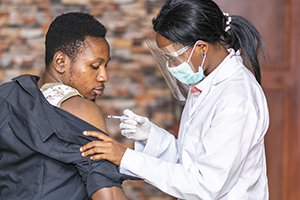 As wealthy countries like the US implement booster plans, leaders from Africa highlighted the lack of vaccines on the continent at the United Nations General Assembly yesterday, underscoring the danger posed to the rest of the world if the situation remains unresolved, the AP reports. “As of mid-September, fewer than 4% of Africans have been fully immunized and most of the 5.7 billion vaccine doses administered around the world have been given in just 10 rich countries.” The president of Namibia referred to the inequitable distribution as “vaccine apartheid.” Acquiring vaccines is just part of the issue, however. CBS News details the logistical challenges of administering them in Lesotho in particular and the role “flying doctors” play in overcoming them.
Some happenings around the world (all from Reuters): the Pfizer/BioNTech vaccine will be the only one used for at-risk children ages 12 to 17 in Mexico; Australia has now fully vaccinated more than half of its adult population as case numbers linger near record levels in Melbourne; South Korea is expected to set a new daily record for COVID-19 cases, with 2,924 reported as of Friday night; and England’s estimated COVID-19 weekly reproduction “R” number is now between 0.8 to 1.0, indicating that the epidemic could be shrinking there.
Apoorva Mandavilli of the New York Times delves into recent research suggesting that there may be differences in efficacy among the mRNA vaccines, with the shot from Moderna having the edge over the one from Pfizer/BioNTech. One such study was published this week in the New England Journal of Medicine, showing a vaccine effectiveness of 88.8% with the Pfizer/BioNTech jab and 96.3% with the one from Moderna among US healthcare workers. “Scientists who were initially skeptical of the reported differences between the Moderna and Pfizer/BioNTech vaccines have slowly become convinced that the disparity is small but real,” Mandavilli notes.
 Amid growing evidence that the rare multisystem inflammatory syndrome (MIS) stemming from COVID-19 can develop in adults, not just children, CDC researchers are urging physicians to be aware of its clinical presentation and offer tips for appropriate management. TCTMD Managing Editor Shelley Wood reports on a new review of the issue published this week in JAMA Network Open.
In a “living” guideline on COVID-19 drugs on the BMJ website, the World Health Organization (WHO) is now recommending Regeneron’s monoclonal antibody therapy combining casirivimab and imdevimab for patients with nonsevere COVID-19 who have a risk of hospitalization over 10%, as well as for those with severe or critical disease with seronegative status. High-risk characteristics among nonsevere patients include lack of vaccination, older age, immunodeficiency, and chronic diseases like diabetes.
Remdesivir (Veklury; Gilead Sciences) reduces the risk of hospitalization in high-risk patients with COVID-19 when given early, the company announced Wednesday in a press release. In a phase III study, a 3-day course of the antiviral led to an 87% relative reduction in risk of COVID-19-related hospitalization or all-cause death by day 28 (0.7% vs 5.3%; P = 0.008), the primary endpoint. There were no deaths in either the remdesivir or placebo group. STAT’s Matthew Herper notes that the findings, due to be presented at the upcoming IDWeek meeting, “could help shore up the perception that the medicine is effective. They also could boost hopes for the use of oral antiviral drugs being developed by drug companies including Pfizer and Merck to treat people in the early stages of COVID-19.”
The FAPIC score, which incorporates a handful of demographic, clinical, and laboratory findings, can provide an estimated mortality risk in patients presenting with vaccine-induced immune thrombotic thrombocytopenia (VITT) after COVID-19 vaccination, potentially helping clinicians decide how aggressive to be when treating the rare complication, according to a study in the European Heart Journal. The tool “can help draw people’s attention to how severe the disease may be and how aggressive to treat them,” Jean Connors commented to TCTMD.
A JAMA Psychiatry viewpoint discusses ways that mental health professionals can encourage people to get a COVID-19 vaccine. “Although mental health is not the first thing that comes to mind when thinking about vaccination, strategic use of mental health professionals’ expertise could provide new opportunities to encourage COVID-19 vaccination,” the authors say.
 Many bird species headed to cities across North America during COVID-19 lockdowns, researchers report in Science Advances. “Some species which seemed to have most enjoyed the reprieve from human activity—or at least shifted closer to civilization—were warblers and native sparrows; osprey and bald eagles; and several species of ducks and geese,” according to a National Geographic story.
September 22, 2021
Of the four SARS-CoV-2 variants deemed to be “of concern” by the World Health Organization (WHO)—Alpha, Beta, Gamma, and Delta—“Delta is, by far, the most transmissible” and remains the dominant strain across the globe, a WHO scientist said Tuesday (Washington Post). “Less than 1% of the sequences that are available right now are Alpha, Beta, and Gamma,” she said. Delta also seems to be outcompeting other newer variants, including Mu and Lambda.
A second, booster dose of Johnson & Johnson’s Janssen COVID-19 vaccine given 56 days after the first provides 100% protection against severe/critical disease and 75% protection against symptomatic moderate to severe/critical disease globally, with the latter figure rising to 94% in the United States, the company announced Tuesday. At least one expert, however, has said he’d like to see more data, including those specific to protection against the Delta variant, CIDRAP News reports. STAT’s Matthew Herper has more.
 COVID-19 numbers among US children continue to rise, CIDRAP News reports, citing the latest data from the American Academy of Pediatrics (AAP). The most-recent week saw nearly 226,000 new cases added to the tally, the third-highest total seen so far. Pediatric cases seem to be up in the United Kingdom as well, with figures from the Department for Education showing more than 100,000 children were absent with confirmed or suspected SARS-CoV-2 infections last week, the highest number since the beginning of the pandemic (The Guardian).
Meanwhile, US COVID-19 deaths are averaging more than 1,900 a day for the first time since early March, with unvaccinated Americans feeling most of the impact, the AP reports: “The increasingly lethal turn has filled hospitals, complicated the start of the school year, delayed the return to offices and demoralized healthcare workers.” As STAT’s Helen Branswell reports, COVID-19 has recently overtaken the 1918 Spanish flu as the deadliest disease in US history.
Harbin, a city of 10 million people in northeastern China, has gone in “semi-lockdown” after the first signs of local transmission of SARS-CoV-2 since early February, Reuters reports. Three of the 16 new local cases reported in the country were detected in Harbin, where officials “vowed to complete an initial round of citywide testing by Thursday, and told its residents to refrain from stepping outside their homes, unless necessary, before their test results are out.”
In the early phase of the COVID-19 pandemic, CV diagnostic procedures fell in eastern Asia, especially China, according to a study published this week in JACC: Asia. “The most-severe reductions in procedure volumes were observed in lower-income countries, where volumes decreased 81% from March 2019 to April 2020,” the authors note.
The average bill for a complex COVID-19 hospitalization in the United States is $317,810, with an average allowed amount of $98,139, according to estimates from the nonprofit organization FAIR Health. For general COVID-19 hospitalizations, those figures are $74,591 and $33,525, respectively. “A complex COVID-19 hospitalization incurs additional costs, such as a stay in the ICU or a ventilator, whereas a general COVID-19 hospitalization does not include those items. That cost difference might be overlooked if the costs were not broken out,” Robin Gelburd, president of FAIR Health, told Axios.
The financial health of hospitals in the US—and presumably elsewhere—will continue to suffer through 2021, according to a report from Kaufman Hall that was released by the American Hospital Association on Tuesday. US hospitals will lose an estimated $54 billion in net income this year even after taking into account federal aid, and more than one-third of centers “will maintain negative operating margins through year’s end.”
STAT has the results of a 6-month effort by photographer Bethany Mollenkof to document the impact of COVID-19 on residents of rural Black communities in the southern US. “While the pandemic has exacerbated existing medical and financial inequities in these remote corners of the region, it has also highlighted communities’ strength in the face of unprecedented challenges.”
 The pandemic has driven demand for taxis down in Thailand, causing one cab company in Bangkok to find another use for its unused vehicles— mini vegetable gardens (Reuters). “The cooperative grows vegetables on the roofs and bonnets of 300 of the disused cabs, providing its drivers and members with food to share while sending a message to the government to do more to help with the hardship.”
September 20, 2021
Meeting Friday, a US Food and Drug Administration advisory committee rejected use of booster doses of the Pfizer/BioNTech vaccine for the general population, but voted in favor of administering third doses in people 65 and older and in those at high risk of severe illness, with a Reuters story noting that US regulators could authorize such use in the next few days. “Health officials signaled they expect boosters will ultimately be recommended for a broad swath of the population, but advised Americans not to seek booster doses until they have the nod from the FDA.” Politico has more.
The Pfizer/BioNTech COVID-19 vaccine provides “robust neutralizing antibody responses” and is safe in children ages 5 to 11 according to results of a phase II/III trial, the companies announced Monday. Participants received two shots administered 21 days apart, at a dose one-third of that used in people 12 and older. The data will be submitted to regulators “as soon as possible.” Results of studies in children as young as 6 months could be available by the end of the year. STAT provides context.
To further stretch COVID-19 vaccine supplies, Thailand is trying intradermal rather than intramuscular injections, Reuters reports. “One vaccine dose can be used for five intradermal injections,” one hospital director said, noting that studies have shown the method induces a similar immune response. Only 21% of the country’s residents have been fully vaccinated.
 The United States will lift travel bans for vaccinated people from the United Kingdom and most of the European Union, as well as those from Brazil, China, India, Iran, and South Africa, starting in November, the Guardian reports. Travelers will need proof of full vaccination and results of a negative COVID-19 test taken within 72 hours of departure.
The latest numbers from the US Centers for Disease Control and Prevention (CDC), published Friday, indicate that COVID-19 numbers ticked back up after a decline the previous week, reports Becker’s Hospital Review. The most-recent 7-day case average rose 6.1% compared with the prior week, although the hospitalization rate declined 5.7%. Deaths, however, went up by 17.4% compared with the week before. The New York Times reports that the average US daily COVID-19 death total topped 2,000 over the weekend, the first time it’s crested that threshold since the beginning of March.
The COVID-19 pandemic was associated with an increase in drug overdose deaths in Rhode Island, consistent with prior research, according to a study in JAMA Network Open. There were increases in overdose deaths among men, those who lost their jobs, and those with mental health diagnoses, as well as greater rates of deaths involving synthetic opioids and those occurring in personal residences. Deaths involving heroin declined.
A possible link between COVID-19 vaccination and menstrual changes “is plausible and should be investigated,” Victoria Male, PhD, argues in the BMJ. She notes that more than 30,000 reports of changes to periods and unexpected vaginal bleeding after vaccination had been submitted to UK regulators through September 2. “If a link between vaccination and menstrual changes is confirmed, this information will allow people to plan for potentially altered cycles,” Male writes. “Clear and trusted information is particularly important for those who rely on being able to predict their menstrual cycles to either achieve or avoid pregnancy.”
A study out of Massachusetts, published in JAMA Health Forum, indicates that COVID-19 vaccines are not getting to the communities that need them most, particularly those with “increased socioeconomic vulnerability and larger proportions of Black and Latinx individuals.” The authors say the findings “highlight ongoing inequities in the approach to COVID-19 and imperil efforts to control the pandemic.”
 A year-and-a-half into the pandemic, one of the last places in the world to record a COVID-19 case, American Samoa, finally has one. According to the Washington Post, a fully vaccinated, asymptomatic traveler tested positive after flying in from Hawaii, with the case discovered during a required quarantine period upon arrival.


Todd Neale is the Associate News Editor for TCTMD and a Senior Medical Journalist. He got his start in journalism at …
Read Full BioRelated News


Comments