Trials Bolster Alternatives to Intravascular Lithotripsy for Calcified Lesions
Lower-cost cutting and noncompliant balloons were noninferior to Shockwave IVL for short-term stent outcomes.

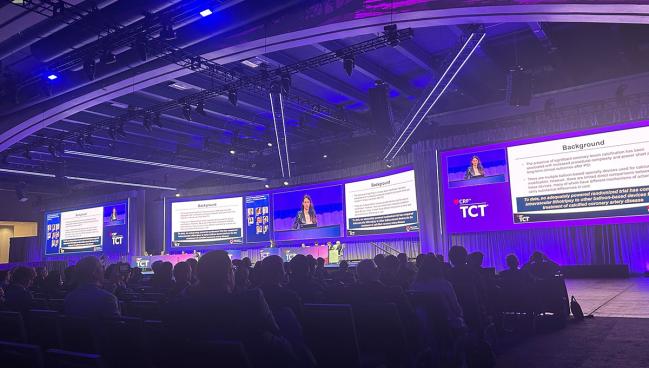
SAN FRANCISCO, CA—The use of cutting and noncompliant balloons for lesion preparation appears to provide results similar to those achieved with Shockwave intravascular lithotripsy (IVL; Shockwave Medical/Johnson & Johnson MedTech) in patients with significant coronary lesion calcification who require PCI, according to the results of two randomized trials presented here at TCT 2025.
In the Short-Cut trial, cutting balloons were noninferior to IVL in terms of postprocedural minimal stent area at the site of maximal calcification, and in the VICTORY trial, the OPN super-high-pressure noncompliant balloon (NCB; SIS Medical AG), was noninferior to the Shockwave system in terms of final stent expansion measured by OCT.
Both trials showed similar safety and early clinical outcomes across study arms. Short-Cut also included a cost analysis, with cutting balloons saving $3,602 per case, primarily related to the lower cost of the device compared with IVL rather than other aspects of the procedure.
“Cutting balloon angioplasty is a reasonable and less costly option when compared with intravascular lithotripsy for the treatment of significantly calcified coronary lesions being treated with imaging-guided PCI,” Suzanne Baron, MD (Massachusetts General Hospital, Boston), who presented the Short-Cut results, said at a press conference.
Noncompliant balloons are expected to come in with a lower price tag as well, and “the OPN NCB potentially represents a reasonable, lower-cost alternative to IVL which may be faster to use, said VICTORY investigator Matthias Bossard, MD (Heart Center – Luzerner Kantonsspital, Switzerland).
Shockwave IVL was approved by the US Food and Drug Administration for the treatment of calcified lesions in 2021 based on the results of the single-arm DISRUPT CAD III trial, which met goals for safety and procedural success. Despite a much higher cost compared with atherectomy systems, it became the go-to approach for treating heavily calcified lesions because of its ease of use.
“Everybody sees IVL now as the standard of care in calcified lesions because it’s democratized treating calcified lesions. Before it was pretty difficult. Smaller centers were not able to do it. Now they have this very safe technology, but it costs a lot of money. And so other technologies that are less expensive are trying to compare themselves against the standard of care,” Azeem Latib, MD (Montefiore Health System, New York, NY), said during the press conference.
Both Short-Cut and VICTORY aimed to provide head-to-head comparisons to help guide decisions about which devices to use in patients with heavily calcified coronary lesions.
The Short-Cut Trial
Short-Cut, conducted at 21 US sites, included 413 patients (mean age 72 years; about 75% men) presenting with stable angina, unstable angina, or NSTE ACS and biomarker levels that were flat or trending lower who had moderately-to-severely calcified coronary lesions requiring PCI. Patients had to have a de novo lesion with at least 70% stenosis or stenosis of 50% to 70% along with evidence of hemodynamic significance. The investigators stratified patients by whether atherectomy was planned for lesion preparation.
The protocol included a strong recommendation for use of high-definition IVUS prior to randomization to confirm the presence of significant calcification and to ensure appropriate device sizing. Such imaging was required after use of the randomized device (but before DES implantation) and upon completion of the procedure to assess study endpoints.
The primary endpoint was postprocedural minimal stent area at the site of maximal calcification determined by an IVUS core lab. Mean values were 8.6 mm2 in the IVL group and 8.0 mm2 in the cutting balloon group, with a difference of 0.6 mm2. The upper bound of the confidence interval (1.1 mm2) came in under 1.2 mm2, establishing the noninferiority of cutting balloons (P = 0.007). Superiority testing indicated no significant difference between groups.
There was a significant interaction (P = 0.044) suggesting that cutting balloons provided noninferior results in patients with planned atherectomy but not in those without planned atherectomy, although additional analyses indicated that the discrepancy could be related to slightly smaller reference vessels among patients treated with cutting balloons, Baron said.
Other imaging endpoints, as well as in-hospital and 30-day clinical outcomes, were similar in both trial arms. Complication rates were low with both devices.
Though costs are higher with IVL versus cutting balloons, Baron noted that in the US, reimbursement is higher for the Shockwave system, muddying financial considerations for hospitals.
“That said, I’d like to think that as doctors and stewards of the healthcare system, we all want to do the right thing by society as far as making sure that we provide value to optimized care,” he said.
Short-Cut showed that both devices are effective and safe for IVUS-guided calcium modification, Baron said, adding that “it’s reasonable to reach for cutting balloons first.” She pointed to the lower cost and data showing very low rates of crossover from one device to another.
“At this point, you don’t lose very much by trying to treat with cutting balloon,” she commented. “If it doesn’t deliver, you don’t get sufficient calcium expansion, well then reach for one of the other tools that are in your toolbox.”
The VICTORY Trial
VICTORY, conducted at two centers and Switzerland and one in Canada, included 282 patients (mean age about 71 years; about 85% men) who presented with acute or chronic coronary disease (excluding those with cardiogenic shock or STEMI) and ischemia-related symptoms and/or evidence of myocardial ischemia. All had a single de novo target lesion with stenosis of at least 70% or 50% to 70% stenosis with evidence of ischemia and met criteria for significant calcification.
There was a nonsignificant trend toward a shorter procedure time in patients randomized to lesion preparation with the OPN noncompliant balloon versus Shockwave IVL (mean 70 vs 79 min; P = 0.061). A higher proportion of patients treated with IVL versus noncompliant balloons required use of either semicompliant or noncompliant balloons before use of the study device, whereas the mean number of study devices deployed was higher in the noncompliant balloon group (1.35 vs 1.04; P < 0.001).
The primary outcome was final stent expansion measured by OCT, which came in at 85.0% with the noncompliant balloon and 84.0% with IVL. With a 10% margin, noncompliant balloons were noninferior to IVL (P < 0.0001), but not superior. Results were consistent across subgroups.
There were no differences in secondary outcomes, with similar—and high—procedural and strategy success in both trial arms. Safety and 30-day clinical outcomes did not differ between groups. Bossard said trial participants will be followed for up to 2 years.
Deploying Multiple Devices
At the press conference, Sanjum Sethi, MD (NewYork-Presbyterian/Columbia University Irving Medical Center, New York, NY), indicated that there’s room for other devices designed to modify calcium alongside Shockwave IVL. “If you do a balloon angioplasty first in clinical practice, it doesn’t take IVL off the table,” he said. “So you could try a balloon angioplasty and if you don’t get results that you want, you can move to another device. I think it sort of gives that message here.”
Robert Byrne, MBBCh, PhD (Mater Private Network, Dublin, Ireland), during a panel discussion at the late-breaking clinical trial session at which the studies were presented, made a similar point. “Our increasing experience is a balloon-based approach first for balloon-crossable lesions—be that cutting balloon angioplasty, high-pressure balloons—and then intravascular lithotripsy is available as a backup balloon option,” he said.
Antonio Colombo, MD (Humanitas Research Hospital, Milan, Italy), the discussant for Short-Cut, said there is “no question that the cutting balloon inflated at high pressure has a positive role in the treatment of calcified lesions.” He added, however, that the device may need to be used along with atherectomy to match IVL in many lesions.
That the cutting balloon comes in as a cheaper option compared with IVL is important, not only for poorer countries but also perhaps for the US, he said.
Both trials, Christian Spaulding, MD, PhD (European Hospital Georges Pompidou, Paris, France), commented at the press conference, “have major implications in Europe, where reimbursement is not given for IVL. The hospital has to pay.”

Todd Neale is the Associate News Editor for TCTMD and a Senior Medical Journalist. He got his start in journalism at …
Read Full BioSources
Baron SJ. The Short-Cut trial: Shockwave lithotripsy compared to cutting balloon treatment in calcified coronary artery disease. Presented at: TCT 2025. October 26, 2025. San Francisco, CA.
Bossard M. A randomized, multicenter, non-inferiority comparison of intravascular lithotripsy and super-high-pressure noncompliant balloons for treatment of calcified and refractory coronary lesions: the VICTORY trial. Presented at: TCT 2025. October 26, 2025. San Francisco, CA.
Disclosures
- Short-Cut was an investigator-initiated and -conducted trial supported by a research grant from Boston Scientific.
- Baron reports grant/research support from Acarix, Abiomed, and Boston Scientific and consulting fees/honoraria from Abbott, Boston Scientific, Edwards Lifesciences, HeartFlow, Medtronic, Pi-Cardia, Shockwave, and Zoll Medical.
- VICTORY was funded by an unrestricted research grant from SIS Medical, which was not involved in the study design and trial conduct.
- Bossard reports grant/research support from Abbott Vascular, Boston Scientific, Cordis, OM Pharma, and SIS Medical and consulting fees/honoraria from Abbott Vascular, Abiomed/J&J MedTech, Amgen, AstraZeneca, Bayer, Biosensors, Boston Scientific, Cordis, Daichii Sankyo, MedAlliance, Mundipharma, Novartis, Novo Nordisk, OM Pharma, Sanofi, SIS Medical, and Vifor.
Related News


Chris Parrino