Suspended Lead Suit Brings Radiation Exposure Down to Zero for Many Structural Imagers
The study of LAAO cases provides physicians with evidence they can cite when requesting tools for additional protection.

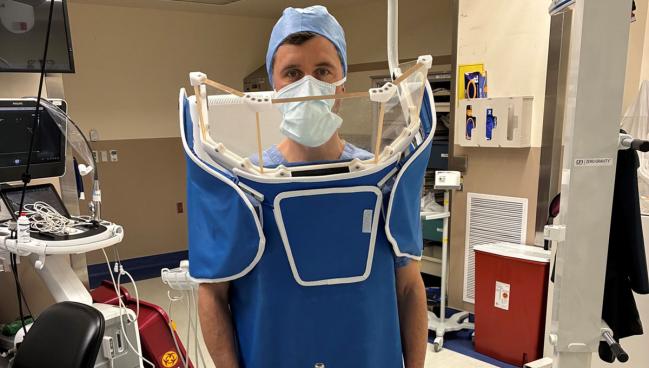
Photo Credit: David McNamara
Interventional echocardiographers working with suspended lead suits (Zero-Gravity system; Biotronik) during left atrial appendage occlusion (LAAO) procedures are exposed to significantly less radiation—with undetectable levels in three out of every five cases—than they are when wearing lead aprons, according to a new study.
The findings illuminate a potential solution to a growing occupational hazard for these imagers, who are not often recognized to be at risk, say researchers.
Now, “[we have] a real-world application of how we might fix the problem,” said David A. McNamara, MD, MPH (Corewell Health West, Grand Rapids, MI), noting that plenty of evidence exists showing both the negative effects of radiation exposure—including left-sided brain malignancies, cataracts, and carotid atherosclerotic disease—as well as the orthopedic issues associated with wearing heavy lead.
In 2022, McNamara and colleagues identified that interventional echocardiographers performing LAAO procedures and transcatheter edge-to-edge repair (TEER) of mitral valve disease receive a three- to twelvefold higher dose of radiation compared with interventional cardiologists. Their risk was and continues to be an underappreciated issue, he told TCTMD.
A 2018 study showed that ceiling-suspended shields can reduce operator radiation exposure during transesophageal echocardiography (TEE) by up to 82%. One small study showed success in reducing interventional cardiologists’ exposure through the same system used in the current analysis, and yet another showed protective effects of a table-integrated shielding system for the whole team.
“But really, the field has not moved forward since 2018,” McNamara explained. “That’s part of the reason this has not been implemented—there was not a lot of steam behind this. I think there’s a knowledge gap.”
A 2024 nationally aired documentary brought the topic to the forefront, but a survey published last year by the Society for Cardiovascular Angiography and Interventions demonstrated that very little has changed in the past decade in terms of how physicians working in these settings are protected.
The cost of these protective systems might seem like the biggest implementation barrier, but instead, McNamara suggested that the larger hurdle might be that imagers aren’t armed with the knowledge needed to ask for them in the first place.
More Data, More Protection
Their study published online this week in JAMA Network Open, included 125 LAAO cases (mean patient age 78 years; 61.6% male) performed at their institution between 2016 and 2018, including 95 where interventional imagers used the Zero-Gravity system and 30 where they wore standard lead aprons.
The median radiation dose for imagers using the suspended suits was significantly lower than those using the lead aprons (0 vs 10.6 μSv; P < 0.001). Moreover, no radiation was detected in 60% of interventional echocardiographers using the suspended suits, whereas all imagers using the lead aprons had some degree of radiation detected (P < 0.001).
The results were similar when the analyses were adjusted for procedural dose area product.
Speaking with TCTMD, Cynthia Taub, MD (SUNY Upstate Medical University, Syracuse, NY), president elect of the American Society of Echocardiography (ASE), commented that the field needs more awareness, education, research, and consensus documents centered around radiation safety.
“Also, I do think institutional leadership needs to be on board,” she said. “Who designs the lab and the equipment and who’s in charge of the capital investment are oftentimes not clinicians, and their decision might not be aligned with occupational health.”
The limitations of physics and technology are also standing in the way, according to Stephen Little, MD (Houston Methodist, TX), an ASE past president. “Frankly, there’s a lot of things hanging from the ceiling—lights and monitors,” he told TCTMD. “There is a bit of a Tetris effort to figure out how to attach things to a ceiling. The space is limited. Good engineering and architecture and design can solve that, [and while] industry is catching up and recognizing this, even industry can be a little blind to the interventional echocardiographer.”
‘Advocacy and Temper Tantrums’
Historically, clinicians have been reliant on others to take care of safety issues in the cath lab. But as procedures have gotten longer and more complicated, Little said the time has come for imagers to play a more proactive role in their protection.
At his institution, Little’s team, through “requests and advocacy and temper tantrums,” managed to have protective bed skirts installed in their hybrid rooms and cath labs. They also were able to purchase a portable shield, that though “cumbersome” adds an additional level of safety.
“We have advocated for and have been promised an additional standard movable shield that could hang from the ceiling, but that hasn’t been delivered yet,” Little noted. “That’s an ongoing conversation. And, from my experience and opportunity to discuss these issues with many colleagues around the country, [they’re in] a very similar situation.”
When she moved to her current institution, Taub was initially “appalled” by the lack of protection in the cath lab for imagers. “There was no shielding next to the image intensifier for interventional echocardiographers—nothing at all,” she recalled. During her first procedure, she borrowed someone else’s lead apron, and “the arm hole was so large, . . . so I was basically being irradiated from my armpit to part of the breast.” She immediately asked for more protection for echocardiographers and was pleased to have a shield installed within the week.
Strong physician leadership is needed to advocate for these tools, Taub said, adding that they also need more data to back up their requests. “I’m in a position of influence. I can make changes,” she said, acknowledging that not everyone has that advantage.
The current paper “certainly provides some more quantitative assessment of radiation exposure for interventional cardiographers without the suspended lead suits, particularly in the head and neck area,” Taub continued. “The quantitation makes people more aware of the potential consequences. But I really think this is a system problem.”
Little said his administration has never pushed back on radiation safety requests, but they aren’t top priority.
“They seem to understand that yes, radiation exposure is not acceptable,” he said. “The challenge is what is current standard? Current standard is to wear a lead vest. Everybody does.”
Cost is likely not the issue either, as “hospitals spend an enormous amount of money on these things,” he added. For example, when his institution built brand new cath labs, “they came to me as an afterthought asking about radiation safety when they were basically done with the design. I said: ‘why didn’t you call me a year ago?’ And it wasn’t intentional. It was simply that’s the way it’s had always been done.”
“Ultimately this is all bottom line for institutions,” Taub agreed. “But the damaging effect to the operators in the room is long standing. It can’t be quantified by the bottom line.”
“As we build a groundswell of national expectation and ultimately changing the standard, . . . [institutions] will refer back to what are other people doing and what’s expected,” Little said. “I think as important data like this paper from McNamara et al come out, it’s yet another sort of nail in the coffin that if somebody suggests that this shielding is currently enough, this is another one to say no, it’s not.”
Understanding the Entire Issue
Defining the scope of the problem for imagers right now is tricky.
Taub estimated that about 2,000 members of ASE are interventional echocardiographers who are regularly exposed to radiation in their work, but this is likely an underestimate as there are others who might not be a part of the organization. “Knowing the landscape is super important,” she said.
As the field has grown, this is a “huge deal for imagers,” Little emphasized. “Part of the problem is the field is so new that there aren’t many people who’ve had a 10-year exposure. But I think there will be. . . . My fear is that in the next few years, we’re going start hearing about adverse cancer events or glaucoma events or cataract events in physicians who’ve been performing interventional echo services for the last 10 or 15 years.”
More specifically, McNamara said, it’s hard to know how many institutions are using radiation protection beyond the status quo. “Part of where we go next is: we’ve got a problem, we’ve got a fix, but we don’t know the scope of the problem,” he said, adding that his team is currently working on a multicenter study looking at current practices and cumulative radiation exposure to better understand where things stand.
What drives Taub’s passion in this space is her desire to protect her fellows, especially those of childbearing age, given that they are signing up for a career associated with long-term exposure.
She called for “standardized radiation safety monitoring” for all who work in the cath lab as well as potentially a national dose registry “so we can measure and then we can improve,” Taub said. “You can’t improve what you’re not measuring.”
Little agreed that more reporting of radiation exposure on a consistent basis is necessary. “A lot of my colleagues have no idea what their annual radiation is,” he said. “It’s a whole area where hospital compliance with radiation safety officers and standards can be a little ‘Wild West.’”
Studies like this will influence guidelines and national societies to get out of the current “data void,” Little continued said. “And the societal position papers on this will also heavily influence hospital practices.”

Yael L. Maxwell is Senior Medical Journalist for TCTMD and Section Editor of TCTMD's Fellows Forum. She served as the inaugural…
Read Full BioSources
McNamara DA, Decker JM, McNamara MW, et al. Suspended lead suits and radiation exposure in interventional echocardiographers. JAMA Network Open. 2026;9:e2558134.
Disclosures
- McNamara reports receiving grants from the Spectrum Health Foundation.
- Little and Taub report no relevant conflicts of interest.
Related News



Comments